BRICS Summit: Why Xi Jinping's India visit could reset ties with PM Narendra Modi
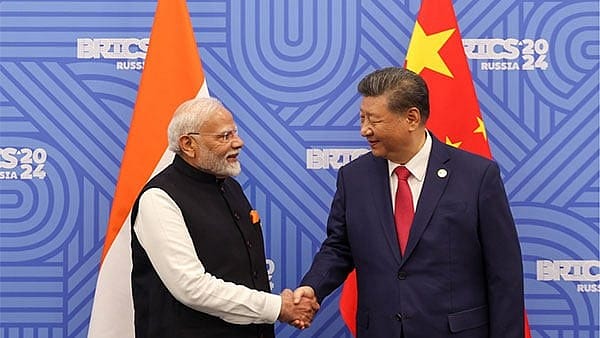
There was a time when a Narendra Modi-Xi Jinping meeting could be read through the lens of trade, border management and regional competition. Now, every handshake between the two leaders carries the weight of everything that happened after Galwan.
Chinese President Xi Jinping is expected in New Delhi for the BRICS Summit on September 12-13, in what would be his first visit to India in seven years. Reuters reported on Thursday that the visit could help advance the diplomatic thaw between the two countries, even as deep mistrust continues to constrain business ties.
That makes the timing significant. India and China are no longer at the frozen point they reached after the deadly 2020 border clashes. But neither have they returned to the old relationship.
The real question, then, is not whether Modi and Xi can meet.
It is what they can actually reset.
The Modi Years
02 Oct 2026 - Vol 05 | Issue 40
A Nation Rebuilt
Why is Xi Jinping's India visit important for India-China relations?
For seven years, Xi has not travelled to India. The last visit was in October 2019, when he met Modi in Chennai for the second informal summit between the two leaders. Much has changed since then.
The 2020 Galwan clash plunged relations into their deepest crisis in decades. Military tensions along the Line of Actual Control, restrictions on Chinese investment, suspended flights and a sharp fall in political engagement followed.
The current visit comes after a sustained effort by both sides to stabilise the relationship.
Reuters reported that the two governments have eased some investment restrictions and increased high-level engagement, but regulatory hurdles, visa delays and technology concerns continue to stand in the way of a broader commercial reset.
What happened between Narendra Modi and Xi Jinping after the 2020 Galwan clash?
The relationship did not suddenly thaw. It moved in small, sometimes barely visible steps.
India and China spent years negotiating disengagement along the disputed frontier. According to India's Ministry of External Affairs, the two sides reached an agreement in October 2024 on patrolling arrangements in Depsang and Demchok, leading to disengagement from the friction points that emerged in 2020.
That agreement created the most important political opening since the crisis began.
Modi and Xi then held their first delegation-level bilateral meeting in nearly five years on the sidelines of the BRICS Summit in Kazan in October 2024. India's official account said both leaders agreed that differences over the boundary should not disturb peace and tranquillity along the border and backed the use of diplomatic mechanisms to stabilise and rebuild ties.
Why did Modi and Xi meet again in China in 2025?
The thaw did not stop in Kazan.
In August 2025, Modi travelled to China for the Shanghai Cooperation Organisation summit in Tianjin and met Xi there. Reuters described the meeting as part of a cautious rebuilding of ties after the 2020 clash, with discussions covering the border, trade, investment and connectivity.
That meeting mattered for another reason: it showed that the two governments were willing to move beyond simply managing the border crisis.
They began talking about what the relationship could look like after the crisis.
What has changed in India-China ties since the border deal?
The most visible changes have been in connectivity and diplomacy.
India and China agreed to resume direct flights after a suspension lasting more than five years. Reuters reported in October 2025 that the flights were due to restart later that month, another sign that relations were moving towards normalisation.
High-level officials have also kept talking.
In August 2026, National Security Adviser Ajit Doval and Chinese Foreign Minister Wang Yi co-chaired the 25th Meeting of the Special Representatives on the India-China Boundary Question in Beijing. Reuters reported that the two sides discussed maintaining peace and stability along the border, advancing boundary delimitation and expanding bilateral cooperation.
That is diplomacy in its less glamorous form: meetings, mechanisms and incremental agreements. But after 2020, those incremental steps matter.
Is India-China trade returning to normal?
Not quite. And this is where the story gets complicated.
China remains one of India's most important trading partners, but the economic relationship is heavily imbalanced in Beijing's favour.
Reuters reported on Thursday that despite the diplomatic thaw, business ties remain constrained by mutual suspicion. Chinese companies face regulatory scrutiny in India, while Indian businesses continue to encounter difficulties with Chinese licences and access to certain critical equipment and technologies.
The contrast is striking.
Diplomats may be talking about stabilisation. Businesses are still asking how much they can trust the other side.
Why are Chinese companies still facing scrutiny in India?
The 2020 crisis changed how New Delhi viewed Chinese investment, particularly in sensitive sectors.
India subsequently introduced tighter scrutiny of investments from countries sharing a land border with it. Some of those restrictions have since been eased.
Reuters reported in August that India had received investment proposals worth about $511.5 million under revised rules introduced in May 2026, which allow certain non-controlling investments from neighbouring countries without prior government approval.
But that does not mean the door has been thrown open.
Just this week, Reuters reported that India's Serious Fraud Investigation Office had recommended a detailed probe into Xiaomi's Indian operations over possible foreign-investment law violations. Xiaomi has denied receiving a formal notice and said it complies with Indian laws.
The message is clear: engagement may be returning, but strategic caution remains.
Why is business becoming the biggest test of the India-China reset?
Because the two economies need each other in some areas while competing fiercely in others.
India relies heavily on Chinese manufacturing and components, particularly in sectors ranging from electronics to industrial equipment. China, meanwhile, has a huge market on its doorstep.
But Reuters reported that several Chinese companies, including BYD and Great Wall Motor, have pulled back from planned investments amid regulatory concerns, while India has stalled a proposed Alipay+ link over security and data-privacy concerns.
That tells you something important about the reset.
The governments may want a more stable relationship without necessarily returning to the pre-2020 model of economic engagement.
How important is the India-China border to the reset?
It remains the biggest test.
The 2024 patrolling agreement helped remove the immediate military confrontation at the friction points created in 2020. But the larger boundary dispute has not disappeared.
India's government has consistently maintained that peace and tranquillity along the border are essential for the broader relationship.
The August 2026 talks between Doval and Wang Yi show that the boundary question remains firmly inside the diplomatic conversation.
So the current reset is better understood as managing the rivalry, rather than resolving it.
Does the United States have anything to do with the India-China thaw?
It is difficult to ignore the larger geopolitical backdrop.
India is simultaneously deepening its engagement with the United States, participating in the Quad with the US, Japan and Australia, maintaining close ties with Russia and working with China through forums such as BRICS and the SCO.
That is not necessarily a choice between Washington and Beijing.
It is a deliberate attempt to preserve strategic room for manoeuvre.
The pressure has become particularly visible amid tensions over US trade policy. Reuters reported in 2025 that Modi's China visit came at a time when steep US tariffs on Indian goods were pushing New Delhi to strengthen relationships across Asia.
But it would be too simplistic to describe the India-China thaw as an anti-US alignment.
New Delhi's approach is better understood as strategic autonomy: cooperate where interests overlap, compete where they do not, and avoid allowing one relationship to dictate all the others.
What does China want from India?
For Beijing, India is too large to ignore.
It is one of the world's biggest markets, a major manufacturing economy and an increasingly influential voice in the Global South.
China also has an interest in preventing its relationship with India from becoming permanently hostile.
Reuters reported that Beijing is emphasising partnership over competition even as mistrust continues to restrict commercial engagement.
The calculation is fairly straightforward: a stable India-China relationship is preferable to another prolonged confrontation on the Himalayan frontier.
What does India want from China?
New Delhi wants peace along the border, greater economic access, reliable supply chains and more predictable commercial relations. But it also wants to protect strategic sectors from excessive Chinese influence.
That explains the apparent contradiction at the heart of the relationship.
India can simultaneously want more trade with China and more safeguards against Chinese dominance.
It can seek better political relations with Beijing while strengthening partnerships with Washington, Tokyo and Canberra.
And it can cooperate with China in BRICS without becoming aligned with China.
Can the BRICS Summit really reset India-China ties?
It can reset the tone. The harder question is whether it can reset the relationship.
Xi's visit would give Modi and the Chinese president their most important face-to-face opportunity in India since the 2020 crisis. A successful meeting could reinforce the border disengagement, push forward economic and travel links and establish a more regular rhythm of high-level engagement.
But Reuters' latest assessment is telling: even with diplomatic progress, deep political and economic mistrust continues to hold back the relationship.
That means the BRICS Summit is unlikely to produce a dramatic "India and China are friends again" moment.
Something more interesting may be happening.
The two countries appear to be testing whether they can be rivals without becoming enemies.
And if Modi and Xi can make that formula work, the BRICS Summit in New Delhi could become less a symbol of reconciliation than the beginning of a new model for managing one of Asia's most consequential rivalries.
(With inputs from yMedia and agencies)