Bengal BJP Chief Rejects Identity Politics, Pushes Economic Growth Agenda
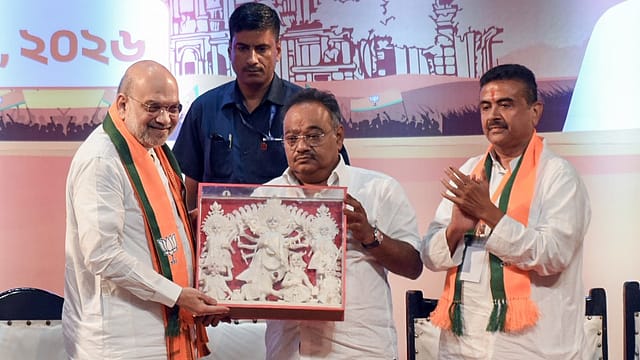
Bengal BJP chief Samik Bhattacharya has sought to redirect political discourse in West Bengal away from identity-based controversies and toward economic development, employment generation and investment.
Reacting to comments made by Humayun Kabir regarding cow slaughter and ritual sacrifice, the Bengal BJP chief said the party’s priority was focused on the state’s economic future rather than historical or religious debates.
“We don't care about Babur, Humayun, Jahangir, or Akbar right now. We are more concerned about bringing investments to West Bengal, increasing employment, and how to stop migration,” Bhattacharya told ANI.
He stressed that the BJP’s central objective was to improve the business climate in the state and attract industries that could generate jobs and reduce outward migration.
“Our goal is to make West Bengal an investment-friendly state,” he added.
His remarks reflect the BJP’s attempt to position economic development and industrial growth as key political issues in the state.
What Triggered the Political Controversy?
The debate began after the West Bengal government issued a public notice under the West Bengal Animal Slaughter Control Act, 1950, ahead of upcoming religious observances involving ritual sacrifice.
The notice prompted strong reactions from Humayun Kabir, who challenged any attempt to interfere with the practice of ‘Qurbani’ or ritual animal sacrifice.
Speaking to ANI, Kabir argued that while governments could regulate beef consumption, they should not interfere with religious traditions.

Exclusive: To the Heavens and Back
19 Jun 2026 - Vol 04 | Issue 76
Shubhanshu Shukla relives the space odyssey that put India into orbit
“The government can make a rule asking Muslims not to eat beef, but ritual sacrifice (qurbani) will continue. We won't listen to any objections,” Kabir said.
He further defended the practice by linking it to long-standing religious tradition.
“It's a tradition that has been going on for 1400 years and will continue as long as the world exists,” he added.
The issue has once again brought debates around religious rights, animal slaughter laws and political messaging into the spotlight in West Bengal.
What Questions Were Raised About Beef Laws?
The controversy also drew comments from Toha Siddiqui, who questioned what he described as inconsistencies in India’s approach to beef-related laws and trade.
“What the law says needs to be followed. But the law should be the same for everyone. No cow slaughter? Okay, we will accept that. But in India, beef is at number two [referring to exports]. A common man offers a sacrifice, that's not allowed. And slaughtering the cows of the country and sending them abroad is permissible? Is that okay?” Siddiqui questioned.
He also argued that India should have a uniform policy instead of varying regulations across different states.
“What is the law? Look at every place and other states in India, beef is sold there. So what is it? It's allowed there, but not here? The law should be one for India.”
His remarks highlighted broader debates around federalism, religious practices and differences in state-level cattle slaughter regulations across India.
Why Is the Issue Politically Significant in West Bengal?
The debate carries political importance because West Bengal has long witnessed intense contests over identity, religion and regional political narratives.
The BJP’s emphasis on investment and employment suggests an effort to shift public discussion toward governance and economic concerns rather than religious polarisation alone.
At the same time, comments from Kabir and Siddiqui underline the sensitivity surrounding issues of ritual sacrifice, beef consumption and religious freedoms, particularly during festive periods.
The controversy also reflects how economic messaging and identity politics continue to intersect in Bengal’s political landscape, where parties are competing to shape public opinion ahead of future electoral battles.
(With inputs from ANI)