Dhar Bhojshala: The Power of Faith
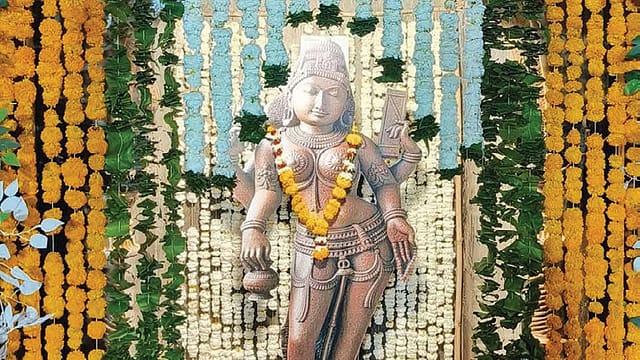
IN 1903 KASHINATH KRISHNA LELE, a ‘civil servant’ in the service of the state of Dhar, was assigned a task by the British agent that perfectly matched his scholarship of Sanskrit and his ability to grasp the historical significance of ancient inscriptions. After he began examining a site popularly known among local Hindus as ‘Raja Bhoj ka Madrassa’, he soon divined that the inscriptions inside the monument predated the mosque known as ‘Kamal Maula Masjid’ and could in fact be traced to the legendary 11th-century Paramara dynasty warrior king and his immediate successors.
Working in the manner of a forensic investigator, Lele painstakingly identified fragments of older stone carvings and an extensive literary record. He found portions of the mosque to be paved with large black slabs with traces of ancient inscriptions that were rendered unreadable. But just as he was all but stumped by the vandalism, Lele discovered that the obverse of two “great black stones” had escaped destruction. They were legible and the compositions, on a historical subject, went back to the reign of a successor of Raja Bhoj. Later, another British agent, Major CE Luard, placed the findings in a fuller context and endorsed Lele’s description of the site as “Bhojshala”—a temple and university built by the polymath king whose bronze statue dominates the banks of modern Bhopal’s bada talab.
Lele’s dedication and enterprise were remarkable, but the superintendent of education in the princely state would hardly have anticipated that his discovery of Bhojshala would be validated by an Archaeological Survey of India (ASI) survey more than 120 years later and become a key piece of evidence in restoring the right of Hindus to worship at a site revered by tradition and faith. Lele’s efforts revealed inscriptions linked to the Paramara dynasty in Sanskrit and Prakrit from the reign of Arjunavarman, who followed about a century-and-a-half after Raja Bhoj, tablets in praise of an incarnation of Vishnu and a record of Sanskrit grammatical rules that peeled away layers from a hidden history. The term Bhojshala was first published by Luard in 1908 and has since stuck in the public consciousness.
On May 15, the Indore bench of the High Court of Madhya Pradesh upheld the Hindu claim to exclusive worship at Bhojshala in Dhar and agreed with the conclusions of an ASI survey that the Kamal Maula mosque was built over the remains of a previously existing temple and library and had in fact cannibalised building material from it. The court said Hindus had an unrestricted right to access and worship, in effect trashing a 2003 ASI order that permitted Muslims to offer namaz on Fridays. The order noted that it is in compliance with a set of 10 principles derived from the Supreme Court’s 2019 ruling in the Ayodhya case dealing with the historical and religious character of a site and contending claims to its title.
The court held the site is a temple dedicated to Goddess Vagdevi or Sarasvati and though the Muslim side has declared its intention to appeal the order, the verdict could, over time, bring quietus to a dispute that has dragged on for decades and led to near-continuous security deployments at the Bhojshala site as well as repeated bouts of heightened communal tension.
Counsel for the Hindu petitioners Vishnu Shankar Jain said in his arguments that his client did not want to claim ownership of the precise “khasra number 604” on which Bhojshala stands. There was no demand as in the Ayodhya case that the site be handed over to a trust for any construction or management. Rather, the prayer was for exclusive right of worship. The ruling, not surprisingly, failed to satisfy commentators and activists allied with the mosque cause, with some of them railing at the court for concurring with a “British era” official, an uncharitable reference to Lele.
The parliamentary record of a question addressed to Jagmohan, the then tourism and culture minister when the Vajpayee government was in office, dated April 28, 2003 sets out ASI’s order issued three weeks earlier splitting access to Bhojshala between Hindus and Muslims. “After a brief exchange of correspondence about the manner in which the protected monument of Bhojshala should be opened, the Madhya Pradesh government made certain suggestions and recommendations… the state government wanted formal orders by the DG ASI, the requisite orders were issued,” Jagmohan told Parliament. The minister went on state: “Keeping in view the background of the case and practical considerations, the solution arrived at was considered the most sound and feasible. The ASI order was that Muslims be allowed access on Fridays between 1-3 pm, Hindus permitted entry on Tuesdays between 9-11 am and annually on occasion of Basant Panchami.” On the days they were permitted to enter the Bhojshala, Hindu devotees could carry “a flower or two and a few grains of rice.”

The fractious nature of the dispute with its long legalistic wrangling gave the 2003 ASI order some sort of permanence that was never intended. The ‘solution’ of permitting both sides access was an expedient measure suggested by the then Congress government in Madhya Pradesh where Chief Minister Digvijaya Singh was under pressure from Hindu groups in the run-up to elections later that year. As things turned out, Congress lost the election and the Bharatiya Janata Party’s (BJP) firebrand Hindutva face Uma Bharti became chief minister. Singh’s poor record of governance was exploited by BJP which tagged the leader as ‘Mr Bantadhar’ (wrecker of things). The 2003 ASI order failed to address the root cause of the dispute stemming from the desire of Hindus to access a site of no ordinary religious and cultural significance. The importance of Bhojshala is often missed by commentators who suggest shared access to the site and is a good example of unresolved problems becoming knottier as the weight of history and deeply held religious beliefs are ignored.
The Hindu Front for Justice submitted that it is committed to restoration of places of worship damaged or destroyed during the “pre-independence” era while the Maulana Kamaluddin Welfare Society represented the Muslim side. Congress leader and former MP Salman Khurshid, who stood for the Muslim side, said a suit for title or ownership cannot be determined on the basis of the ASI survey the court had commissioned. The ruling notes that Khurshid dwelled on various paragraphs of the judgment passed in the ‘Ayodhya Case’ and submitted that even if archaeological material suggests existence of an earlier structure, which in the case of Bhojshala remains dated to the 12th century, that does not determine title or ownership. Khurshid said settled legal principles and evidence tested in civil trial should be the basis of a judicial verdict. Any claim that a prior structure was demolished needs “cogent evidence” and not historical conjecture.
The high court on March 11, 2024 ordered an ASI examination to settle claims. The court noted the excavation was conducted carefully and was “minimally invasive” and did not disturb the standing structure. The upper layers constituted later construction and beneath lay a “pre-existing large structure” at a depth of 4-5 metres. The earlier structure dates back to the Paramara period (10th-11th century CE) and the ASI report recorded extensive material relating to temple architecture and iconography. “A total 94 sculptures and fragments were recovered. Depictions include Ganesha, Brahma, Narasimha, Bhairava, animal and mythological figures such as lion, elephant, horse, snake and tortoise,” the court said. The human and animal figures are impermissible in a mosque and while several were defaced, many pillars of temple style were repurposed. More than 150 Sanskrit and Prakrit inscriptions were linked to Paramara rulers.
“ASI relies on inscriptional and structural evidence to argue the earlier structure was a centre of learning and religious activity associated with Saraswati worship (Sharda Sadan). Subsequently the structure was modified, damaged and reused, leading to its conversion into a mosque. A significant inscription (15th century, Khilji period) refers to destruction of idols and conversion of the temple into a mosque,” the high court said.
After Lele and Luard identified the site as Bhojasala, other scholars presented evidence that an inscribed sculpture in the British Museum was Raja Bhoj’s Sarasvati. The court has suggested the Union government consider seeking the return of the idol to its rightful place. In its order, the court said it was not deciding the title of the property. “Most of the arguments of other respondents and interveners were as if the petitioners are claiming title over the disputed area. The judgment in Ayodhya case arose out of a civil suit dealing with the claim of a title over the disputed area. In the present case... we have to determine the character of the disputed area on the basis of historical literature, architectural features and ASI survey reports,” the court said.
The account of the Hindu petitioners that the attack on Bhojshala in 1305CE by Delhi Sultan Alauddin Khalji, whose reign saw the destruction of many temples, altered the character of the site was borne out by the ASI report. The dominance and conquests of successive sultanates led to a number of Islamic structures being raised in the Bhojshala area. But Bhojshala’s identity could not be erased even as Hindus clung to faith and memory. A few days after the high court’s verdict, devotees entered Bhojshala on May 18 to offer prayers to an idol of Goddess Sarasvati consecrated a day earlier.