American Tourists Gave Up Hope of Finding Their Lost Bags. Then a Kerala Policeman Asked One Unexpected Question
Imagine this.
You're travelling in a foreign country. You've spent the day moving from one place to another. Somewhere along the way, three bags vanish.
Not just bags.
The kind that hold the things travellers worry about most: electronics, personal belongings and the little essentials that make a journey possible.
You search. You retrace your steps. Nothing.
Eventually, you do what most people do when hope runs out.
You assume they're gone.
That's exactly where the story seemed to be heading for three American tourists visiting Thalassery in Kerala's Kannur district.
But then a policeman asked a question.

The Modi Years
02 Oct 2026 - Vol 05 | Issue 40
A Nation Rebuilt
And suddenly the ending changed.
The bags that refused to disappear
Henna Higgins, Sigin and Morris Joseph had been exploring the historic coastal town of Thalassery, a place known for its trading history, colonial-era landmarks and food culture.
Three days earlier, they had travelled in an auto-rickshaw driven by a man named Vineesh.
Only after dropping them off did Vineesh notice something unusual.
Three bags were still sitting inside his vehicle.
Think about the fork in the road here.
The tourists had already moved on. The driver had no obvious way of finding them. No phone number. No hotel details. No guarantee he would ever see them again.
Yet instead of ignoring the discovery, Vineesh reportedly went looking for the visitors. When he couldn't locate them, he took the bags to the Thalassery Traffic Police Station and handed them over for safekeeping.
The bags stayed there.
Waiting.
A question that stopped three tourists in their tracks
Days passed.
No one came to claim the luggage.
Then Assistant Sub-Inspector Suvern V Gopal was carrying out his routine duties when he noticed three foreign tourists walking in the area.
He introduced himself.
And then came the question.
"Have you lost anything?"
The tourists were reportedly stunned.
Yes, they had.
Quite a lot, actually.
What followed sounds less like a police procedure and more like the final scene of a feel-good travel movie.
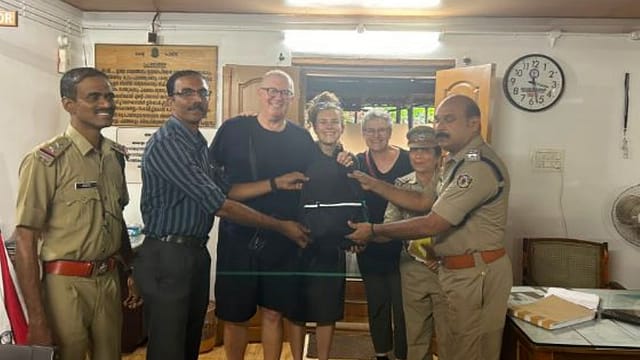
The visitors were taken to the traffic police station.
Inside were the bags they had already written off as lost.
The moment they saw their belongings again
There is a particular expression travellers make when a missing passport, wallet or bag suddenly reappears.
Relief arrives first.
Then disbelief.
Then a quick inventory check.
The bags reportedly contained valuables, including electronic devices. Everything was returned to the tourists by traffic police personnel, including Sub-Inspectors Sajithkumar and M K Sreejith, along with Assistant Sub-Inspectors Suvern V Gopal, K Aisha and K Bineesh.
Nothing dramatic.
No chase.
No mystery.
Just an auto-rickshaw driver who did the right thing and police officers who made sure the story reached its rightful conclusion.
Why this tiny story feels bigger than three bags
Travel stories are often built around monuments, beaches and famous landmarks.
But ask frequent travellers what they remember most, and many will tell you something else entirely.
A stranger who helped.
A problem that got solved.
A moment that restored faith in people.
That's why this story lingers.
Thalassery has spent centuries as an important trading town on Kerala's Malabar Coast. Today, visitors come for its history, cuisine and coastal charm.
For three American tourists, however, the most memorable part of the trip may not have been a monument or a museum.
It may have been an auto-rickshaw driver named Vineesh.
And a policeman who walked up to three strangers and asked a question so unexpected that it sounded almost impossible.
"Have you lost anything?"
As it turned out, they had.
And somehow, against the odds, Kerala had been keeping it safe for them.
(With inputs from ANI)