Ahead of polls, Christian group protests against art work at Kochi Biennale
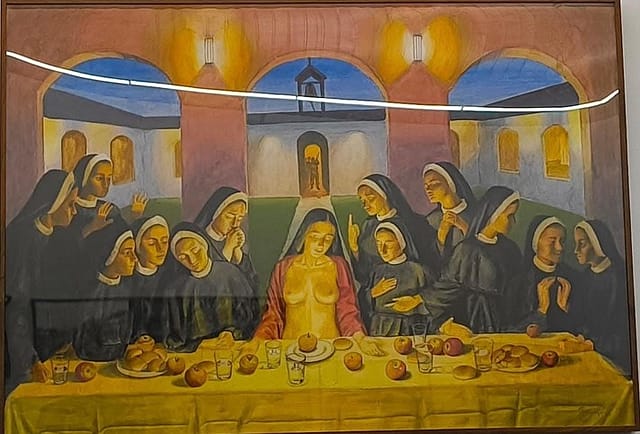
The long arm of the Latin Catholic Church in Kerala, which successfully campaigned for who would be the new mayor of Kochi recently and has traditionally backed the Congress party, wants to extend its reach to the world of art, too, if their opposition to an artwork displayed at the ongoing Kochi-Muziris Biennale (KMB) is any indication.
The Christian church in Kerala, where over 18% of the population is Christian, is known to be active in politics and statements from any denomination, coming as they do this time, just months ahead of the assembly elections due this year, suggest that the controversy is not going to die down but gain in momentum thanks to politicians chipping in to pull in votes over the issue. Kerala will likely go to polls in April to elect 140 new members to the legislative assembly. That the Latin Catholic Church reportedly managed to have two politicians, V K Minimol, who is married to a member of the Church, and Shiny Mathew, a member of the Church, share the five-year term of the Kochi mayor by spiking the choice of Congress leader Deepthi Mary Varghese for the position, is proof of its influence within the Congress-led United Democratic Front (UDF) in the state.
Look Who's Talking Regime Change
23 Oct 2026 - Vol 05 | Issue 43
In a letter addressed to key officials in the state and in public statements, the church has expressed its vehement objection to the display of a work of art by Tom Vattakuzhy, an alumnus of Santiniketan and Maharaja Sayajirao University of Baroda, claiming that it is an “inappropriate” replica of “The Last Supper”, which “holds profound and sacred significance for Christians”. In their letter addressed to the district collector of Ernakulam and copied to a state minister, a member of Parliament, a local MLA, the city police commissioner of Ernakulam, curator of Kochi Biennale and others, the Kerala Region Latin Catholic Council (KRLCC) said, “We write to you with deep anguish, shock, and strong protest against the public display of a distorted and in appropriate replica of the “The Last Supper” exhibited at one of the venues of the Kochi Biennale.”

It added that the exhibition of a wrongly replicated and insensitive version of this sacred image in a public forum has caused widespread pain, resentment, and emotional distress among the Christian community. Such an act, under the guise of artistic expression, crosses the boundaries of creative freedom and enters the realm of deliberate insensitivity to religious beliefs, the letter added, emphasising that “publicly displaying such content undermines communal harmony and violates the spirit of mutual respect enshrined in our Constitution.
“In this context, we strongly condemn the said exhibition and earnestly urge your good office to intervene immediately and ensure the withdrawal and removal of the offensive replica from public display. We also request that appropriate directions be issued to prevent the recurrence of such acts that hurt the religious sentiments of any community,” says the letter signed by Father Jiju George Arakkathara, general secretary, and Joseph Jude, vice-president, KRLCC. Other denominations have also expressed outrage.
Artist blames ignorance for protests
Meanwhile, Tom Vattakuzhy, the artist whose work is at the centre of the controversy, told Open that his work was an illustration done for a play penned by playwright and scriptwriter C. Gopan that appeared in the literary magazine Bhashaposhini 10 years ago. Gopan’s play was a dramatic interpretation of a poem titled Narthaki (dancer) on Mata Hari by the legendary Malayali poet Vyloppilli Sreedhara Menon in the 1930s.
Gopan’s play, written as early 2006 was, in fact, staged in St Thomas College by director Vinod Narayanan, Gopal told Open in a phone interview, adding that most literary performances back in the 1930s were done using a bioscope, a confirmation of the rich visual literacy of Malayalis around then. He also said that, contrary to Menon’s later style, his poem Narthaki (which depicts Mata Hari’s last dance, the last wish granted to her by the French) dwelled on women and their features, their sensuality, attraction, fragility and so on. Mata Hari, as we know, was a Dutch dancer executed by the French during World War 1 over allegations of being a spy. Certain historians state that she was killed over trumped-up charges. Over the past century – she was killed aged 41 in 1917 – Mata Hari has inspired works of literature, plays, songs and movies across the world. A 1931 movie titled Mata Hari stars Greta Garbo. Interestingly, in 2016, Paulo Coelho wrote a novel titled The Spy retelling the story of Mata Hari, one of modern world’s best-known exotic dancers and courtesans.
Playwright Gopan backs artist
Gopan told Open that the cover illustration by Tom Vattakuzhy in Bhashaposhini (the same one on display at a venue of the Kochi Muziris Biennale) had to be replaced in the face of protests back then, too. The cover image that replaced it – one by noted artist Riyas Komu -- also created a storm. According to Gopan, in addition to other troubles, thanks to that publication of his play Mridwamgiyude Durmrityu (loosely translated as ‘The Tragic Death of the Sylph’ or ‘The Tragic Death of a Sylph-like Young Woman) in 2016, editor KC Narayanan himself lost his job, highlighting the lack of comprehension of historical characters and literary references among those who scream in the name of religious sentiments over frivolous reasons.
Speaking to Open, Vattakuzhy said, “All this confusion comes in when you take a work of art out of the context. Poor visual reading culture is the cause of all this.” Thirty of what Vattakuzhy describes as his “story paintings” – linked to literature, but conceived as paintings with the aim of enhancing visual literacy in Kerala – are on display at the biennial art summit in Kochi launched in 2012.
With elections around the corner and multiple political stakeholders looking to extract their pound of political flesh, the row over this work of art is unlikely to find an end anytime soon. Although the KMB venue that displayed the work is already closed to the public, the political storm over it will likely take more time before it dissipates.