51 km, 153 Bridges: Why Mizoram’s Bairabi–Sairang Railway Matters
The first goods train brought cement. Five days later, the first outward parcel consignment was booked for Delhi: anthurium flowers.
Between those two consignments lies the promise of Mizoram’s Bairabi–Sairang railway.
On September 14, 2025, a day after the line’s inauguration, more than 26,000 bags of cement arrived at Sairang from Tetelia near Guwahati. On September 19, flowers were booked for the journey to the national capital. By December, a consignment of 119 Maruti cars had also reached Sairang by rail, according to the Ministry of Railways.
Building materials, flowers and cars make an unusually effective introduction to a railway. They show what a new connection can carry into a place—and what it can help that place send to customers elsewhere.
A year after its inauguration, the 51.38-km corridor offers a useful answer to a deceptively simple question: how much can a short railway line change?

Zeroing In on ECI
09 Oct 2026 - Vol 05 | Issue 41
Constitutional legitimacy versus political opportunism
Why Do These 51 Kilometres Matter to Mizoram?
The Bairabi–Sairang line extends the national railway network to Aizawl’s doorstep. Inaugurated by Prime Minister Narendra Modi on September 13, 2025, it gives the area access to services connecting Sairang with Guwahati, Kolkata, Delhi and Silchar. Its significance comes from the much larger network it joins. A passenger boarding at Sairang can begin a long-distance train journey closer to the state capital. A consignment arriving there has completed another portion of its journey by rail before its final delivery by road.
That distinction matters in understanding the project. Sairang is the gateway serving Aizawl; the line does not remove the onward journey to every home, shop or village. The extension nevertheless changes where that transfer between road and rail can happen. For passengers and businesses, that is a practical change in how a journey can be organised.
Why Did a Short Railway Need 153 Bridges?
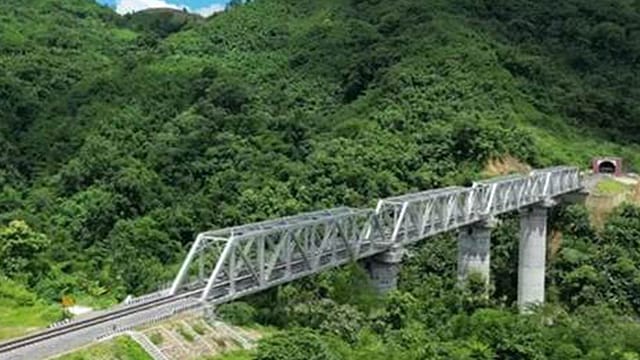
Distance on a map reveals little about the difficulty of laying tracks through hills. According to the Railways’ anniversary figures, the corridor includes 45 tunnels extending for nearly 16 kilometres. That means roughly 31% of the route runs through tunnels. Six bridges exceed 70 metres in height; the tallest stands at 114 metres.
The reported total of 153 bridges includes 55 major bridges, 88 minor bridges and 10 road overbridges or underbridges. It is therefore a count of several kinds of crossings across the project. 1
Railways need controlled gradients and curves. In difficult terrain, bridges and tunnels make that continuous alignment possible. Their concentration here explains why the line’s modest length understates the scale of construction. Ahead of its inauguration, the government put the project’s cost at more than ₹8,000 crore. 2
What Has Changed for Train Passengers?
The Ministry of Railways says services associated with the line completed more than 1,100 trips and carried over 15 lakh passengers during the first year.
The Sairang–Anand Vihar Rajdhani Express supplies the direct premium connection with Delhi. Other services link Sairang with Kolkata, Guwahati and Silchar, expanding the choices available for journeys beyond Mizoram.
Those connections matter for reasons that extend beyond tourism. They can serve students travelling to study, families visiting relatives, traders meeting customers and people seeking services in other cities.
The passenger tally records use; it should not be read as 15 lakh different individuals. People can make repeated journeys. Even with that distinction, the first-year figures establish that the new services have attracted substantial traffic, according to the ministry’s account.
How Can Freight Trains Change Everyday Commerce?
More than 2,500 freight wagons reached Sairang during the first year, carrying construction materials, foodgrains, fertilisers, automobiles and other goods, the Railways says.
For a business moving heavy consignments, rail adds another option for the long-distance portion of the supply chain. The cement delivery illustrates that role particularly clearly: material needed for construction can arrive in bulk at a railhead closer to its destination.
What happens next determines the benefit to customers. Unloading, storage, road delivery and distribution all remain part of the bill. More freight arriving by train does not, by itself, establish that retail prices have fallen.
The commercial opportunity is to make the whole journey work better. A useful rail service must connect with dependable local transport, so that goods can move from the wagon to the warehouse and onward to the buyer.
Why Are Flowers the Most Telling Consignment?
Cement demonstrates the capacity to bring goods in. The anthurium parcel shows a route available to producers sending goods out. For flowers, transport is part of the product’s commercial value: they must reach the buyer in a saleable condition. A rail connection creates another delivery option, whose usefulness depends on schedules, packaging, handling and the journey at either end.
The ministry also identifies opportunities for Mizoram’s handloom products and bamboo crafts to reach wider markets. Access provides a starting point. Regular orders and viable delivery costs are what can turn that connection into a lasting business.
That is the next chapter for Bairabi–Sairang. Its first year has put passengers on trains, cement into freight wagons and flowers on a route to Delhi. The measure of its success will increasingly lie beyond the station: in the journeys people can afford and the customers local businesses can keep.
(With inputs from ANI)