14 Years After Nirbhaya: Why Women’s Safety Still Hinges on Staying Indoors
When a woman is attacked in a public space, the advice often follows a familiar script: stay indoors, avoid dark stretches, do not travel alone.
But what happens when the danger is at home?
Nearly 14 years after the Nirbhaya case forced India to confront sexual violence, the alleged gang rape of a 17-year-old girl at Delhi’s Aastha Kunj Park has revived a fundamental question: are authorities making spaces safer, or asking women to surrender access to them?
The response must extend beyond parks and streets. National Crime Records Bureau figures cited in the report show that cruelty by husbands or relatives remained the largest category of registered crimes against women in 2024.
More Than 1,200 Cases a Day
According to the NCRB’s Crime in India 2024 report, police registered 4,41,534 cases of crimes against women nationally, a decline of about 1.5 per cent from 4,48,211 in 2023.

Losing Memory
16 Oct 2026 - Vol 05 | Issue 42
The making of a medical and social emergency
That still amounts to more than 1,200 registered cases a day.
Rape accounted for 29,536 cases, or more than 80 daily. There were also 1,20,227 cases of cruelty by husbands or relatives, 67,829 cases of kidnapping and abduction of women, and 48,303 cases of assault with intent to outrage a woman’s modesty.
These are police-recorded cases, not a count of every incident of violence. A decline in registrations alone cannot establish that women are safer.
For advocate Seema Samridhi Kushwaha, who represented Nirbhaya’s family, under-reporting remains central to the problem.
“Many girls cannot even raise their voice against their own people, and countless cases go unreported,” she told ANI.
Stronger Laws, Delayed Justice
The Nirbhaya case led to sweeping legal changes in 2013, strengthening provisions on sexual offences and introducing specific offences such as stalking and voyeurism.
Kushwaha argues that implementation has failed to keep pace.
“We enacted strict laws, but their implementation is flawed,” she said.
She recalled a case that, by her account, had been pending for 18 years. When she took it up the previous year, prosecution evidence had still not concluded.
Forensic delays compound the problem, she said, questioning how courts can deliver timely trials when DNA and other examination reports take months to arrive.
“Writing strict laws in books and establishing nominal fast-track courts means nothing if we haven't built the infrastructure or fixed institutional accountability,” she said.
The NCRB recorded 2,06,777 rape cases pending trial at the end of 2024. Its rape conviction rate was 24.4 per cent—but that figure concerns cases in which trials were completed, not all rape cases registered.
The distinction matters: pending cases have not yet reached an outcome.
Safer Parks or Fewer Places to Go?
Following the Aastha Kunj case, the Delhi Development Authority announced measures including tighter access after sunset, additional security, CCTV coverage, better lighting, increased patrols and a wider safety audit of its parks.
The measures prompted debate over whether restrictions after dark would shift the burden of safety onto women.
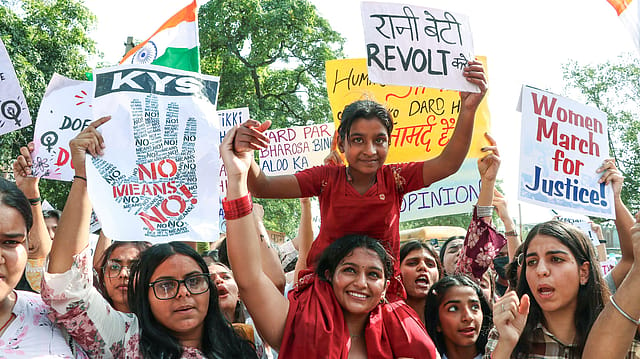
Students from Lady Shri Ram College for Women, Gargi College and Miranda House protested, raising concerns about lighting, policing and routes around their campuses.
Kushwaha criticised restrictions on access as a response to failures in security.
“Secure the crime scene, yes, but the message you must send is: ‘Daughters, step out day and night; we are standing here to protect you.’ Locking up parks is not a solution,” she said.
She called for authorities to identify and illuminate dark spots, strengthen patrolling and improve the investigation and prosecution of offences.
Delhi City recorded 13,396 crimes against women in 2024, slightly above 13,366 in 2023. Its registered crime rate was 176.8 cases per lakh women.
Accountability Beyond the Offender
Kushwaha also questioned enforcement of transport safety measures, referring to the alleged rape of a 17-year-old girl on a sleeper bus travelling from Greater Noida towards Delhi in August.
She raised concerns about checks on the vehicle, driver verification and whether safety equipment was functioning.
Her broader argument is that punishment of perpetrators must be accompanied by scrutiny of officials responsible for prevention and investigation.
“My personal opinion is that while the accused must be convicted, dereliction of duty by an on-duty responsible person must also be treated as a crime and penalised,” she said.
Home Is Part of the Safety Debate
The scale of reported domestic cruelty challenges the assumption that staying indoors guarantees protection.
Children face particular difficulties when an alleged abuser is a relative or another trusted person, Kushwaha said.
“When a child is abused inside the house by a relative and parents refuse to listen, the child is helpless,” she said.
India registered 1,87,702 crimes against children in 2024, up 5.9 per cent from 2023. Of these, 69,191 cases were registered under the Protection of Children from Sexual Offences Act.
Kushwaha called for age-appropriate education about bodily safety, access to counsellors and schools where children can safely disclose abuse. Families, she said, must take such disclosures seriously rather than suppress them under social pressure.
For her, the legacy of Nirbhaya cannot be measured solely by the punishment of those convicted. It must also be judged by whether institutions prevent violence, respond to complaints and deliver timely justice.
“Women's safety is not a mere discourse or narrative; it is a fundamental human rights issue.”
With inputs from ANI