12 Bills Passed, 11 Without Debate: Parliament’s Monsoon Session Ends at 19% Lok Sabha Productivity
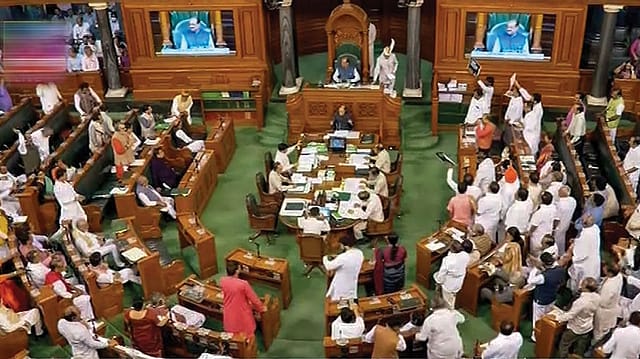
Parliament did plenty of lawmaking this Monsoon Session. What it barely managed was debate.
Over 19 sittings spread across 25 days, Parliament passed 12 Bills. Eleven of them went through without discussion. Only the Public Examinations (Prevention of Unfair Means) Amendment Bill, 2026, received a detailed debate. The numbers tell the story of a session caught between legislative business and political breakdown: Lok Sabha functioned for roughly 19% of its allotted time. Rajya Sabha managed about 39%.
When both Houses were adjourned sine die on Thursday, they brought down the curtain on weeks of repeated disruptions, slogan-shouting and confrontation over the NEET paper leak, alleged police action against protesting students and allegations of theft of donations at the Ram Temple in Ayodhya.
Yet amid the noise, legislation kept moving
Eleven Bills were introduced in the Lok Sabha and two in the Rajya Sabha during the session, while 12 were passed by both Houses. Two replaced ordinances promulgated before Parliament convened: the Supreme Court (Number of Judges) Amendment Ordinance and the Income-Tax (Amendment) Ordinance, both of 2026.
Rise of the Pivotal Power
18 Sep 2026 - Vol 05 | Issue 38
The BRICS declaration is a strategic victory for Modi
One Bill got a debate. Eleven didn't. The exception was the Public Examinations (Prevention of Unfair Means) Amendment Bill, 2026, legislation that landed at the centre of one of the very controversies driving the political confrontation outside and inside Parliament.
The law seeks to tighten India's response to examination malpractice by imposing strict timelines on investigation and prosecution. Investigations into cases involving unfair means must be completed within two months, while trials are to be concluded within three months. States and Union Territories can establish Special Fast Track Courts, Special Public Prosecutors can be appointed and the Centre can constitute Special Task Forces where required.
The legislation also raises penalties and creates a time-bound appellate mechanism before a Division Bench of a High Court. It was passed by both Houses and subsequently received presidential assent.
But for the other legislation, debate largely vanished. Parliamentary Affairs Minister Kiren Rijiju said 11 Bills were passed in the Lok Sabha without discussion, blaming Congress MPs for turning parliamentary participation into disruptions and slogan-shouting. “The government was ready to answer every question, but the Opposition did not allow discussion,” Rijiju said.
The Opposition told a very different story
Its leaders accused the government of pushing legislation through Parliament without adequate scrutiny while refusing to provide the accountability they had repeatedly demanded. What else did Parliament pass? Among the significant pieces of legislation was the Prevention of Insults to National Honour (Amendment) Bill, 2026, which brings Vande Mataram under Section 3 of the Prevention of Insults to National Honour Act, 1971. The amendment makes intentional obstruction of the singing of Vande Mataram, or disruption of an assembly engaged in singing it, an offence, extending statutory protection to the National Song.
Parliament also cleared the Registration of Births and Deaths (Amendment) Bill, 2026, tightening the procedure for delayed registrations. Registrations delayed by more than a year and up to two years will require approval from the competent Executive Magistrate, while delays beyond two years will need the approval of a Judicial Magistrate First Class.
The MSME Development (Amendment) Bill, 2026 proposes a national digital platform for free and voluntary registration of micro, small and medium enterprises, along with measures to improve access to finance, speed up delayed-payment disputes and decriminalise certain offences by replacing conviction-based fines with graded penalties. The Bankers' Books Evidence Bill, 2026 updates the law for the digital age, expanding the definition of bankers' books to cover electronic, digital, virtual and cloud-based records.
And the Kerala (Alteration of Name) Bill, 2026 seeks to amend the First Schedule of the Constitution to formally rename Kerala as Keralam. The National Co-operative Development Corporation (Amendment) Bill, Tribunals Reforms Bill and Mines and Minerals (Development and Regulation) Amendment Bill were among the other pieces of legislation cleared during the session.
One contentious Bill didn't get through
The Foreign Contribution (Regulation) Amendment Bill, 2026 took a different route. It was referred to a 31-member Joint Committee of Parliament, comprising 21 Lok Sabha and 10 Rajya Sabha members, after Opposition parties including Congress, Samajwadi Party and Trinamool Congress argued that the proposed changes could be weaponised against NGOs, minority institutions and organisations receiving foreign funding.
The government has defended the changes as a transparency measure. The committee is expected to report by the last day of the first week of the Winter Session. Congress, however, has maintained that sending the legislation to a parliamentary committee does not satisfy its demand for the Bill to be withdrawn. Parliament's last day captured the entire session Thursday began with something Parliament had never witnessed before. All six stanzas of Vande Mataram were played in the Lok Sabha, following fresh Home Ministry directions governing protocol for the National Song. Prime Minister Narendra Modi, Home Minister Amit Shah and senior Union Ministers including Rajnath Singh, Nitin Gadkari and Kiren Rijiju stood at attention.
Then the protests returned. Opposition MPs raised slogans demanding answers from Shah over the police action against protesting students.
“Apologise.” “Who ordered the lathi-charge?”
The ruling benches responded with counter-protests. Soon afterwards, Speaker Om Birla adjourned the House sine die. One departure from parliamentary convention stood out: the Speaker did not deliver the customary valedictory address outlining the Lok Sabha's performance during the session.
The Rajya Sabha's final sitting brought another controversy.
Congress raised allegations that a “purification” ritual had been performed at a venue in Haldwani, Uttarakhand, after Congress president Mallikarjun Kharge addressed a rally there. Kharge questioned whether such an act was compatible with democratic values. Union Minister JP Nadda called the episode a matter of concern and said the BJP did not support such actions.
NEET and the student crackdown haunted the session
If one issue supplied much of the political fuel for the Monsoon Session, it was the controversy over alleged NEET examination irregularities and police action against students marching towards Parliament on July 20. Opposition MPs repeatedly demanded that Home Minister Amit Shah explain allegations that force, including lathis, had been used against students. The issue remained unresolved as disruptions repeatedly brought normal proceedings to a halt. On Wednesday, Shah said the government was prepared for a discussion and accused the Opposition of avoiding one.
Rahul Gandhi rejected that argument. “The Opposition has clearly said that we are not interested in Amit Shah giving us a lecture. Who shot the students? Who gave the order to beat up the students with lathis?” Gandhi said.
Running alongside the student protests was another combustible issue: allegations surrounding the theft of donations at the Ram Temple in Ayodhya. Together, the controversies fuelled protests inside Parliament and demonstrations outside it, with the BJP and INDIA bloc repeatedly trading accusations and staging counter-protests.
At one point, Congress MP Pawan Khera joined Opposition MPs carrying a toy monkey and chanting a jibe aimed at Modi's oft-cited “56-inch chest”. The BJP, meanwhile, protested against Rahul Gandhi and Congress over what it described as their failure to acknowledge an ongoing agitation in Jharkhand. CPI(M) MP Amra Ram accused the government of engaging in “theatrics” and pushing legislation through without proper debate. Samajwadi Party MP Rajiv Rai accused Shah of waiting until the end of the session to respond to concerns over the student protests. Priyanka Gandhi Vadra questioned the absence of the Prime Minister and Home Minister during crucial moments of the session.
Rijiju ended on a more hopeful note, saying he expected “a change for the better” when MPs return for the Winter Session. The Monsoon Session ultimately leaves behind two sets of numbers that sit uneasily beside each other. Twelve Bills passed. Eleven without debate. Lok Sabha productivity: 19%. Rajya Sabha: 39%. Parliament got its legislative business done. The debate that is supposed to accompany it largely never happened.
(With inputs from ANI)