When Indian Films Took the Classical Arts Seriously
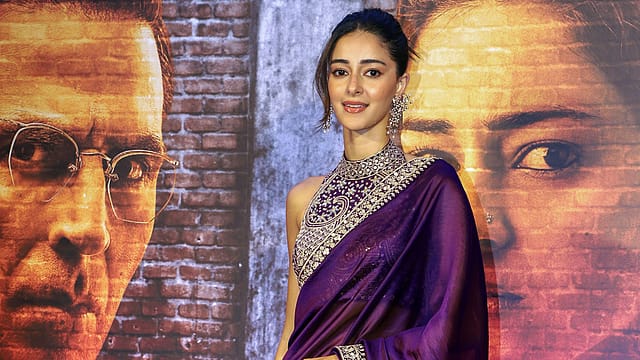
Every few years, Indian cinema reaches for a classical art form and reveals how little it understands it. A sequence in Vivek Soni’s new film, Chand Mera Dil, is the latest example of this. The sequence, in which actor Ananya Panday performs a Bharatanatyam-inspired routine, drew widespread flak from classical dancers, choreographers and viewers who found it to be in poor taste. Popular cinema often does treat the classical arts as props. But there have also been films that approached them with patience, rigour and curiosity, and their history is worth recovering.
Between 1938 and 1947, the Carnatic musician MS Subbulakshmi acted in five films, her most celebrated role being the saint-poet Mirabai in Meera (1945, Tamil; 1947, Hindi), after which she effectively left cinema to dedicate herself to music. Ellis R Dungan, the American director who made Meera, understood that he was working with something that exceeded his medium, that the voice of Subbulakshmi singing the Mirabai bhajans was not a film soundtrack but a primary spiritual event. The result is one of the earliest instances in Indian cinema of a film treating its classical content as substance. The music is not illustrating the story; the story is a pretext for the music.

Zeroing In on ECI
09 Oct 2026 - Vol 05 | Issue 41
Constitutional legitimacy versus political opportunism
Thirty years later, GV Iyer, who had begun his career in Gubbi Veeranna Nataka Company and brought that company’s devotion to craft into a filmmaking practice of extraordinary rigour, made Hamsageethe (1975), based on TR Subba Rao’s novel about the 18th-century Carnatic musician Bhairavi Venkatasubbiah. The film presents the singer in the Romantic model of the artist, as a musician who received the patronage of Chitradurga royalty, defied Tipu Sultan, and, in the film’s legend, cut out his own tongue to prove that music is nobody’s slave. M Balamuralikrishna won the National Award for Best Male Playback Singer for Hamsageethe, whose music drew deeply on the Carnatic repertoire. It is among the richest film tracks in the history of Indian cinema, almost entirely unknown outside Karnataka. Iyer would later make Adi Shankaracharya (1983), the first Sanskrit feature film ever produced, with Balamuralikrishna composing again and Madhu Ambat behind the camera, winning the National Award for Best Feature Film and several other honours. It’s a film in which the Sanskrit language itself functions as a classical form whose precision and density the camera is asked to honour.
In Hindi cinema, the 1950s and 60s produced genuinely serious engagements with classical form. Baiju Bawra (1952) used Ustad Amir Khan and Pandit DV Paluskar as playback singers, making Hindustani classical music the film’s spine. Pakeezah (1972) treated the mujra tradition with a seriousness that Kamal Amrohi spent over a decade trying to get right. Umrao Jaan (1981) went further, with Muzaffar Ali using thumri and ghazal to foreground a woman’s inner life. And then there is Madhuri Dixit, who remains the most significant exception Hindi cinema has produced to its own tendencies. Birju Maharaj, the greatest Kathak master of his generation, choreographed her in several films, including Dil To Pagal Hai (1997), Devdas (2002), and Dedh Ishqiya (2014). That Hindi cinema could produce her, and then largely fail to build on what she represented, speaks to how Bollywood struggles to learn from its own best instincts.
What Baiju Bawra did for Hindustani classical music, V Shantaram’s Jhanak Jhanak Payal Baaje did for Kathak in 1955 The film gave Gopi Krishna, a Kathak dancer who had trained his entire life, a popular platform. Sandhya, Shantaram’s wife and co-lead, had not trained formally before the film and underwent intensive Kathak preparation.
In Dancing Women: Choreographing Corporeal Histories of Hindi Cinema, Usha Iyer traces how Hindi cinema absorbed and transformed classical dance traditions through the bodies of dancer-actresses like Vyjayanthimala. The early films produced by South Indian studios tended to foreground her Bharatanatyam training more directly, while later Bombay productions increasingly folded that training into the broader grammar of Hindi film spectacle. Waheeda Rehman’s trajectory from South India to Bombay mirrors Vyjayanthimala’s and her relationship with the classical arts is equally grounded in the body rather than in its image. Waheeda Rehman was schooled in Bharatanatyam, and both she and Vyjayanthimala brought South Indian classical dance training into Hindi cinema as practitioners rather than imitators. Rehman had been noticed by Guru Dutt, who was himself trained in dance under Uday Shankar, in a dance sequence in Telugu cinema, and it was the quality of her movement that Dutt organised some of his most visually ambitious films around. A Bharatanatyam guru had initially refused to teach Rehman because she was Muslim, relenting only after reading her horoscope and saying she would be his last and best student. It is incredible how some of Indian cinema’s best encounters with the classical arts were serendipitous.
The fullest expression of what Rehman’s training made possible on screen is Guide (1965), in which her character Rosie, a dancer trapped in an unhappy marriage, escapes into the freedom of her art. The emotional authority of the dance sequences depends in large part on the fact that Waheeda Rehman brought a classically trained body to them. The film charts Rosie’s transformation into the celebrated dancer Nalini, and the credibility of that transformation rests on the audience believing they are watching someone for whom dance is not performance alone but identity itself. Without that grounding in classical movement the film would have become a story about performing dance rather than living it.
K Viswanath understood this profoundly and he demonstrated it across a body of work—Shankarabharanam (1980), Sagara Sangamam (1983), Swarna Kamalam (1988), Swathi Kiranam (1992)—that remains the most sustained meditation on the classical arts in the history of Indian popular cinema. Shankarabharanam, when it released, spread across South India in the way that good music manages to cross borders. In Tamil Nadu it screened in its original Telugu to packed houses. KV Mahadevan’s compositions, SP Balasubrahmanyam’s vocals, Veturi’s lyrics, and the Kuchipudi dancer Manju Bhargavi in a central role—it all worked together to create something memorable. Sagara Sangamam, with Kamal Haasan, trained in classical forms since childhood, as a brilliant classical dancer trained across forms and destroyed by a world that asks him to compromise on his art, contains a scene where the protagonist attempts to choreograph a film heroine in genuinely classical sequences while the director watches, demanding romance and sensuality. The scene is a diagnosis of what commercial cinema often did to classical form, and that it was made in 1983 in Telugu remains its own comment on where the seriousness lived and where it did not.
The 2009 volume The Performing Pasts: Reinventing the Arts in Modern South India provides the structural frame for understanding why South Indian cinema was different: the institutions that produced the classical arts were geographically and culturally proximate to the film industries of Madras, Trivandrum and Hyderabad in ways that had no equivalent in Bombay. The volume argues that the invention and classicising of the performing arts was forged at the intersection of colonialism, nationalism and regionalism, and that the elite metropolitan discourses surrounding the arts reveal something significant about the workings of modernity in South Asia generally. In South India, directors, composers and sometimes actors were products of the same cultural formation as the classical arts themselves. The ecosystem was shared.
This shared ecosystem produced, between 1991 and 1993, a cluster of Malayalam films about the classical arts with few equivalents elsewhere in Indian cinema. Bharatham, directed by Sibi Malayil from a script by AK Lohithadas, placed Carnatic music at the centre of a story inspired by the Ramayana: Mohanlal as the younger brother sacrificing his own gifts in loyalty to a gifted but self-destructive elder. The film brought National recognition to Mohanlal and KJ Yesudas for Ramakadha Ganalayam, along with Special Jury recognition for Raveendran’s music. The following year, Malayil and Lohithadas made Kamaladalam, with Mohanlal as a dancer at an institution modelled on Kerala Kalamandalam, the school founded by Vallathol Narayana Menon on the banks of the Nila to preserve Kerala’s classical arts traditions. Where Bharatham asks what art demands of a family, Kamaladalam asks what it does to the artist himself, and arrives at something more unsettling.
And how could one forget Manichitrathazhu (1993), one of the most radical representations of classical dance in Indian film history? Fazil’s psychological thriller treats classical training as something stored deep in the body, surviving beneath the conscious self, such that when Nagavalli’s ghost takes possession of Ganga it is recognisable because of a different quality of movement. Shobana’s own Bharatanatyam training gives the film’s central dance sequence its uncanny authority.
There were other serious films, though most remained films about the arts rather than films that absorbed the arts into their understanding of life itself. In Tamil, Thillana Mohanambal (1968), adapted from Kothamangalam Subbu’s novel, follows a nadaswaram vidwan and a Bharatanatyam dancer through temple festivals, travelling troupes, jealousies, negotiations and wounded pride. Padmini’s formal training enlivens the dance sequences, but the film’s greater intelligence lies in its understanding that classical art in South India was a profession tied to patronage, caste and survival. AP Nagarajan and KV Mahadevan do not dilute the world they are depicting, trusting the audience to keep pace. Sindhu Bhairavi (1985) approached Carnatic music differently. K Balachander used the concert stage to ask who classical music is really for, and what happens when an art begins speaking in a language its listeners no longer understand. Ilaiyaraaja’s score moves easily between classical rigour and emotional accessibility because the film itself refuses to see those things as opposites. In Vanaprastham (1999), perhaps the bleakest of them all, Mohanlal plays a lower-caste Kathakali artiste who achieves transcendence on stage while remaining socially diminished outside it. The performance tradition does not redeem or heal him.
The argument these films make is finally the same—that the classical arts are not like borrowed jewellery you can wear for an evening, that a body either knows or it doesn’t, and that an audience, given half a chance, can tell the difference. The memes about Ananya Panday’s performance are cruel, but they are correct about something larger than one actress in one film. They are correct about a cinema that grew so comfortable with the surface of things that it forgot there was anything beneath.