The Mindhunters
July of 2026 was the month when Jantar Mantar in Delhi became the eye of the proverbial storm that engulfed India. Beneath the serious political and national ramifications, the pop-culture impact of the movement helmed by the Cockroach Janta Party (CJP) was unprecedented: it resulted in viral memes, earworm slogans and community bonding. Among the many viral posts was a Reel with text: “Send Shilpa Shinde from Lock Upp to the protest site. Only she can deal with the police.” Shinde appeared in the Netflix reality show as a wildcard entry, weeks after admitting on a podcast that the sexual harassment allegations she made against a producer had been false. The meme was more than a throwaway joke. It was a sign of how deeply the actor had embedded herself in public imagination.
July turned out to be a memorable month for reality TV in India. Prime Video’s first-ever global reality series Alliance, hosted by Kunal Kemmu, butted heads with Lock Upp, hosted by Farah Khan and Riteish Deshmukh. Both reality shows aired their premiere episodes within days and competed for viewers’ attention. Wild card entries, controversies, changed alliances and exposed secrets had an entire generation of reality TV lovers in a chokehold.

Zeroing In on ECI
09 Oct 2026 - Vol 05 | Issue 41
Constitutional legitimacy versus political opportunism
Earlier, a handful of flagship reality shows dominated the airwaves; think JioHotstar’s Bigg Boss and Khatron ke Khiladi. Now, streamers are investing heavily in unscripted entertainment, broadcasters are responding with bigger franchises, and audiences have multiple reality shows competing for their watch hours. Scripted shows require actors, sets, locations and bigger budgets. Compare that to reality TV, in which you get to put a bunch of popular personalities in a room, find a format that works, get sponsorship and voila! Every fight, a controversial moment is cut into a Reel that goes viral.
Nikhil Madhok, director and head of Originals, Prime Video and MGM Studios, India, says that he noticed a “growing weariness” among reality TV audiences, where the category seemingly relied “too much on manufactured drama and conflict”. With shows like The Traitors, Alliance and Rise and Fall, Prime Video wanted to bring the focus back on “drama that emerges organically rather than manufactured”. Madhok’s observation rings true because Alliance was a strategy-heavy game which relied less on contestants’ personal lives and controversies.
If conflict took a backseat in Alliance, it played a somewhat central role in Lock Upp: Sach ya Sazaa. Tanya Bami, series head, Netflix India, says that the Indian audience no longer thinks in terms of ‘scripted vs non-scripted’. For Netflix, Bami says, “Success isn’t necessarily about finding the biggest or loudest format; it’s about finding a distinctive premise and a story engine that can sustain conversation beyond the episode itself.”

In Lock Upp, sexuality, divorce and abuse became key topics: actors Ram Kapoor, Harshad Chopda, Shreya Kalra and Shivangi Joshi revealed that they were sexually abused as children. In one episode, the contestants who bared their secrets were reunited with their parents, putting into perspective the guilt parents carry. Bami feels this is meaningful discourse which the younger audience, especially Gen Z, appreciates. “These are big wins for the genre where the core has been driving voyeurism.” Bami shares that Lock Upp had a watchtime of 125+ million viewing hours, 7 million+ conversations and 5 billion online views.
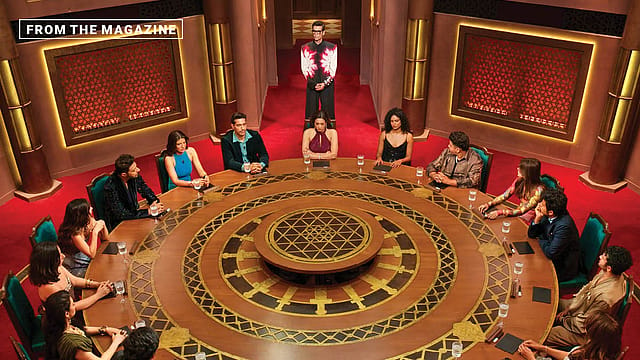
Season two of The Traitors, recently aired on Prime Video, caused quite a storm in the Indian reality TV landscape. Hosted by Karan Johar, its contestants are divided into Traitors and Innocents; the former secretly work to eliminate the latter, while the Innocents try to identify and banish the Traitors. Speaking to Open, Johar says: “I think audiences today are far more active participants in reality television than they were a few years ago. They’re not simply watching what unfolds anymore. They’re reading people, questioning decisions, forming theories, picking sides, and often changing their minds before the episode is even over. That level of engagement has opened up the genre tremendously.”
The show also had a personal impact on Johar. “I’ve always liked to believe that I’m fairly good at reading people, but The Traitors has certainly made me a bit more sceptical. In the show, the players and the audience can be convinced that they’ve figured someone out, only to discover that they’ve read the entire situation wrong. That’s what makes this game so fascinating,” he says. “It doesn’t just make you question the people around you; it makes you question your own judgement as well. I still trust my instincts, perhaps just with a little more caution than I did before.” Had he been a player, Johar thinks that “playing as an innocent would be interesting, especially to feel the euphoria of catching the traitors”.
Kemmu, as the host of Alliance, brings a style unlike what we have seen before. He is calm, composed, yet firm—even with some of his memorable one-liners. “Sometimes a smile or a raised eyebrow can do much more than words ever could,” Kemmu tells Open. “I realised early on that people are agitated when they’re unable to express themselves correctly, or worse, when they feel misunderstood. All I did was listen to them or gently course-correct them.”
If Alliance had contestants competing in teams and The Traitors saw them play a wicked game of Among Us, Lock Upp had them survive in a jail set-up, live on survival trays and reveal their deepest, darkest secrets to save themselves from elimination. Actor Akanksha Chamola had two revelations: the first was her divorce from TV actor and former Bigg Boss winner Gaurav Khanna; the second was her bisexuality, revealed unceremoniously by fellow contestant Shreya Kalra (who eventually went on to win the season).
Arguably the most controversial contestant this season, Chamola, says: “The kind of doors that a captive reality show can open, even scripted television cannot. You are recognised for your personality, rather than for a character you play on a show.” She found herself at the centre of intense scrutiny and trolling, but says, “I have always been under public scrutiny. I was always known as someone’s wife. I was always trolled and condemned. But I wouldn’t handle anything differently [if given a chance to do it all again]. I have managed to change opinions and the audience is accepting me more than they did earlier.”
Krystle D’Souza, joint winner of The Traitors with content creator Rida Tharana, got so into the format that she started questioning the simplest interactions. “You spend the whole day with someone, laugh with them, genuinely bond with them, and then suddenly wonder if any of it was a part of their game.” The 36-year-old actor feels that being a Traitor added another layer of complication for her: “I knew I was doing exactly the same thing to other people”. The game boils down to how convincing one can be and whether “you can make someone trust you in that moment,” she says. To put it plainly: every conversation can change the game.
Mini Mathur, former VJ and television host, says with a note of irony that it was “wonderful” to be “rediscovered” after she won Alliance. “I hope this win encourages makers [and the industry] to not categorise women like me into subsidiary side character energy roles or spaces. I feel my win is proof enough that somebody like me, with seasoned experience, deserves main character roles.” She adds that it is important not to assume that viewers wouldn’t enjoy “intelligent or more strategic stuff” and just want to “sack out and watch people fight”.
Mathur is no stranger to non-fiction programming. “I remember when I was hosting the first season of Indian Idol, I saw people being emotionally invested in Abhijeet Sawant and Amit Sana’s rivalry. I believe allowing viewers to vote and making them believe they are a part of the game is a very strong peg, which is why shows like Kaun Banega Crorepati work, right?” Mathur is happy the cast of Alliance has no bad blood post the show. “I received thousands of messages saying that my win was personal. Women, especially, felt that it was very inspiring for them to see someone at my ‘grand old age’ of 54 compete with the big guys and 25-year-old gym bros,” she says.
This month, Bigg Boss season 20, hosted by Salman Khan, hit the screens, along with regional editions helmed by Sourav Ganguly (Bengali) , Nagarjuna (Telugu) and Deshmukh (Marathi). As new shows have emerged to challenge its dominances, it will be interesting to see how the series reinvents itself. A JioHotStar spokesperson says that these shows “reinforce the strength of the category that Bigg Boss helped shape. Many formats have followed and built on this appetite, but Bigg Boss continues to command the attention of the entire nation”.
What makes reality television so compelling is that it offers a stage for a country constantly negotiating its own changing realities. As India changes, so does the reality TV landscape—and the spectacle it chooses to watch. People continue to watch, participate, take sides and turn real lives into moments that refuse to disappear. In this new theatre of the real, the next act has only just begun.