Stalin vs Vijay: How Tamil Nadu Politics Became a Full-Blown Cinema Potboiler
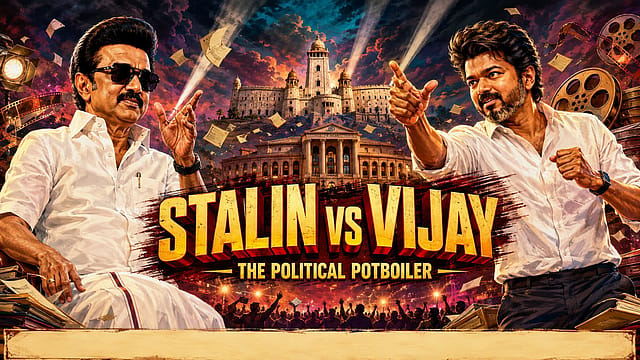
Every South Indian political potboiler needs two powerful men.
One arrives with history, ideology, a formidable party organisation and the weight of a famous surname. The other brings superstardom, fan clubs, punch dialogues and the ability to turn a public appearance into an event. Add an election upset. Reverse their positions. Send the superstar into Fort St George and the veteran back to the opposition. Then let them argue about empty treasuries, renamed schemes, unstable governments and whether the Legislative Assembly has become a cinema set.
Welcome to Stalin versus Vijay.
The Tamil Nadu election ended in May. The political film it produced appears to be running without an interval. Its latest scene came at a DMK executive committee meeting in Chennai, where party president MK Stalin accused Chief Minister C Joseph Vijay of concentrating on renaming schemes launched by the previous government.

Zeroing In on ECI
09 Oct 2026 - Vol 05 | Issue 41
Constitutional legitimacy versus political opportunism
Then came the line designed for the trailer. “The present Chief Minister is busy changing the names of all the schemes we introduced. He is treating the Legislative Assembly like a cinema set and delivering punch dialogues,” Stalin said.
It sounded like a fresh jibe. It was actually the latest episode in a rivalry that has been building for nearly two years.
ACT ONE: VIJAY NAMES HIS VILLAIN
The first major declaration came in October 2024.
Vijay had launched the Tamilaga Vettri Kazhagam earlier that year. At the party’s inaugural conference in Vikravandi, he needed to tell supporters where TVK stood and whom it intended to fight. He identified the BJP as his ideological opponent. Then he named the DMK as his political adversary.
Vijay reportedly attacked the DMK over corruption while presenting TVK as a secular, social-justice alternative. The political newcomer had chosen the ruling party as his principal opponent. Stalin initially resisted giving Vijay the starring role he wanted. New parties often enter Tamil Nadu politics by attacking the DMK, he suggested during the 2026 election campaign. Criticising his government, Stalin argued, had become their entry ticket.
That response revealed the DMK’s early strategy. Do not allow the superstar to turn the election into a two-hero film.
Vijay kept trying. In November 2025, he accused Stalin of making slanderous statements and practising the “politics of hatred”. NDTV reported that Vijay described the then chief minister as intoxicated by power and said he had lost his sense of humanity, ethics and dignity. The language had hardened. The campaign had found its confrontation.
INTERVAL: THE STAR ENTERS FORT ST GEORGE
Then the screenplay delivered its twist.
Vijay won. The actor who had spent decades playing rebels, saviours and reluctant leaders on screen became Tamil Nadu’s chief minister on May 10, 2026.
The DMK, which had governed the state under Stalin, fell to 59 seats. At a party meeting after the defeat, Stalin accepted responsibility, commissioned feedback from constituencies and began examining what had gone wrong. He also offered his interpretation of what had swept the DMK out. This was no political tsunami, he argued. It was a “glamour tsunami”. Stalin reportedly blamed campaign failures while acknowledging that TVK had successfully converted Vijay’s enormous personal appeal into electoral momentum.
That phrase mattered. Calling it a glamour wave allowed Stalin to recognise the force of Vijay’s victory while questioning its political depth. A wave created by cinema, the argument suggested, could recede once governance replaced applause.
Vijay had won the first instalment. Stalin was already questioning the durability of the franchise.
THE EMPTY-TREASURY SCENE
Their first post-election confrontation arrived almost immediately.
In his initial address as chief minister, Vijay claimed that the previous DMK government had emptied Tamil Nadu’s treasury and left behind a heavy financial burden.
Stalin did not wait. He rejected the allegation, said the state’s debt remained within permissible limits and warned Vijay against disappointing the people by blaming a lack of funds for difficulties in fulfilling his election promises. “Funds are there,” Stalin said in effect. Learn the nuances of governance and deliver what you promised.
The next day, something almost cinematic happened. Vijay visited Stalin at his Alwarpet residence. The two men exchanged bouquets, draped each other with silk shawls and smiled for the cameras, according to The New Indian Express.
Tamil Nadu had just watched them fight over the treasury. Now it watched them exchange courtesies. Even the fiercest potboiler occasionally needs a family scene.
WILL THE GOVERNMENT SURVIVE THE SECOND HALF?
The politeness did not last. Less than a month after Vijay took office, Stalin questioned whether the TVK government would survive even three months. “It is not a question of six months, five months or even four months. The question now is whether this government will last even three months,” Stalin said at a DMK event on June 7, according to The New Indian Express.
The remark caused enough noise for the DMK to issue a clarification. Party leader Thangam Thennarasu said Stalin had not threatened to topple the government. He had been describing what the DMK regarded as its precarious political condition.
Stalin returned to the theme later that month. He called Vijay’s administration a minority government, told DMK workers elections could arrive at any time and urged them to remain prepared.
Stalin reportedly suggested that the government might not complete its five-year term. In cinema terms, the former chief minister was already hinting at an early sequel. In political terms, he was trying to keep a defeated cadre mobilised while portraying the new government as temporary.
WHEN THE ASSEMBLY BECAME THE SET
The rivalry soon moved into the Assembly.
Vijay delivered a speech filled with theatrical gestures and political attacks. DMK members walked out. The chief minister continued and reportedly recreated a gesture associated with Stalin, producing the kind of viral clip his opponents believe he values too highly. Stalin’s response was cutting.
The Assembly’s live camera, he suggested, was being treated like a cinema camera. Governance was being replaced by performance. Hindustan Times reported that Stalin accused Vijay of turning legislative proceedings into a dramatic production instead of addressing matters of public importance.
That criticism reached its natural destination at Saturday’s executive committee meeting. The “cinema camera” became a “cinema set”. The dramatic performance became “punch dialogues”. Stalin was no longer merely attacking Vijay’s policies. He was challenging his entire political method. The subtext was easy to read: Tamil Nadu elected a star, but does it have a chief minister? Vijay’s answer would presumably be just as direct: the audience has already voted.
REMAKES, XEROX COPIES AND STICKERS
The second recurring attack concerns originality.
Stalin now claims Vijay is changing the names of schemes introduced by the DMK. His son Udhayanidhi Stalin has pushed the charge harder, calling Vijay a “dummy CM” and alleging that the TVK government merely places new stickers on DMK programmes.
The language has become increasingly cinematic. The DMK has called the government a “xerox copy”. It has accused Vijay of producing remakes instead of original governance. Schemes have become scripts. Renaming has become rebranding. The chief minister’s Assembly speeches have become scenes created for social media.
There is strategy beneath the mockery. The DMK wants voters to believe that whatever works under Vijay began under Stalin. If the TVK government struggles, the DMK can attack its inexperience. If it succeeds using inherited programmes, Stalin can claim authorship.
Vijay faces the opposite challenge. He must convert charisma into administration and demonstrate that his government possesses an identity beyond its leader. Winning power required spectacle, organisation and a promise of change. Keeping power will require budgets, delivery and an ability to survive the daily grind that cinema edits out.
STALIN BEGINS WRITING THE COMEBACK
Saturday’s meeting was about Vijay, but it was also about the DMK.
Stalin told party leaders that they had lost an election, not suffered a permanent defeat. He acknowledged failures among office-bearers and argued for a comprehensive self-assessment instead of a constituency-by-constituency purge. The party approved age ceilings and term limits across several organisational positions. It lowered the entry barriers for younger leaders and began rebuilding its committees.
That is the less glamorous part of the story. No spotlight. No background score. No slow-motion entrance. Just organisation. And that may be Stalin’s most serious reply to Vijay. The DMK cannot out-star the star. It can try to out-organise him.
Vijay’s fan clubs gave TVK reach, energy and an army of emotionally invested supporters. The DMK possesses a 75-year-old structure built through local committees, ideological training and electoral battles. Saturday’s resolutions were an attempt to repair that machinery before the next confrontation.
Stalin delivered the punch dialogue about the cinema set. Then he returned to rewriting the party organisation.
CLIMAX PENDING
Tamil Nadu has seen this story before, although never quite with these actors.
Cinema and politics have shared the same screen in the state for decades. CN Annadurai and M Karunanidhi wrote for films. MG Ramachandran and J Jayalalithaa converted superstardom into political authority. Vijayakanth built a party around his popular appeal.
Vijay entered a road paved by giants. Stalin inherited a movement shaped by some of them. That history gives their rivalry its deeper tension. Vijay represents the disruptive power of celebrity when it acquires political organisation. Stalin represents the institutional memory of the Dravidian establishment after an unexpected defeat.
One has the government. The other has the comeback script. For now, Stalin keeps accusing Vijay of confusing governance with cinema. But here is the delicious irony. Every time Stalin calls the Assembly a movie set, mocks Vijay’s punch dialogues or labels his victory a glamour tsunami, he adds another scene to the political blockbuster he says Tamil Nadu should stop watching. The election is over. The hero and his rival are still trading dialogues. And somewhere in Tamil Nadu, the audience is waiting to decide who gets the climax.
(With inputs from ANI)