Rajini as a Cultural Experience
The mythmaking, in fact, begins long before the movie starring Rajinikanth does. It is prevalent in the basement parking lot of the multiplex, where two-wheelers are abandoned hastily, the resulting impatience causing an unnecessary push towards the auditoriums upstairs. It is present in the rush on the stairs and the lifts, the scramble of the patrons sharing a real likeness to spectators who are late to a big cricket game in international stadiums around India. There is a spring in the step, or double steps, as the young man takes in front of me, all while watching an Instagram reel of the real Rajini attending the premier of his film, Jailer 2, in another part of this Rajini-mad city, Chennai.
“He smokes a cigarette in this padam da,” another ticket-holder tells his friend in Tamil, barely containing his excitement. We pour into Audi 1 of this theatre complex in Injambakkam on East Coast Road, boys and girls, thathas and paatis, and, most incredibly, for a sequel to a very violent original released in 2023, children. Many, many children. There is a 4-year-old child seated on the lap of a patron in my row; there is also an 8-year-old boy in the seat in front of me, directing his nervous energy into casually kicking the seat in front of him.

Zeroing In on ECI
09 Oct 2026 - Vol 05 | Issue 41
Constitutional legitimacy versus political opportunism
Again, the first round of cheering – the hall is now a hive of shrill whistles – begins even before the film does. All that has happened is the lights in the auditorium have dimmed for the feature presentation. This is still only a vocal greeting, for the dark theatre is soon going to be illuminated with hundreds of camera phones, all these fished-out mobile screens soon to be reflecting a miniature version of the opening credits.
Since the release of Annamalai in 1991, all Rajini-starrers have announced his authority over the forthcoming feature in this fashion: the words ‘SUPER’ and ‘STAR’ frame the black panel, the letters studded with neon lights. From within these starry brackets shoots out the name ‘RAJNI’, flaming yellow letter by flaming yellow letter, horizontally, like in the written prologue to a Stars Wars film. The gentleman seated to my right is beside himself, clapping and hooting like everyone else, yet the off-screen soundtrack is comfortably drowned out by the accompanying on-screen one, which the writer Karthik Krishnaswamy once perfectly described in an article as “a rousing tune with vague echoes of James Bond and the Pink Panther.” The tune ends to that famous, echoing laughter from Rajini, the legend yet hidden from view.
He appears, or rather makes his grand entry, a good five minutes into the film. When he first does, it is still a tease, either he is blurred or hidden behind everyday objects in a supermarket that Rajini’s character is the manager of in this plot. Then he altogether appears, a close-up of his face, proudly baring wrinkles and streaks of white hair, and the audience once again explodes with unadulterated mirth. An aisle away, an elderly lady has made a video call to perhaps someone from her family who couldn’t make it, first displaying to the person on the call her ecstatic face, followed by the giant Rajini’s, in quick succession.
The first dialogue, as he chastises a young shop-lifter with a witty punchline, is delivered after a long pause, for directors have wizened up to the fact that there will be hooting chaos at his first appearance. It, then, almost feels like Rajini is listening to us, waiting for a semblance of silence before mouthing the lines that will soon be studding the front of T-shirts. The famous ones, especially from Baasha (1995), are sprinkled all over clothes in this auditorium.
Rajini’s character in this film, Muthuvel ‘Tiger’ Pandian, speaks less and listens more than his younger characters have, giving the dialogues even more heft when spoken. True to his real-life age, 76 (75 when the movie was shot), he plays a grandfather, even though that barely stops him from beating up the baddies with great style and gore. All that bloodshed is lapped up unblinkingly by the children around me. But unlike in real life, where he is proudly bald, on-screen Rajini always wears a wig, the one in Jailer 2 bracketed by tufts of white above the temples.
This isn’t a movie review so the plot is irrelevant: the story is wafer-thin even if incredibly entertaining. I had watched Jailer (2023) on TV in preparation for the upcoming experience, barely cared for the twists and turns in my solitude, yet found myself wholly immersed in the sequel in the company of others in the theatre, often even cheering along with my fellow spectators. Which is precisely what this cinematic experience of a theatrical release featuring Rajini in the lead is wholly about, especially on the first day: the privilege of being part of something far bigger than the movie itself. Something profound, like a festival, where the local multiplex becomes the doorway to participate in a community-driven, state-wide occurrence of a cultural event.
In the days of the single-screen halls, during Rajini’s absolute pomp in the 90s, his giant cutouts would famously be bathed in milk (paal abhishekam) and patrons would dance in the aisles during his songs, throwing vast amounts of torn ticket stubs as happy offerings towards the silver screen. In Jailer 2, grandfather Rajini doesn’t dance at all and the tickets have given way to online QR codes. Yet, the in-cinema experience of watching Rajini is exactly as it always was, an emotional rollercoaster, where you, in the audience, lift and fall by his presence.
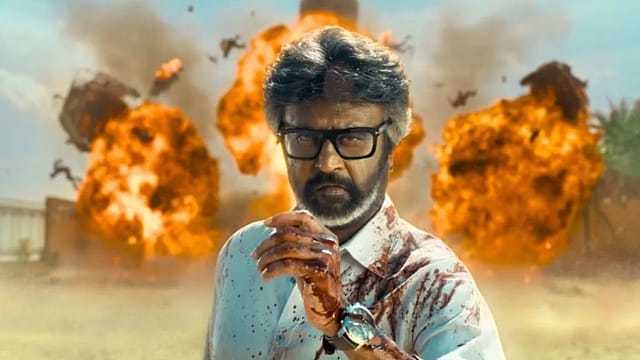
I don’t know if this counts as a spoiler, but Rajini does indeed smoke on-screen in Jailer 2. The flipping of a lit cigarette directly into his mouth used to be a signature move in his heyday. But that was replaced at the turn of the century (Chandramukhi in 2005 being the line in the sand) when he replaced it with stylish tosses of chewing gum. But when it returned in the Jailer franchise, it did so with a bang. Quite literally, with a private jet blowing up on a forlorn runway behind him, the theme song physically shaking the seats and Rajini coolly flipping a cigar into his mouth, shifting it from side to side before lighting it.
Simultaneously, the cinema hall lit up as well, to a standing ovation, a reaction that I quite hadn’t witnessed at a movie before. As the end credits rolled, we streamed out, largely delirious, with the word ‘super’ thrown around a lot. But the words I shall leave you with were the ones I heard within my earshot of the exit door. One young man threw an arm around another’s shoulder and said: “Night show paakalama?”