‘I Always Wanted To Be On The Other Side’: How Mauli Singh Went From Publicist To Protagonist
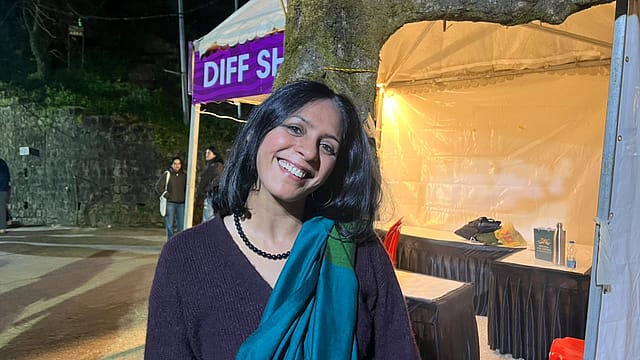
“I was hiding that I can also act,” says Mauli Singh.
For four years, she was on the other side of the Dharamshala International Film Festival’s red carpet. As a publicist, her job was to put other people’s faces in front of cameras. “I always wanted to be on the other side,” she tells OPEN Digital.
This year the cameras turned on her. Birds in the Dark (Hanere de Panchi), the debut feature by Shashank Walia, had its India premiere at DIFF 2026, with Walia and several of the cast and crew in town. Mauli plays Dilraj Kaur, the film’s moral centre.
Her route to the screen was a long one. She spent two decades in Bombay, close to cinema but never in front of it. Her acting debut came around four years ago, during Covid, in Adh Chanani Raat, a black-and-white Punjabi film. She met Walia at the Tikri border, where the farmers protest camped for more than a year. A future actor and a future director met in the middle of a movement about land, and they would later make a film about the same thing.

The Era of Forever Wars
30 Oct 2026 - Vol 05 | Issue 44
Coping with an explosive Middle East
Walia picked her for Dilraj. “Shashank gave me confidence to act,” Mauli says.
The film begins at daybreak in a forest. Amir (Shahnawaz Bhat), who works in a call centre, is seized by Jagtar (Harinder Singh Aujla), a police informer convinced he has caught a suspect. The two are forced to travel together, and over that difficult journey a closeness grows between them. When Jagtar finally sees he has got the wrong man, the pair separate, leaving something unsaid.

Jagtar heads home to his village on the banks of the Beas. There his childhood friend Dilraj is organising landless labourers to reclaim the land they work. Amir turns up, looking for Jagtar, and forces him to choose between the burdens of his past and what might come next. By the river, new alliances take shape and a reckoning draws near.
It is a long film, at 142 minutes, and it moves between Punjabi, Urdu and Kashmiri.
“IT WAS LIKE FAMILY”
Walia does not want the film put in a single box. “It is an intersectional film,” he says. “It was never a caste or gender issue alone.” Class and sexuality are in it too, he says, as are patriarchy and the way masculinity performs itself. “It is a people’s film.”
He means that quite literally. “Five villages came together to help us make this film. It was they, the villagers, who gave us this film. It was like family. We spent months there.”
The film has travelled well. It premiered in the Vision section of the 31st Busan International Film Festival in October. It won Busan’s Songwon Vision Audience Award for Asia and the New Currents Award for emerging Asian directors. Dharamshala was its first stop in India.
WHY NO COLOUR?
When asked about the black and white at nearly every screening, Walia answers in two parts. First, it comes from Punjab’s realism. Second, the film has a poetic side, and that matters, because the plot sometimes leaves gaps. “It is just the poetic form of the film that gets them together,” he says. “Something was off about colour. It didn’t represent the people we showed.”
The seasons shape the story too, but not as scenery. “Films are also about materiality,” Walia says. He was interested in the means of production and who controls the crops and the land, and the seasons became his way of tracking those questions.
PLAYING DILRAJ
Those questions land on Dilraj, a woman who has already left one hard life and is now fighting for a bigger one. For Mauli, the role mattered because it was rare. “Women are less in the centre in Punjabi cinema,” she says. “This was a strong one, at the centre of the story.”
Dilraj works for upper-caste farmers and has walked out of an abusive marriage, a risky choice in her world. She is tired, but she hasn’t stopped seeing what’s wrong around her. Her brother is Dalit, and his story supplies the film’s most disturbing moment. At a celebration hosted by an upper-caste man, he joins the dancing. The guests are shocked at his nerve. The film cuts that mood short as he is taken away and badly beaten.
Dilraj’s closest companion is Rinku (Sapna Das), a younger labourer who brings lightness to the film. Late in the story, as Dilraj prepares to call a protest for the rights of Dalit farmers and workers, she goes to Rinku, who is shaken. Rinku says no. She will not join the fight, because she has her own life, and her unborn child, to protect. The film treats the refusal as a choice, not a betrayal, and Dilraj accepts it.
Sayani Gupta, who was in the audience at the screening, was moved. “I’m a proud FTIIan after seeing this,” she said. Looking at Mauli, she added: “You have to come more on screen. The camera loves you.”
DESIRE, REDRAWN
Sayani also praised the film’s love scenes, calling them stunning, sensual and beautifully done. They are part of the film’s larger argument. It opens with a love scene between two men, and Aujla admits he walked into it nervous. He was curious about the scene and sceptical. How explicit would it get? Would it be vulgar? “But we displayed the best without going there,” he says.
When Jagtar comes home, he meets Raman (Navdeep Bajwa), a wealthy upper-caste landowner who was once his lover and wants that closeness back. The village’s caste tensions are near breaking point by then. Walia reads the zamindar as a man who owns the land and also wants to own love.
For Walia, this is about how a film is built, not just what it shows. “We have to find new ways, meanings and paths to love,” he says. He argues that films should be told in a queer enough way as form, rather than simply putting queerness at the centre as a topic. “Only then can we truly depict queer stories on screen.”
The film also keeps faith in view without making a speech about it. In one frame, pictures of Ambedkar and Jesus hang next to each other on a wall. In another, Punjabi women sing hallelujah and glory to God.
THE VILLAGE’S DAUGHTER
Sapna Das says the shoot reshaped her. Walia told her from the start that Rinku would not cry. “Ye strong hai. Rona nahi hai,” she remembers. Women, she says, have been shown as weak and tearful on screen for too long. “This film changed me a lot and my perspective.”
The villagers of Chamba, she says, showed her love and affection. They still call her Rinku, and she keeps in touch. Walia puts it simply: Sapna became the daughter of the village.
BACK ON THE CARPET
Mauli doesn’t describe Dilraj as a cause or a symbol. She describes someone she knows.
It would be easy to call her story tidy: a publicist who spent years putting others in front of the camera finally stepping in herself. But Dilraj is not a tidy role. She leaves a marriage, rallies a village, and asks for little beyond being treated as an equal.
That, Mauli says, is the point. Asked what Dilraj wants, she does not reach for anything grander. “Dignity, that’s it. Equality to live. That’s how I am in real life too.”