Paolo Bulgari Dies at 89: Inside the Life of the Gem Master Who Helped Make Bvlgari a Global Brand
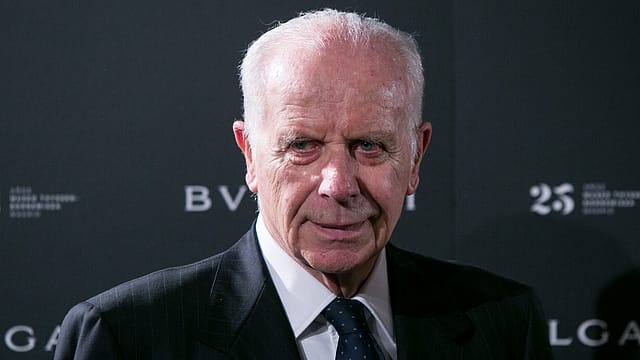
When the actress Anna Magnani walked into the Bulgari shop in Rome, the young Paolo Bulgari was sent to serve her. He was in his early twenties. Magnani was one of the stars his father, Giorgio, had cultivated through the 1950s, and she was not pleased to be handed over to a junior.
“How dare you have me served by this brat!”
That was how Paolo remembered her words when he told the story to La Repubblica in 2011. In another account quoted this week, he put it more simply: “She treated me terribly.”
He had come to the counter by way of a persuasive father. Paolo was studying law, though architecture appealed to him more. Giorgio Bulgari wanted his son in the workshop. There were no fixed hours and no weekends. He learned by watching Giorgio and his uncle, picking up the secrets of the trade a little at a time.

The Wealth Issue 2026
06 Nov 2026 - Vol 05 | Issue 45
Portraits of Dreamers and Doers under 35
On Saturday, November 21, 2026, his family announced that Paolo Bulgari had died in Rome. He was 89. By then he had helped turn his Greek grandfather’s silver shop into one of the great names in Italian jewellery, sold control of it to Bernard Arnault’s LVMH and trained the woman who would take over a buying job once reserved for the Bulgari brothers. His family called him “the greatest jeweller of our time”.
Eighty cents in his pocket
“My grandfather Sotirios arrived in Rome in 1881 with only 80 cents of a lira in his pocket,” Paolo told the Greek newspaper Proto Thema. Paolo never met him. The sum was one of those details a father remembers and a son remembers hearing.
Sotirios Voulgaris was a silversmith from Paramythia, a mountain village in Epirus in northwestern Greece known for its silver. He fled Ottoman rule, settled first in Naples and then moved to Rome, adapting his surname to Bulgari. In 1884 he opened a shop on Via Sistina. In 1905 came the shop on Via dei Condotti where his grandson would one day face Anna Magnani.
Born in Rome in 1937, Paolo first visited Paramythia in 1954. Asked whether he felt more Greek or Italian, he worked his way through both claims. His roots were Greek. He had been born and raised in Italy. His answer was European.

Paolo recalled entering the family workshop at 18. The house dates his professional collaboration with Giorgio to 1960. His father knew how to set stones in gold. On buying trips to Paris, London and Amsterdam, Paolo told the journalist Stefano Lorenzetto, he watched how Giorgio chose them, and learned. A son accompanying his father could see which stones he passed over as well as the one he eventually took home.
Hollywood on Via dei Condotti
In the early 1960s, while Elizabeth Taylor and Richard Burton were filming Cleopatra in Rome, Paolo saw a good deal of their courtship from the shop. The couple spent whole days in Bulgari’s private salon, he recalled. They quarrelled constantly, and Burton had discovered that giving Taylor a jewel helped them make peace.
The house was by then developing the look that would make its name. It had begun working with the rounded cabochon cut, inspired, Bulgari says, by the great domes of Rome’s skyline, and setting stones in bold, unexpected combinations of colour.
Giorgio died in 1966. His eldest son, Gianni, took over the running of the company as it began to expand abroad. By the 1970s the family name was appearing above shops in New York, Geneva and Monte Carlo. Back in Italy, a famous surname made its bearers conspicuous at a time when kidnappings for ransom were frighteningly common.
In 1975, Gianni was reading a newspaper in the back of his chauffeur-driven car in Rome when gunmen abducted him. Thirty years later, Lorenzetto asked Paolo in Panorama about the hardest moments of his life. He named Gianni’s kidnapping and the 1983 abduction of their cousin Anna Bulgari Calissoni and her teenage son, Giorgio.
“For my brother, I had to conduct the negotiations personally,” Paolo said. For weeks, he recalled, the family was at the mercy of people purporting to speak for different armed groups. In Paolo’s account, the family paid 1.3 billion lire. After about a month, Gianni came home.
What Paolo brought to Bulgari
The three brothers’ business partnership ended in the 1980s. Paolo became chairman, his younger brother Nicola became vice-chairman and their nephew Francesco Trapani, son of their sister Lia, became chief executive. Gianni sold his stake to his brothers in 1987. He would go on to make watches under his own name.
Paolo gave Lorenzetto a plain account of who did what in the business. He looked after the creative work, Nicola looked after America and Francesco ran the company. Under the three of them, Bulgari listed on the stock market in 1995, expanded into perfume, leather goods and accessories, and put the family name on hotels. Paolo was still designing necklaces, rings and bracelets when the time came to decide who should own it all.
By 2005, talk of a sale had come and gone more than once. Lorenzetto put one rumour to him: two years earlier the family had supposedly been ready to sell 30 per cent to Switzerland’s Swatch. Paolo said this was the first he had heard of it. Had Trapani been negotiating secretly with Bernard Arnault? Paolo dismissed that as talk, too. Six years later, it was Arnault who bought control of Bulgari.
The apprentice who inherited his eye
Lucia Silvestri arrived to cover a maternity leave. She was an 18-year-old biology student, and the job in Bulgari’s gemmology department was meant to last four months. Her father, described by Harper’s Bazaar India as Paolo’s right-hand man, had suggested it.
Paolo and Nicola became her mentors. Paolo, she has said, was looking for a young person to follow him when he went out to buy semi-precious stones, and he picked her. It was not always easy. When she began negotiating on her own, dealers often told her they would rather wait for Mr. Bulgari. India, she has said, was especially difficult.
One of Paolo’s first lessons was to buy a stone only when she knew how she would use it. A 93-carat emerald from Jaipur gives some idea of what he was asking of a buyer. To see the stone today, you have to look into the mouth of a Bulgari serpent. It holds the green cabochon like an egg.
The young woman who had come in to cover a maternity leave went on to become the house’s creative director for jewellery and its director of gem acquisitions, a role, according to The National, previously held only by the Bulgari brothers.
Why he sold
The Bulgari family signed its agreement with LVMH on March 5, 2011. The deal, announced on March 7, valued Bulgari at about €3.7 billion. The family exchanged its roughly 50.4 per cent stake for LVMH shares, becoming the French group’s second-largest family shareholder. Other shareholders received a cash offer of €12.25 a share. Paolo stayed on as chairman.
Two days after the announcement, Paolo explained to Ettore Livini of La Repubblica why he had agreed to sell, a decision he said had caused him great personal pain. He began with the size of the family. There were children, cousins and grandchildren to consider at the next handover. There were also 4,000 employees depending on the family getting that decision right.
What he still resented was the suggestion that the Bulgaris had lightly handed an Italian house to a French buyer. For five years, he told Livini, they had looked for a partner in Italy. They had been prepared to accept a minority stake. Everyone they approached had turned them down. Some bitterness towards his own country remained, he admitted.
By then the family had already managed a more gradual handover in the gem room. The buying job had passed to someone whose surname was Silvestri. Paolo had spent years showing her what to look for and had seen what she could do on her own. Finding a successor for the company proved harder.
In the years after the takeover, an Italian tax prosecution brought Paolo and Nicola before a Rome court over the company’s affairs under the previous ownership. Both denied the allegations. On April 20, 2018, the court acquitted the brothers and all 11 other defendants.
Paolo had six children from two marriages. In 2019, he and his wife set up a foundation to support schooling and job training for young people on the outskirts of Rome. In Tor Bella Monaca, the foundation worked with residents, local associations and the city to redevelop the district’s main square, Largo Mengaroni. It reopened in December 2023.
In his later years, Paolo still took a turn behind the counter on Via dei Condotti. According to Euronews, he sometimes introduced himself as a shop assistant. He had told Lorenzetto years earlier how much he enjoyed serving there.
“There are customers who only want to deal with me.”