Zoho and Sarvam AI: India's Rising Tech Outliers Making Waves
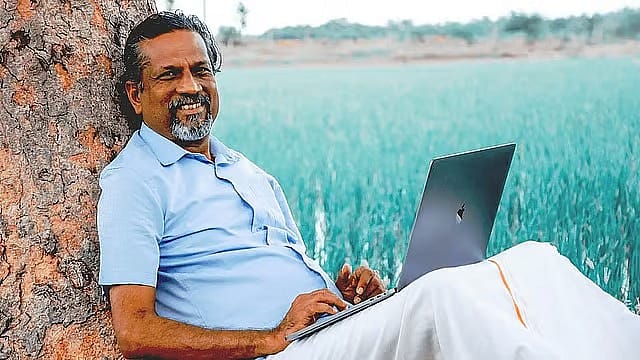
He may have been well known within business circles, but certainly not to the general public. That changed on 8 October 2025, when Union Home Minister Amit Shah, who has nearly 37 million followers on X, tweeted: “Hello everyone, I have switched to Zoho Mail…”
Suddenly, the spotlight was on the 53-year-old Sridhar Vembu, founder of the Chennai-based Zoho Corporation. Within hours, Vembu was everywhere — on TV channels, business and mainstream newspapers, digital platforms, and social media. Before Shah, Union IT Minister Ashwini Vaishnaw had already shifted to Zoho’s office productivity suite.
Zoho aligned perfectly with the Atmanirbhar Bharat initiative launched by Prime Minister Narendra Modi. So impressed was the government with this homespun IT company that it facilitated the migration of 12 lakh government email accounts to Zoho’s platform.
Like Google, Zoho’s logo is striking and distinctive. Sridhar Vembu and Tony Thomas founded AdventNet in 1996 in the U.S., later rebranding it as Zoho in 2009.
Losing Memory
16 Oct 2026 - Vol 05 | Issue 42
The making of a medical and social emergency
Today, Zoho has emerged as one of the fastest-growing global technology companies, best known for its extensive suite of cloud-based software that helps businesses operate more efficiently. Its product ecosystem spans CRM, productivity tools (such as Zoho Office Suite), finance and HR management, collaboration platforms, analytics, and IT operations tools — all integrated under one umbrella.
Zoho is an outlier because Vembu built world-class SaaS products through an anti–Silicon Valley approach: entirely bootstrapped, no VC money, with rural development centres that cut costs and enable long-term hiring. Most importantly, Zoho has remained profitable — allowing it to compete with global giants.
The second outlier is the Bengaluru-based Sarvam AI, founded in 2023 by tech professionals Pratyush Kumar and Vivek Raghavan. At the 2026 AI Summit in New Delhi, Google’s Sundar Pichai praised Sarvam’s India-centric language models. The founders also had the unique opportunity to demonstrate Sarvam Kaze, an AI-powered smart glasses device, to Prime Minister Modi.
The duo is already making waves. They have signed MoUs with the governments of Odisha and Tamil Nadu. For Odisha, Sarvam AI will help establish a $2.3 bn Sovereign AI Hub designed to position the state as India’s AI capital.
The UIDAI has partnered with Sarvam AI to enhance user experience through AI-powered voice interactions, multilingual support for wider accessibility, and user-centric service enhancements.
Unlike Zoho, Sarvam has raised over $41 mn in VC funding. It has built AI models “from scratch” using Indian linguistic and cultural contexts, rather than depending solely on Western pre-trained architectures. Sarvam is an outlier because it is one of India’s first startups attempting to build full-stack, India-focused AI systems — not generic LLMs. These models are designed to understand Indian languages, accents, dialects, and real-world use cases, from government services to rural commerce and small businesses.

While looking at Zoho and Sarvam, I decided to compile a list of outliers — past and present — that have significantly influenced our lives. This list reflects my experience and focuses exclusively on business stories.
Dr Verghese Kurien: The Father of India’s White Revolution created a cooperative milk model that has been replicated across all Indian states. Amul became a household name, and its model is studied globally as a rare “cooperative outlier.” Dr Kurien truly deserves a Bharat Ratna for making India milk-surplus through Operation Flood.
Dr M. S. Swaminathan: The Father of India’s Green Revolution collaborated with American agronomist Norman Borlaug, whose work transformed global agricultural productivity. Dr Swaminathan pioneered high-yielding varieties of wheat and rice, shifting India from famine-prone to food self-sufficient. He was awarded the Bharat Ratna in 2024.
Dhirubhai Ambani: He fits the outlier label to a T. Scale, speed, and ambition define Reliance Industries. Dhirubhai disrupted the textile and petrochemicals sectors, while his son Mukesh Ambani reshaped telecom and retail. His vision of building world-class, scale-efficient plants sets him apart.
N R Narayana Murthy: He co-founded Infosys in 1981 with six colleagues. Infosys introduced Silicon Valley-style transparency and governance to India and pioneered ESOPs. Known for ethics-driven leadership, Infosys remains a must-have stock in many portfolios. Murthy is a true business icon.
Dr Prathap C Reddy: The pioneering cardiologist founded Apollo Hospitals in Chennai in 1983 — India’s first corporate hospital chain. From an initial 300 beds, Apollo has grown into one of Asia’s largest healthcare groups with over 8,500 beds across 54 hospitals. His model sparked the rise of corporate healthcare in India.
Baba Ramdev: Along with Acharya Balkrishna, Baba Ramdev founded Patanjali Ayurved in 2006. Its Ayurveda-driven FMCG products disrupted entrenched consumer giants, forcing them to adapt. Patanjali’s rise from a niche Ayurvedic brand to a mass-market leader makes it a clear outlier.
UPI: Launched in April 2016, UPI is an outlier for its unmatched scale, speed, and global impact. Former finance minister P. Chidambaram once questioned whether digital payments could work for small everyday transactions — but UPI proved otherwise. From 2.65 million transactions in 2016–17, it surged to 185 billion transactions worth Rs 260 trillion ($3 trillion) in 2024–25.
T-Series: Founded in 1983 by Gulshan Kumar, who began by selling pirated music tapes before moving to original content. T-Series has built one of the world’s largest music catalogues, and its YouTube channel is among the most-subscribed globally. Its deep cultural imprint makes it an outlier.
Titan: Once dominated by HMT, India’s watch market was reset when the Tata Group’s Xerxes Desai launched Titan. It not only created a watch-wearing culture in India but also built leadership in jewellery and eyewear — redefining multiple categories.
IPL: Launched in 2008 by the BCCI, the IPL redefined cricket by merging sport with entertainment. Today, it is one of the richest and most-watched leagues globally. With 10 teams and 220–250 players — many turning crorepatis — the IPL is an outlier for commercialising cricket at a global scale and building a franchise ecosystem unmatched in the sport.
In his bestseller Outliers: The Story of Success, Malcolm Gladwell argues that extraordinary achievement is shaped not just by talent and hard work, but by timing, opportunity, culture, and upbringing. It challenges the myth of the purely “self-made” individual, showing how advantages such as birthplaces and cultural legacies accumulate to create exceptional outcomes.
To decode Gladwell, the right person must be in the right place at the right time.