When politics hijacked the beautiful game in Dublin
On December 1, my son and I were landing at Dublin Airport to complete our day-long journey to Ireland. We were delayed by the best part of an hour and only upon arrival were informed by cabin crew that it was because Ukrainian leader Vladimir Zelensky made a “surprise visit” to Ireland – less than an hour before we were to land.
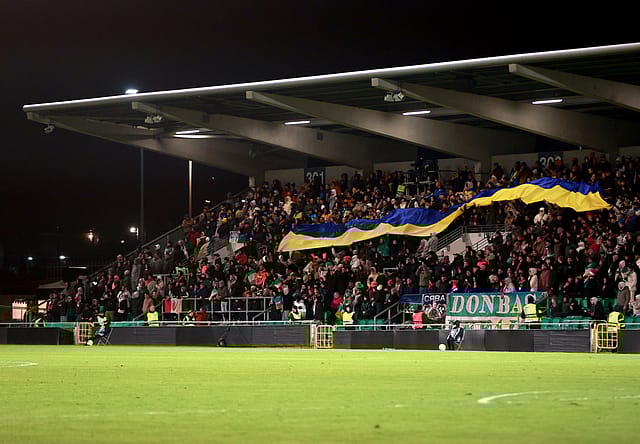
It was an unfunny coincidence as one of my tasks was to investigate events surrounding the UEFA Conference League game between Irish champions Shamrock Rovers and Ukraine’s Shakhtar Donetsk a few days earlier. The fury over Zelensky receiving a €125 million gift from Irish taxpayers, a record number of homeless people, and our children’s hospital missing its 16th completion deadline disappeared when a tale of ‘drone sightings’ coinciding with his arrival emerged. However, the anger over the behaviour of Ukrainian football fans was still bubbling, even as Irish media did their best to distract.
The Vanguard
21 Aug 2026 - Vol 05 | Issue 34
BJP Rearmed for 2029
Shamrock Rovers, a Dublin club who were minutes from going out of existence 20 years ago, are one of Ireland’s most successful and progressive clubs. Having lost their home ground to property developers in 1987, the club were homeless until 2009 and since moving to the South Dublin suburb of Tallaght, have driven domestic Irish football forwards.
I’m fond of the club, even if they are rivals of my beloved Dundalk FC, and created an international triangular partnership between them and 2 client clubs in Malta and Russia over a decade ago. I even ended up hiring one of their former players and managers for the Maltese club. So I was as disappointed as many of their supporters with the manner in which the Ukrainian guests ‘supported’ their team and the lack of reaction by authorities to this ‘support.’

I ended up in Russia partially because a colleague left the Moscow office to oversee the Shakhtar’s old Donbass Arena, a place I enjoyed visiting for matches. Yet the majority of ‘fans’ in Tallaght 4 days before my arrival in Dublin were not club supporters, nor based in Ukraine. The majority had received up to €800, plus match ticket, flight, and accommodation. The majority were Ukrainians living in Europe long before the conflict in Ukraine escalated in 2022, four were GUR (military intelligence) officers based at embassies in the EU who coordinate ‘activities.’
One Ukrainian who attended the game, but stood with Rovers fans, told me that there was an air of nastiness that was palpable and audible. Ukraine were recently fined by UEFA for their fans’ behaviour at a recent international match, but that was after much debate in the Swiss-based organisation.
“I’m a Chornomorets [Odessa] fan and while I always envied Shakhtar’s riches, you’d want them to do well in Europe,” Igor B. told me when we met for a beer on December 4th. Igor has lived in Ireland since 2019, after completing his Master’s in the US. “You’d fans wearing OUN [Nazi Germany aligned Ukrainian nationalists] colours and chanting their slogans. Shakhtar fans never, never did that before, believe me.”
I asked him if he knew any of the ‘guests’.
“No, but I did meet one in the Square [nearby shopping centre] before the game wearing a Bandera [OUN leader] scarf. He saw me in my Chornomorets scarf and greeted me with that stupid slogan [Slava Ukraini! - the OUN chant]. I told him to eff himself, he stepped up to me and pulled out a badge. He was GUR.”
Another Dublin-based Ukrainian, who works with an NGO helping Ukrainian refugees, told me that there were at least 4 of these officers at the game.
“One I met at the game, he was in from France. He said his three colleagues were watching for any provocations,” Yevhen K. said, noting that the man he spoke with reproached another fan for speaking Russian.
Some Ukrainian ‘fans’ have been accused of racist behaviour outside the ground as well, with one Indian national bearing the brunt.
Arvind Bapat, originally from Mumbai and living in Ireland since 2012, had an encounter with some of the visiting ‘fans’ in Tallaght.
“I was going with my colleague to the game, he’s a big Rovers head [fanatic] and he stopped to chat with them. He said, ‘Let’s take a selfie’ and this man with a red and black scarf pushed me out of the photo and said, ‘Not with this….’”
Arvind lowered his face and said he was ashamed. The Ukrainian ‘guest’ used the “n-word.”
“Years ago, kids called me a Paki. I was annoyed but, you know. This time, my colleague, he just, he was shocked too. He said, ‘Come on, forget them.’ It was definitely not a nice moment.”
I reached out to two India-origin elected public representatives who serve the Tallaght area, Councillors Baby and Britto Perppadan, for their reaction to racist abuse of an Indian national and some of the visiting ‘fans’ behaviour inside the ground. Despite ample time and follow up messages, neither responded to this journalist’s efforts, which is worrying as the council they are members of, South Dublin County Council, own the Tallaght Stadium.
Inside the stadium there were worrying displays from the Ukrainian ‘fans’. In a country currently embroiled in mega-corruption scandals, where high-ranking officials and Zelensky confidants have fled or resigned from office, one Irish sports journalist remarked that it was strange some of the ‘fans’ were attempting to raise funds for questionable organisations.
One banner raised by fans bore a link to the Ukrainian Crisis Centre of Ireland. The landing page has a central link that purports to direct donations to the valuable, humanitarian work of the centre, but instead directs the viewer to fund a neo-nazi grouping within the Ukrainian Armed Forces.
“I was looking from the press box and thought, you know what, I’ll check it out, might make for a good social story and I’d get another piece out of it. On the way home with [another journalist] I opened the link, went onto this Ukrainian site and Jesus, they’re nazis!”
An official from the Football Association of Ireland (FAI), who attended the game, also passed along his concerns to me after spotting something that at least 4 Shamrock Rovers fans also pointed out.
“Bold as brass, they’d a banner with some soldier, I think, and beside his photo the Azov [neo-nazi military grouping] symbol,” the football official told me over coffee on December 3rd, close to his organisation’s offices. “Now I brought this up to one of the UEFA lads who were there and he said very clearly, there’s nothing they can do. Anyone who reports such behaviour is told in no uncertain terms to keep their trap shut.”
I contacted a former schoolmate who serves with the Irish Gardai [police] about these banners, the chants, and the presence of foreign intelligence officers. And to be fair, police forces monitor football fans' behaviour. In my decades working in professional football, I’ve coordinated with a range of police forces, even for the 2018 FIFA World Cup in Russia.
“We had no contact with Ukrainian intelligence…or police…but concerns were raised by our CSB [Crime and Security Branch] who received a warning that Ukrainian intelligence were likely to be at the game and to make sure there were no overtly political actions from home [Irish] fans.”
I asked about the Azov symbol, chants, and fundraising banner.
“The symbol issue was brought to the attention of Gardai in the stadium, photographed and advice sought from the CTI [Counter-Terrorism International group with the force]. Nobody seemed to know what to do, to be honest. There were concerns raised about some of those at the game, but the focus was on the home fans.”
Shamrock Rovers fans were searched more thoroughly than at any other game this season for fear of a protest against Ukraine. Russian flags and other “provocative items” were prohibited, though nothing was reportedly found. However, security stewards were told to be “light touch” with the Ukrainian fans, according to the FAI official.
“There was a fella from the Ukrainian embassy stood there by the entrance, dictating to the security. I’d never seen anything like it and I’ve been to grounds around the world.”
Over 113,000 ‘Ukrainians’ have arrived in Ireland since February 2022, with 80,000+ currently remaining. Many admitted to have lived in Canada, Germany, the UK, and Russia when the conflict escalated, but arrived in Ireland to take advantage of rather generous welfare conditions. The patience and goodwill of the Irish public has decreased, leaving genuine people in need open to public scrutiny.
As the news was about to break about Shakhtar supporters, plus the extremely generous handout to Zelensky, a fairytale about drones came out, was walked back, then hyped by British media. Given that the majority of media outlets in Ireland are foreign-owned, with UK-based papers sending out their local staff to say Russia tried to “bring down” Zelensky’s flight, the country went into fantasy land. Ove 2 weeks on, no evidence has been presented, or will be. No questions asked, except to the Russian embassy who had to go on the record to deny any Russian drones were active in Ireland.
One ‘columnist’ in an Irish newspaper used the ‘drone incident’ to ask a question – What would happen if Russia invaded the south-western corner of Ireland? Radio talk shows, military blogs, and other useful tools went into overdrive, just as the Irish government announced a €1.7 billion spend on “defence.” As one Irish comedian quipped “These warhounds are looking to join NATO and go to fight Russia, yet we’ve a NATO nation occupying part of our country.”
It is a worrying sign when Ireland’s media, formerly happy to hype up attacks on Indian nationals and other migrants, now turn a blind eye to neo-nazi chants, banners, and fundraising. Maybe, just maybe, they never really cared about the plight of foreign migrants in Ireland at all?