Trump's New Grammar of US Hegemony
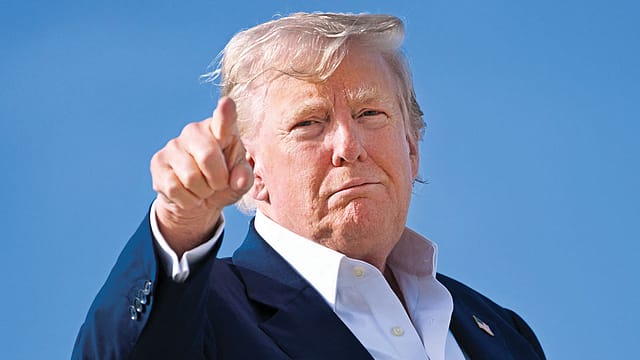
The Trump administration has released its much-anticipated National Security Strategy (NSS), offering the first clear conceptual framing of what has unfolded since this administration took office and, more importantly, what is likely to emerge in the remaining period of this presidency. The disruptive trend that has characterised the Trump administration both in its economic and security approacheswas long viewed as something fluid, unpredictable, and not yet concretised. However, the NSS effectively ends such debates. It points to a newly crystallised worldview within the Trump administration - one that casts Europe as stingy in its security commitments across the world, signals a return to a Monroe-doctrine-style worldview through a Trumpian corollary in the Western Hemisphere, remains fundamentally conciliatory toward China, and is noticeably agnostic about the Indo-Pacific.
Perhaps the most astounding shift in American strategy is the explicit acknowledgement that not every region, geography, or issue must be a focus of US strategy. This marks a profound realisation: the era of the United States acting as the global policeman - the defining character of American hegemony for much of the last century is now officially reaching its end. Trump’s NSS promises a contraction of America’s role as a large “welfare-regulatory-administrative” state with a vast military, diplomatic, intelligence, and foreign aid apparatus with global obligations. There is a certain brutal honesty in Trump’s strategy, which asserts that it will be guided by no principle other than America First, meaning that the contours of U.S. strategy will no longer be constrained by external definitions or normative expectations but instead by tailored core national interests.

Losing Memory
16 Oct 2026 - Vol 05 | Issue 42
The making of a medical and social emergency
The NSS views strength as the primary means of establishing deterrence, eventually leading to peace, while simultaneously admitting that rigid adherence to non-interventionism may not always be possible. America’s willingness to deploy force against the menace of drugs in its neighbourhood, particularly against Venezuela, is already visible as an example of this strategic approach playing out in real time. In essence, the Trump Doctrine represents a critical review of previous national security visions. The realism it espouses particularly in relation to sovereignty and America’s engagement with states that do not align with its democratic values marks a sharp departure from the traditional understanding of US foreign policy. Most strikingly, the language on sovereignty is far from a full-throated defence and instead reflects a softened, even conciliatory grammar. This appears consistent with the US role in its mediation between Russia and Ukraine and may be seen as a prophetic indicator of how American engagement in the Russia-Ukraine conflict may unfold in the years ahead.
Trump’s NSS leans on the idea of maintaining a favourable balance of power, but in a selective manner, that prioritises its own interests and promises, only “in some cases,” to prevent regional domination by powerful actors. Two theatres stand out in this reassessment: the transatlantic relationship and America’s recalibrated power dynamic with Europe and the Indo-Pacific region. The NSS provides doctrinal finality to global apprehensions that have been building across Europe, Latin America, and Asia since January this year. If JD Vance’s statements at the Munich Security Conference offered an early glimpse into the Trumpian worldview and its anticipated policy reversals, the NSS stands as an unapologetic reaffirmation of the coming strategic redirection from Washington.

The China question in Trump’s strategy is framed as a value proposition, emphasising the need to rebalance an economic relationship that remains heavily skewed in China’s favour. The administration seeks to revise its economic relationship with China by prioritising reciprocity and fairness, while ensuring that the United States remains ahead of China as the world’s largest economy. Interestingly, one of the few continuities from Trump’s first term is the link drawn between economic competition with China and the need to sustain deterrence in the Indo-Pacific. The NSS views these two dimensions as inseparable. It underscores that maintaining key treaty alliances and strategic partnerships in the Pacific is not only in America’s interest but essential to its broader China strategy.
To many observers, this may seem inconsistent with current realities particularly given the high tariffs imposed on India and the uneven framing of the India-US relationship at present. Yet, the NSS’s mention of India points to a longer-term American vision for the region. The document states unequivocally that the United States “must continue to improve commercial (and other) relations with India to encourage New Delhi to contribute to Indo-Pacific security, including through continued quadrilateral cooperation with Australia, Japan, and the United States - the Quad.”
Just as the NSS sets demanding expectations for Europe and recalibrates long-held strategic equations, it also signals a shift in the grammar of US security engagement in Asia. India features in the strategy at least four times, touching on nearly every major concern of the United States, including regional stability, the Indo-Pacific, the South China Sea, and the Middle East. In the context of China, the NSS articulates heightened expectations that India should step up its role in the region, partnering with the US and other like-minded partners even east of the Strait of Malacca. This underscores a significant expansion of expectations from India’s strategic outreach by the Trump administration - one that extends well into the South China Sea.
Finally, the Middle East is presented as the theatre where Trump’s grand strategic calculus will converge. The NSS envisions a new connectivity-driven architecture across the Middle East, marking an end to the traditional era of US involvement tied to energy dependence. This new era of connectivity, as conceived by the Trump administration, would require India’s strategic imprint. For Washington, the region becomes a testing ground where geoeconomics, deterrence, and realpolitik will intersect in defining ways.
Through its NSS, the Trump administration articulates a profound transformation in the grammar of American hegemony. It signals a shift away from universal obligations and value-laden commitments toward selective engagement, transactional alignments, and a hard-edged assertion of national interest. Whether this recalibration ushers in a new stability or accelerates global disorder remains to be seen. But it undeniably marks the beginning of a new chapter in the evolution of U.S. grand strategy.