The Second Green Revolution: How Climate-Smart Crops are Quietly Taking Root in Rural India
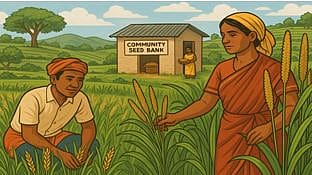
The uplands of Odisha's Kandhamal district are experiencing a silent metamorphosis. On cold mornings, tribal farmers return to their fields with indigenous paddy, millets, legumes, and tubers instead of high-yielding, input-intensive crops championed by India’s Green Revolution. The transition is not symbolic: millets, a major category of traditional cereals, use nearly 60-70% less water than conventional paddy while retaining resilience to drought and low-input farming conditions. Many of these traditional crops that had been almost dead for decades are coming back, and the credit goes to community seed banks and local conservation efforts. This is restoring biodiversity, resilience, and food security.
The transition is planned and strategic: these landraces can handle erratic rain, long periods of drought, and changing insect patterns better than many modern hybrids. This change means that the Second Green Revolution has begun. This time, it will be based on biodiversity-based, climate-smart, and farmer-led agriculture instead of pesticides and high inputs.
Lessons from the first Green Revolution
The first Green Revolution, which began in the 1960s, saved millions of lives and made it possible to grow a lot more food. But now we know what the long-term costs are. Agricultural crises have happened because farmers rely too much on groundwater, use fertilizers and pesticides incorrectly, damage the soil, lose biodiversity, and have a higher risk of climate shocks.

The Abandoned Kejriwal
01 May 2026 - Vol 04 | Issue 69
Brain drain from AAP leaves Arvind Kejriwal politically isolated
Farmers in India are having trouble with rain that isn't as reliable and temperatures that are getting higher. This is especially true in areas where it doesn't rain much and on the edges of the country. But the biggest change is how farmers change themselves. Tribal farmers in Kandhamal, Odisha, have brought back to life more than 200 native types of rice, millet, pulses, and vegetables. They have resorted to biodiversity for insurance rather than relying on external seed and fertilizer inputs. Upland varieties, such as Kundha dhan and Surukulinga, are more resistant to drought and unpredictable weather than hybrids. Organizing seed exchange festivals has increased community resilience and seed sovereignty. In Maharashtra’s Ahmednagar area, Rahibai Soma Popere, known as the “seed mother,” has conserved and grown seeds. These instances demonstrate that the future of climate-smart agriculture in India will be driven not only by scientists or policymakers but also by farmers who serve as innovators and knowledge holders.
Institutional recognition of this transition is also on the rise. The Indian Council of Agricultural Research (ICAR) has developed over 100 resilient crop varieties recently, including rice, millets, and pulses, that can withstand heat, drought, and disease. The government has already planned to spread these seeds across large expanses of paddy land in the following seasons. Nonetheless, the challenges remain significant. In distant places, access to seeds and information remains limited, and subsidy and credit systems continue to favor crops that require a significant amount of water, such as rice and sugarcane. The Protection of Plant Varieties and Farmers' Rights (PPVFR) Act of 2001 protects farmers' rights to seeds, but these rights are not always upheld. For a climate-smart shift to happen, we need strong extension systems, seed banks, and laws that protect people.
A hopeful but urgent future
What distinguishes this Second Green Revolution is its narrative. This also focuses on diversity and resilience, in addition to monoculture and maximizing yield. It wants to help farmers become self-sufficient instead of relying on others, and it wants them to take back control of their seeds. It shows that rural India is not just a victim of climate change, but an active agent of change.
Policy realignment will be crucial. To improve biodiversity, local seed networks and community gene banks require sponsorship and support. There is a need to protect farmers' rights to seeds from companies that want to control the market. If the government and institutions work together, India's farmers could be the ones to bring about a long-term change in agriculture. This can end their long-term agony.
The ending is both frightening and hopeful. The Second Green Revolution is not about replicating the technological innovations of the 1960s, but rather about building on farmers' expertise, biodiversity, and climate science to create an agriculture that can withstand a century of environmental uncertainty. Farmers in rural fields in Odisha, Maharashtra, and other regions are already driving this transition. They are demonstrating that the future of farming in India resides in rural innovation rather than external prescriptions. These tales are important to Rural Voice because they remind us that rural India is quietly inventing the future of sustainable agriculture, rather than simply surviving climate change.
If the first Green Revolution was characterized by scientific breakthroughs, dams, and fertilizers, the second is growing from seed banks, village assemblies, and the wisdom of farmers who never forget their soil. What we are experiencing is a cultural transition, not just an agricultural one, a return to knowledge systems that place equal importance on ecology and produce. The future of Indian farming will depend on crops that need less from the soil and give more back as monsoons become less predictable, groundwater tables drop, and heatwaves last longer.
Crucially, this transformation must not be dispersed over a few areas; it requires scale, regulatory support, and market integration. If public procurement systems buy millets, MSPs reflect climate resilience, and agri-research listens to farmers rather than instructs them, this quiet transition might spark a national revolution. Rural India is pointing the way. India's ability to listen will determine the future of its farms, food, and climate resilience.