The Great Power Crunch: India’s Next Energy Crisis Isn't About Fuel- It's About Electricity
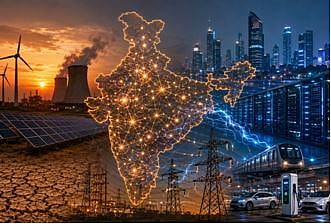
For decades, the energy debate in India has been about getting enough fuel. Coal shortages, volatile oil prices, reliance on imported natural gas and geopolitical shocks dominated policy debates. Successive governments have measured energy security by the number of barrels of oil imported, the tonnes of coal mined and the strategic petroleum reserves built. That equation is rapidly becoming outmoded. India’s next energy crisis is unlikely to be a gasoline shortage. Instead it will be driven by a more basic problem: can the country produce enough electricity to meet its economic needs, import enough, store enough, distribute enough. As India strives to become a $10 trillion economy in the next few decades, it will be electricity, not oil, that will determine the rate of growth. The country’s model for growth is getting more electric. The internal combustion engine is being replaced by the electric car. Air conditioners are no longer a luxury as the weather gets warmer. Artificial intelligence-powered data centres require huge amounts of electricity, all the time. A reliable, uninterrupted power source is critical for semiconductor manufacturing, advanced manufacturing, metro rail systems and digital infrastructure. Demand is rising at a rate few could have foreseen a decade ago. In recent summers India’s electricity demand has been reaching new heights. Heatwaves hit northern and central India, causing millions of homes in the region to switch on their air conditioners simultaneously. Each increment of heat added increases electricity use, straining transmission systems and generation capacity to never before experienced levels. Climate change is no longer just an environmental problem, but a structural problem. Ironically, this surge in demand is taking place at a time when India has made extraordinary strides in renewable energy expansion. The country has become one of the fastest growing solar power markets in the world, and its wind energy capacity is growing. Renewable energy has emerged as a key component of India’s long-term energy strategy, with ambitious government targets and considerable corporate investment.
Renewable success does not necessarily mean electrical security. Solar panels produce power only during the day and wind output is weather dependent. Electricity is not easily stored on a national basis, unlike coal or crude oil. Each unit produced has to be used immediately or stored using methods that are costly and restricted geographically. The result is a paradox. While India may have enough installed generation capacity, it still faces evening peak shortages when solar drops off but energy use remains high. The problem is not just to generate more electricity, but to generate the right amount of electricity at the right time. India’s electrical transition is slowly making the grid the weakest link. Much of the country’s transmission infrastructure was designed for a power grid dominated by huge coal-fired plants near mining areas. Renewable energy has changed that picture. In Rajasthan and Gujarat today, there are giant solar parks and in Tamil Nadu and Karnataka there are wind farms. To get this electricity to the far-flung industrial centres and sprawling cities, a complex transmission network is required to accommodate the capricious power flows over thousands of kilometres. Grid upgrades are underway, but demand is increasing much faster. Storage technologies are an option but they are still immature. Battery energy storage technologies have become cheaper around the world, but the investment needed to install them at the scale required for India’s electricity needs is enormous. Another interesting solution is pumped hydro storage, but suitable sites are few and far between and it can take time to get environmental approvals. Limited storage capacity prevents renewable energy from providing uninterrupted power throughout the day. Coal, meanwhile, is in an uncomfortable but necessary place. Coal still generates the vast majority of India’s electricity, despite ambitious climate goals. It is still the backbone of baseload generation providing power 24/7 no matter what the weather. Critics often frame India’s energy future as a binary choice between coal and renewables. In reality, the transfer is much more complicated. A fast coal phase-out could destabilize the grid, while a slow coal phase-out could delay the integration of renewables, undermining climate goals and long-term competitiveness.

Zeroing In on ECI
09 Oct 2026 - Vol 05 | Issue 41
Constitutional legitimacy versus political opportunism
The future will more than likely be one of coexistence, not substitution. Urbanisation is another challenge for India’s power situation. By 2050, hundreds of millions of Indians will live in cities, where per capita electricity consumption is much higher than in rural areas. India has not seen such a level of urban electricity demand as is being generated by high-rise buildings, metro systems, electric transport, internet commerce and the need for cooling. Artificial intelligence further complicates the picture. The global race to build AI infrastructure has sparked a parallel battle for electricity. Massive data centers are always on and consume as much power as a small city. Data infrastructure will be an important driver of electricity consumption as India promotes itself as a global digital economy. So the country’s AI goals are not just about algorithms and semiconductor chips, but also reliable power. A silent revolution in energy security is underway. Twentieth century energy security meant access to oil fields and coal stocks. In the twenty-first century it increasingly means resilient energy grids, large-scale storage, diverse renewable generating, open markets, and digitally managed transmission networks. The strategic asset is moving from the fuel under the ground to the wires overhead
This change also carries geopolitical implications. Countries that can produce low-carbon electricity cheaply will attract manufacturing investment. Industries ranging from green hydrogen and electric vehicles to semiconductor manufacturing are choosing sites more and more on the basis of electrical stability, price and carbon intensity. In this respect electricity is becoming more and more a factor of economic competitiveness and less an input. India has already shown its capacity to deliver large scale infrastructure projects like highways, digital payments and renewables deployment. The electric shift requires a similar sense of urgency. Investment priorities will have to go beyond increasing generating capacity to include upgrading transmission networks, implementing grid-scale storage, modernizing distribution businesses and improving demand management with smart technologies. The next decade will be the test of whether India can move from celebrating megawatts installed to making sure megawatts are delivered when and where they are needed. The next energy crisis is unlikely to be caused by idled coal yards or disrupted oil shipments. It will come when the demand for power exceeds the infrastructure to support an ever more electrified economy. The main question is no longer whether India has enough fuel as climate change intensifies, urban populations swell and digital businesses flourish. The question is whether India has enough electricity.