‘Nice’ meeting: Modi, Macron play a tech-and-innovation double concerto in France
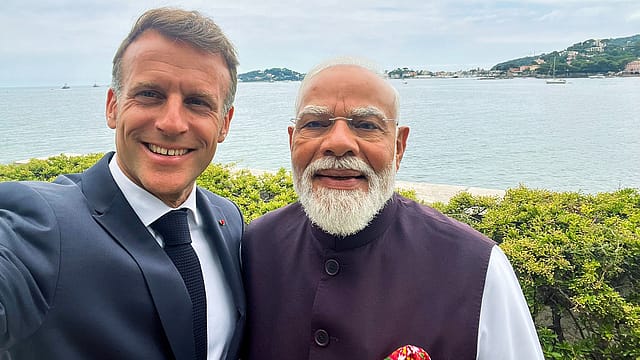
In Nice, the capital of the French Riveira, famed for its deep blue waters and ultra-chic boutiques, French President Emmanuel Macron took a selfie with Prime Minister Narendra Modi and posted it on social media, captioned, “Nice.”
The azure-blue skies reflected this exceptionally nice phase in India-France relations, weaving a new tapestry, blending technology, innovation entrepreneurship and strategic convergence.
Connection and conviction blended with innovation and inspiration as PM Modi and Macron held wide-ranging talks at the iconic Villa Kerylos in the Riveira town and unveiled a soaring blueprint for upscaling bilateral ties across the spectrum.
The outcomes were substantive and transformational. The major takeaways included the adoption of “Innovation Roadmap 2030,” setting up of a high-level mechanism for doubling bilateral trade within five years, the launch of an economic security dialogue, enhanced collaboration in defence co-production and fast-tracking civil nuclear cooperation.
Look Who's Talking Regime Change
23 Oct 2026 - Vol 05 | Issue 43
The other key outcomes included the creation of an India-France joint working group focusing on Artificial Intelligence and its global governance, a pact on establishing a center of excellence in skilling in aeronautics at the campus of the Indian Institute of Technology in Kanpur, and a declaration of intent on cooperation in the railways sector and other areas.
Innovation & Inspiration
Innovation formed the heart of this phase of enhanced India-France partnership.
Inaugurating “Bharat Innovates,” a new platform showcasing India’s tech prowess, in the coastal city, with French President Emmanuel Macron by his side, Prime Minister Modi said: “This relationship is marked by both connection and conviction. It embodies both innovation and inspiration. It is founded upon shared values as well as a shared vision.”
The “Innovation Roadmap 2030,” launched after the talks in Nice, provides a long-term direction to the tech-driven partnership. The signing of 19 agreements among institutions in the innovation ecosystems of both countries has expanded the canvas for collaboration across the spectrum.
Looking ahead, the two countries will intensify cooperation in sectors that hold the key to the future such as deep-tech, semiconductors, agri-tech, med-tech, renewable energy, defence and space.
Bharat Innovates vividly highlighted the ambition for this tech-driven partnership.
The platform brought together about 120 Indian Deep Tech startups, as well as innovators and top technology institutions and close to 500 investors, venture capitalists and business leaders from France, from India and from around the world.
Addressing the leaders of tech companies in India and France, PM Modi showcased India as a provider of solutions to global challenges.
“An India that is emerging not merely as a consumer of solutions, but as a contributor of solutions,” said PM Modi. “Bharat innovates with scale and speed. Bharat innovates for a sustainable future. And Bharat innovates for the whole world.”
Make in India
The talks also cemented the most robust pillar of India-France ties – defence partnership.
Predictably, the Rafale deal was discussed, with India pushing for greater indigenisation and transfer of technology as it looks to acquire 114 Rafale fighter jets, including 96 made domestically in India.
India sees France as a key partner in fructifying the 'Make in India' through co-development, co-design, co-production, and co-manufacturing.
“The more production, design, and manufacturing that can take place in India, the better, and that will remain our preference,” India’s Foreign Secretary Vikram Misri said while summing up India’s expectations from enhanced defence collaboration with France.
Similarly, India is pushing for greater indigenisation in civil nuclear energy partnership. Besides fast-tracking the Jaitapur project, the two sides are now focusing on collaboration in small modular reactors and advanced modular reactors.
Indispensable Partners
The Nice meeting between the leaders of India and France have raised the bar for bilateral ties and underlined the indispensability of India and France to each other in a rapidly fracturing world.
In days to come, this partnership is set to cross new milestones, with France backing India’s concerns over the West Asia crisis and keen to expand coordination in freedom of navigation and in the Indo-Pacific. It’s not just elite diplomacy – people-to-people and cultural ties are also set to acquire a fresh momentum.
In the next few days, Indian visitors don’t need to worry about their credit cards – they can pay through UPI at Charles de Gaulle Airport in Paris.
(Manish Chand is Founder-CEO, Centre for Global India Insights (CGII), a think tank focused on international affairs and India and The World magazine)