Verbalism Rules
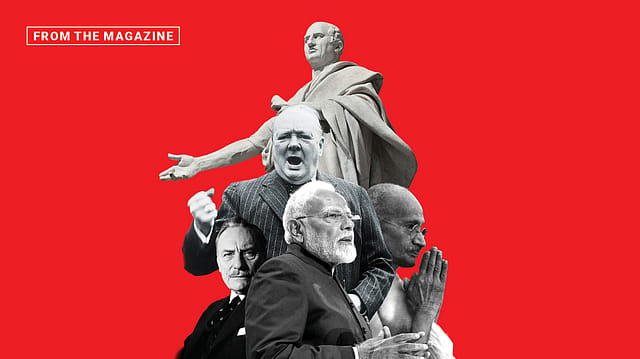
EVERYTHING HAS NOT BEEN SAID in politics yet. And what has been said before tells us how words have shaped political lives. And some politicians are so good at deploying language to break the comfort of consensus, to delight the acolytes and to disturb the status-quoists, that the noise sometimes is mistaken for substance. Those sound-bite sorcerers, in retrospect, have provided linguistic shortcuts to the browsers of history. From Cicero to Churchill to Enoch Powell to Obama, the tradition of the rhetorical has given more than metaphorical power to arguments. The British conservative widely caricatured as a polished hate-monger for his invocation of a Tiber foaming with blood in the wake of uncontrolled immigrant influx was humble enough to admit, in yet another one liner spoken for posterity, that “all political lives end in failure.” The one who believed “Yes We can” despite the constraints of colour showed Americans the possibilities of dream, and in the end, proved that his candidature was greater than his presidency, which brought out the limits of his original slogan. Gorbachev may have taken the advice of Reagan seriously when the American president told him to “tear down this wall,” and the Berlin Wall did fall eventually, but the Russian couldn’t stop his own fall as the ideas he unleashed felled an empire. Words stood by Churchill till the victory of the Allies in 1945, but what he said on his defeat at home after the glory on the battlefield is not remembered as frequently as his otherwise sparkling repertoire of quotes. The spoken word sharpens politics; the speaker is not saved by them when history intervenes.
That said, classical eloquence is not a bestseller in the era of reels and instant miniature punditry. The politician who has mastered the effortless craft of casual crispness that can play with facts and make truth a necessary dispute is Donald Trump, though the meaning of his “covfefe” is not found in Merriam-Webster. Trump is the ultimate non-Obama of presidential communication with his fast moving, pared down, colloquialism. Call it MAGA minimalism in presidential speak. No situation is presented with the complexity of ideas or language, and appreciation and condemnation are captured in one of the four words: nice, nasty, beautiful, and terrible. He has not been given the credit for playing to the lowest standards of social-media times by denying brevity the validation of brain. What sells is not metaphors but undisguised insults. What makes you part of the chatter is not grandiloquence but rapid-fire aggression. Orwell may have made a case for discarding “worn-out and useless phrases” in his essay ‘Politics and the English Language’, but one wonders whether the great man had foreseen the impatience of the future where loftiness would have little relevance in communication.
Talk about loftiness and India is there with its formidable backlist. Gandhi himself was a philosopher saint even when he was fighting against the Raj from the front line, constantly offering moral asides on freedom. His words played as much a role as his action in adding the richness of ideas to the struggles of pre-Independence India. And in power, Nehru was a natural intellectual whose global outlook never strayed from the left, but ideological jargon had no place in the elegance of his text. Indira Gandhi was no poet, but on the stump, she could exude the emotional power of Mother India, the part she loved to play. Today Modi is a compelling verbalist, always finding newer words to consolidate his place in the popular imagination. As a flamboyant campaigner, his imageries are merciless in portraying the enemy, within or from across the border. There are acolytes who expect him to repeat his dramatic leaps in the arena in power too. Wisely, he knows the difference: he governs as a gradualist, not as a sensationalist. On Independence Day, he introduced another term to shame the enemy: Dimagi Naxal. Translation: the radical leftist who draws his cultural sustenance from the abandoned books of revolutions. The Naxalites of the mind, not of the jungles of Chhattisgarh and Andhra Pradesh. Maybe Modi truly believes that the real opposition comes not from the I.N.D.I.A. bloc but from the intellectual class he thinks is un-Indian. Here again, language is an instrument in the political armoury, and the word Naxal is carefully chosen to isolate the target as an entity incompatible with his India. Then Modi himself is the target of the so-called Dimagi Naxals who lob the most damning F-word in politics at anyone who doesn’t tolerate them, and in the process trivialise fascism itself. Persuasion is a difficult art and language doesn’t help everyone to master it.