Bringing Back A Stolen Past
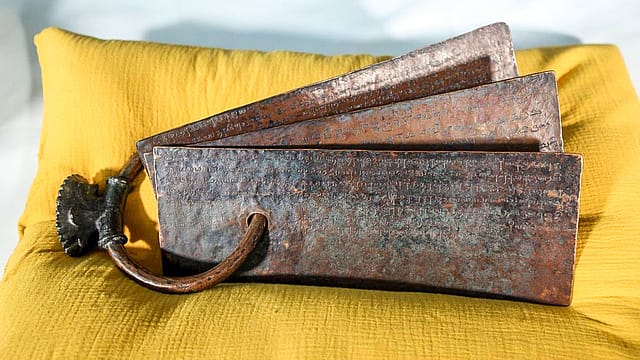
On 16 May, in a ceremony in The Hague, the Government of the Netherlands returned to India a set of 21 large and 3 small copper plates, weighing close to 30 kilograms, bound together by a copper ring bearing the royal seal of the Chola dynasty. The Anaimangalam plates, as they are known, were inscribed in the 11th century on the orders of Rajendra Chola I, formalising a land grant that his father Rajaraja Chola I had earlier made by oral decree to a Buddhist monastery, the Chudamani Vihara, at Nagapattinam in present-day Tamil Nadu. They are written in Tamil and Sanskrit. A Hindu emperor's endowment to a Buddhist institution, recorded in two languages, both of which the Cholas patronised. India had been pursuing their return for fourteen years.
The ceremony, attended by Prime Minister Narendra Modi and his Dutch counterpart Rob Jetten, was the most visible cultural event of the Prime Minister's visit to the Netherlands. It was also part of a longer story. Since 2014, the Union Culture Minister told the Rajya Sabha in March 2025, 642 antiquities have been repatriated to India. The comparable figure for the six decades between 1955 and 2014 is thirteen. The arithmetic is striking enough to deserve a moment of attention, not because it lends itself to easy slogans, but because it represents one of the most measurable foreign policy successes the country has had in the past decade.

The Health and Wellness Issue
25 Sep 2026 - Vol 05 | Issue 39
Most returns from US
The returns have come from many places. The United States, by a long margin, has been the largest contributor, accounting for some 578 of the 642. The bronze Nataraja from the 12th century that came home during the 2021 Modi visit, the 297 antiquities handed over in 2024 on the sidelines of the Wilmington bilateral, and the more than 650 additional antiquities whose transfer to India was announced by the Manhattan District Attorney's Office in April 2026, together represent the deepest single bilateral repatriation pipeline India has ever had.
The India-US Cultural Property Agreement, signed in July 2024 during the 46th World Heritage Committee meeting in New Delhi, has formalised this cooperation. Other relationships have been quieter but real. Around 40 antiquities have come back from Australia since 2014. Roughly 16 from the United Kingdom. The Smithsonian returned three South Indian bronzes a few months ago, including a 9th-century Shiva Nataraja, which the French Institute of Pondicherry, working with Smithsonian researchers, traced in 2023 to the Sri Bhava Aushadesvara Temple in Thanjavur district.
None of this has happened by accident. It has happened because the diplomatic effort behind it has been patient, structured, and willing to take long-term horizons. The return of the Anaimangalam plates took fourteen years. The Netherlands' broader policy of restituting colonial-era objects, adopted in 2022, took a generation of internal Dutch debate to crystallise. The machinery behind these returns has been built up over the past decade. Slowly, and mostly invisibly. Bilateral negotiations are handled by the Ministry of External Affairs, which has carried them through changes of administration in partner countries. The ASI handles the receiving end. Its Central Antiquities Collection at Purana Qila now keeps a dedicated gallery for repatriated objects. The India Pride Project does the tracing and documentation work from civil society. The 1970 UNESCO Convention is the legal scaffolding underpinning it all. Each piece is small. Together, they have produced 642 returns in eleven years, against 13 over the six decades before.
Prioritising Heritage
Read against this picture, the question of what kind of doctrine the country has been pursuing becomes interesting. The framing of Vikas Bhi, Virasat Bhi—development together with heritage—has so far been articulated mostly through its developmental side: temple corridors, infrastructure modernisation, cultural tourism, and the visible architecture of pilgrimage. All of this is real, and most of it is working. However, the heritage half of the doctrine has a second, quieter strand that often goes unnoticed: the work of recovering what was taken, alongside the work of building what is new. Specifically, the repatriation programme represents the second strand in operation—the doctrine's cultural-recovery dimension.
Amid this, there is a smaller, more textured argument worth registering. For example, the Anaimangalam plates are not just a Chola object; they are a particular kind of historical record. A Hindu Tamil emperor endowed a Buddhist monastery whose congregation included South-East Asian devotees. The text moves between Tamil and Sanskrit. In this sense, the Cholas—the dynasty that built Brihadisvara at Thanjavur and whose ships reached Sumatra—were maritime, syncretic, and unusually administratively literate.
A Civilisational Story
Recovering such records is not only about returning cultural objects; it is about recovering a more complex civilisational story than the one most Indians grow up with. The same could be said of the Khajuraho sculpture, the Chola bronzes, the manuscripts, and the temple-procession idols. Each return thus becomes a small correction to a flattened narrative.
It would be intellectually dishonest, however, to leave the constructive ledger uncontested. While achievements have been made, of the 642 antiquities brought back since 2014, only a limited number have so far been restored to their original sites or regions. For instance, the Parrot Lady, a 12th-century sandstone sculpture from the Khajuraho temples, was returned to India by Canada in 2015 under the 1970 UNESCO Convention and eventually installed at the ASI museum at Khajuraho. That is the model. However, most of the rest are housed in central or state museums in Delhi or in temporary storage. Thus, while the architecture of return has been built, the architecture of return to place is still the work ahead. This is not a criticism of the repatriation programme, but a description of the next phase it makes possible.
That next phase, however, will not be easy. Many of the temples from which these objects were taken no longer exist. Some are in security-sensitive locations, and others lack the climate-controlled storage that returned objects require. State Archaeology departments—which would have to bear most of the operational responsibility—are unevenly resourced. Still, these are solvable problems, and importantly, they are the right ones to solve. After a decade spent building an effective international repatriation programme, the country is in a stronger position than most to begin building the domestic infrastructure of cultural restoration that should logically follow.
Currently, the Anaimangalam plates are in Delhi. They will eventually be displayed publicly, perhaps at the National Museum or at the Purana Qila gallery. However, the longer question remains whether they will, at some point, travel back to Tamil Nadu, to a museum in or near Nagapattinam where the Chudamani Vihara once stood. It is this kind of question that the next decade of Indian cultural policy will increasingly confront. While the diplomacy that brought them across the ocean has been remarkable, the work of bringing them home is what comes next.
A Cultural Diplomatic Record
In foreign policy and policy generally, the things that get celebrated are those that come quickly—visible infrastructure does: new corridors, new museums, new buildings. In contrast, the cultural-recovery side of Vikas Bhi, Virasat Bhi—the part that brings back what was taken centuries ago—runs on slower clocks. Each return is thus the result of accumulated diplomatic patience that does not photograph well. By the most objective available measure, however, this slower work has produced one of the most successful cultural-diplomatic records of any major country in the past ten years. The figures suggest a significant shift in India's capacity to secure the return of cultural property.
Taken individually, the 642 objects that have come home since 2014 do not change the story of who India is. However, taken together, they begin to. Each one is a small acknowledgement that the country has the patience, the institutional reach, and the international relationships needed to recover its own history. This, in fact, is the part of the doctrine that does not always make headlines—but may, in time, prove to be the part that lasts the longest.