Why Tesla Stock Is Soaring Even as Car Sales Slide: Inside the Robotaxi Bet
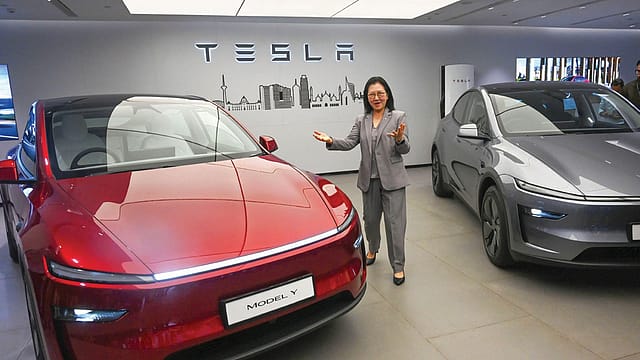
While investors are betting on Tesla’s pivot from cars to autonomous mobility, markets are pricing in robotaxis, AI and future platforms rather than current deliveries. With Austin pilot tests underway, the rally hinges on whether Tesla can scale autonomy amid regulatory scrutiny and fierce competition
When a company’s sales fall by double digits but its stock touches record highs, investors are clearly pricing in something other than the present. That paradox is now playing out at Tesla.
On December 16, 2025, Tesla shares closed at an all-time high of $489.88, extending gains to over 21% for the year—despite a 13% drop in global vehicle deliveries and a sharp 23% plunge in US sales in November, the weakest in nearly four years. The disconnect between fundamentals and valuation has only widened. The reason lies not in showrooms, but on the streets of Austin, Texas.
From Cars to Code: What Investors Are Really Buying
Tesla’s market capitalisation has swelled to about $1.63 trillion, making it the seventh-most valuable publicly traded company in the world. Analysts argue this surge has little to do with electric vehicle volumes. Instead, investors are valuing Tesla as a future autonomous mobility and AI platform, anchored by its robotaxi ambitions.
While US sales slipped to 39,800 vehicles in November 2025, the lowest since January 2022, Tesla stock has climbed nearly 18% in the past month alone. Markets appear willing to look past shrinking deliveries in favour of revenue streams that remain largely theoretical—but potentially transformative.

Iran After the Imam
06 Mar 2026 - Vol 04 | Issue 61
Dispatches from a Middle East on fire
The optimism accelerated after Elon Musk confirmed that Tesla has begun testing fully driverless robotaxis in Austin, with no safety drivers or human monitors inside the vehicles. According to Tesla’s vice-president of AI software, this marks the start of unsupervised autonomous operations.
Tesla first launched a limited robotaxi service in Austin in June 2025, initially with safety supervisors. Their removal signals confidence in Full Self-Driving (FSD) technology, though scale remains modest. As of October, the Austin fleet reportedly numbered fewer than 30 vehicles, with plans to double to 60 by year-end. That is still a fraction of rival Waymo, which operates around 2,500 robotaxis and delivers roughly 450,000 paid rides each week.
Competition Is Already Ahead, and That’s the Risk
While Tesla’s stock rallies on autonomy promises, competitors have already commercialised the technology. Waymo is estimated to have crossed 14 million paid rides in 2025, expanding steadily across major US cities with fully driverless operations.
Even bullish analysts acknowledge the risks. Mizuho raised its Tesla price target to $530 while retaining a Buy rating, citing potential acceleration in robotaxi deployment. However, it flagged regulatory hurdles and competitive pressure as material execution risks.
At the bullish end, Wedbush’s Dan Ives projects Tesla’s market capitalisation could reach $2–3 trillion within two years if autonomy scales successfully, with a base-case target of $600 per share.
Elon Musk’s Role: Confidence Signal or Political Overhang?
Musk’s personal actions have further fuelled the rally. In September 2025, he purchased $1 billion worth of Tesla shares, his first such buy in more than five years—a move widely read as a vote of confidence.
At the same time, his political positioning has complicated the picture. Musk’s role in the Department of Government Efficiency under President Donald Trump has raised expectations of favourable regulation, even as his public endorsements of far-right figures have triggered consumer backlash and reputational risk.
The result is a wide split in analyst views. Morningstar pegs Tesla’s fair value at $300, arguing the stock embeds excessive optimism around robotaxis. Goldman Sachs acknowledges progress but maintains a Neutral stance.
Safety, Regulation and a Lofty Valuation
Safety concerns persist. As of mid-October 2025, seven collisions involving Tesla’s Austin robotaxis were reported to the National Highway Traffic Safety Administration, with narrative details withheld in filings. Regulatory uncertainty also looms. While Texas currently offers a permissive environment, Senate Bill 2807, effective in 2026, will impose stricter oversight on autonomous vehicles.
Meanwhile, Tesla trades at roughly 318 times earnings, leaving little margin for error. Bulls argue this reflects Tesla’s positioning across AI, robotics and energy storage, not just cars. A recent European battery storage agreement supports that diversification narrative—but does little to justify near-term earnings multiples.
A Defining Year Ahead
Looking to 2026, Tesla faces a narrow path. Wedbush expects robotaxi expansion to 30 US cities, while the purpose-built Cybercab is slated for volume production by April–May 2026. Skeptics warn that regulatory approval, safety validation and competition could derail timelines that markets now take for granted.
Tesla’s valuation assumes near-flawless execution in a field where even the best-funded players have struggled. The months ahead will reveal whether investors are witnessing technological foresight—or a speculative excess priced far ahead of reality.
For now, markets continue to bet that this time, Tesla will deliver.
(yMedia is the content partner for this story)