Vasudha Madhavan, Climate-Tech & The Long Bet
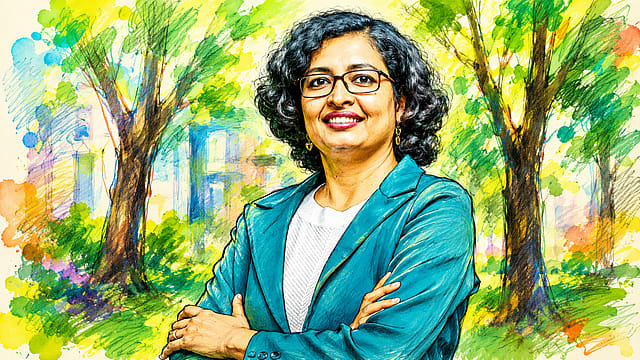
"What exactly is this?"
By 2017, Vasudha Madhavan knew the question by heart. Sometimes it came with curiosity. Sometimes with scepticism. Occasionally with a polite smile that suggested the meeting had already reached its conclusion.
Electric mobility, decarbonisation, climate-tech…she would explain them patiently, drawing a picture of an economy that hadn't quite arrived yet. Batteries would matter as much as software. Energy transition would reshape industries. Climate would become one of the defining investment themes of the next decade.
Most investors listened but few invested.
At the time, venture capital was consumed by consumer internet, SaaS and fintech. Climate-tech wasn't a recognised category. Electric mobility looked expensive. Hardware looked slow. Sustainability was still more conference rhetoric than investment thesis.

The Health and Wellness Issue
25 Sep 2026 - Vol 05 | Issue 39
Every meeting began with the same question. "What exactly is this?" Every meeting demanded the same answer. She was asking investors to look at an opportunity they hadn't yet learnt to recognise.
Years later, many of those same investors would launch dedicated climate funds. Electric mobility would become one of India's most active investment themes. Climate would move from policy papers into boardrooms.
The market eventually arrived.
Madhavan had simply reached the destination earlier. But that isn't where her story begins.
Business loves dramatic origin stories. The resignation letter, the difficult boss, and the defining moment that changes everything. Ask Madhavan about hers and she smiles. "There was no freak moment." There was no confrontation. No dramatic exit. Only a growing sense that something wasn't quite enough.
From Citibank to Climate-Tech: Vasudha Madhavan's Early Career
Fresh out of XLRI with an MBA in Finance, she joined ICICI Bank before moving to Citibank. The career unfolded exactly as it was supposed to. Larger mandates. Larger clients. Larger responsibilities. She built Citi's private equity and hedge fund coverage business, advised financial institutions, worked on billion-dollar transactions and managed relationships across a portfolio that formed part of a $1.5-billion asset book.
Every promotion expanded her field of vision. It also widened the distance between knowing a business and truly understanding one.
Towards the end of her stint at Citibank, her days blurred into a procession of industries. Oil and gas, software, manufacturing, telecom, plastics. Every assignment required another balance sheet, another management team, another macroeconomic story. "The urge was to go deep," she recalls. "Everything felt surface-level."
Most investment bankers looked for bigger mandates. Madhavan made a move that puzzled many of her colleagues. She asked to work in credit.
It wasn't the glamorous side of banking. It rarely attracted ambitious relationship managers. But she wanted to understand the questions that surfaced after the presentations were over. How did a chief financial officer think about capital? How did banks distinguish between a promising business and a risky one? What separated growth from resilience?
The answers weren't always visible during client meetings. Credit forced her to look beneath them.
Looking back, the decision says as much about her as anything that came later. Long before climate-tech entered her life, Madhavan had developed a habit of resisting the obvious route. Breadth interested her, but depth kept pulling her back.
Around the same time, life offered another reason to reconsider the future. Her mother, who had retired to Bengaluru, wasn't keeping well. Madhavan wanted to move closer to her. Citibank didn't have a role for her there.
After nearly a decade in institutional banking, she resigned. The move wasn't driven by a carefully constructed entrepreneurial blueprint. It simply took her to Bengaluru. And into an entirely different world.
Why Vasudha Madhavan Left Corporate Banking
She joined a boutique investment bank expecting smaller deals. Instead, she discovered an entirely different way of looking at business.
For the first time, the companies sitting across the table weren't mature institutions with decades of operating history. They were founder-led businesses still trying to discover their markets. Some were burning cash. Some had barely proven their business models. Yet investors were valuing them at numbers that would have seemed impossible inside traditional banking.
It took time to understand the logic. For years, Madhavan had evaluated businesses through cash flows, credit profiles and financial discipline. Here, investors were evaluating ambition—markets that didn't yet exist and founders betting they eventually would.
The more conversations she had, the more she realised that building a company and analysing one were two completely different disciplines. Financial statements captured outcomes. They rarely captured uncertainty, experimentation or the hundreds of decisions that produced those numbers.
A thought began taking shape. If she could advise clients inside somebody else's firm, why couldn't she build one herself? The answer arrived during an ordinary client meeting. As the discussion ended, the client paused. "If you ever start your own firm," he said, "I'll be your first client."
The sentence lingered long after the meeting was over. For the first time, entrepreneurship stopped feeling hypothetical.
Building Ostara Advisors from Scratch
In January 2015, Madhavan started her own firm: Ostara Advisors, India's first specialized climate-tech investment banking firm.
The first few weeks were consumed by tasks no investment banker ever imagines. There was a website to build, business cards to print, clients to meet, and a brand to create from nothing. Everything depended on one thing: Her credibility.
The uncertainty arrived soon afterwards. There was no analyst preparing models. No associate building presentations. No research team gathering information. Every responsibility landed on the same desk. "I kept wondering," she recalls, "'How will clients come? How will I build a brand? How will I make this work?'"
Then came New Year's weekend. Her mother and sister left for a holiday. Madhavan stayed home. For three days, while most people welcomed 2015 with celebrations, she sat in front of her laptop building the first version of her firm's website. She picked up her DSLR camera, photographed objects around the house, used them across the site, ordered business cards online and prepared for the first working day of a company that existed only because she had decided it should.
The first client arrived. Then another. Slowly, the uncertainty gave way to momentum. For nearly two years, the mandates came from everywhere—manufacturing, enterprise software, media, aerospace. She wasn't trying to specialise. She was simply trying to build a business. She had no way of knowing that another conversation was quietly steering her towards the sector that would define the rest of her career.
The Climate-Tech Bet That Changed Everything
The conversation arrived in 2017. It began over breakfast.
Nagesh Basavanhalli, who had recently taken over as Managing Director and CEO of Greaves Cotton, wanted to talk about the future. Greaves had spent decades building engines for India's auto-rickshaws. Basavanhalli believed the next chapter would look very different. Electric mobility had begun appearing on the horizon. He wanted to understand it. "He asked me how Greaves should think about the future," Madhavan recalls. She didn't answer immediately. Instead, she asked for a week.
A few weeks earlier, a venture investor had introduced her to a small electric two-wheeler company in Coimbatore. It was one among several assignments she was working on. At the time, there was nothing to suggest it would become a landmark transaction.
When she returned to meet Basavanhalli, she carried a brief presentation. One blind teaser. No company name. Just an idea. Instead of building an electric vehicle business from scratch, what if Greaves acquired one? The conversations that followed culminated in Greaves acquiring Ampere Vehicles, a transaction widely regarded as India's first electric two-wheeler acquisition.
The acquisition became an inflection point. For Madhavan, electric mobility was no longer another sector on a long list of industries she advised. It marked the beginning of an entirely new investment landscape. Until then, most venture investors had grown comfortable backing software businesses, consumer internet, SaaS, fintech. The playbook was familiar.
Climate-tech demanded an entirely different way of thinking. Factories instead of code. Supply chains instead of servers. Years of patient capital instead of rapid scale. Every conversation seemed to begin at the same place. "What exactly is this?"
Sometimes the question came from investors. Sometimes from entrepreneurs trying to understand where they fit. Sometimes from institutions that had spent decades financing traditional industries. Explaining electric mobility wasn't particularly difficult. Explaining why it deserved capital was. "People understood the technology," she says. "The challenge was helping them understand why this would become a large investment opportunity."
The scepticism never bothered her. She understood where it came from.
For years, investors had been rewarded for backing businesses that scaled without factories, machinery or manufacturing. Climate-tech asked them to embrace businesses that looked slower, consumed more capital and solved problems measured over decades rather than quarters.
Madhavan's conviction rested on a simple belief. Every technological revolution begins with physical infrastructure. Artificial intelligence cannot exist without data centres. Cloud computing needed servers long before it became invisible to users. Energy transition would follow the same path. The hardware would come first. Everything else would be built on top of it. It was a thesis she repeated so often that it gradually became the identity of her own firm.
By then, Ostara had quietly stopped being another boutique investment bank. It had become a specialist. That decision puzzled people. Why narrow your universe? Why ignore sectors attracting far more capital? Why build an advisory business around an industry that barely existed?
Madhavan never saw it as narrowing anything. She saw it as finally doing what she had wanted all along: Going deep.
How Ostara Advisors Built India's Climate-Tech Investment Ecosystem
The years that followed brought a steady stream of founders solving different pieces of the same puzzle. Some were building battery technologies. Others were electrifying logistics fleets or expanding charging infrastructure. Still others were working on advanced materials, industrial decarbonisation, recycling and energy storage.
Many of those businesses looked too early. Some disappeared. Some pivoted. Others survived long enough for the market to catch up. Investor by investor, introduction by introduction and transaction by transaction, Ostara built relationships across India, Singapore, Europe and the United States, often bringing global climate investors into India for the first time.
Over time, the conviction translated into numbers.
Over the past decade, Ostara has helped channel more than $150million in climate capital into Indian startups, quietly becoming one of the country's earliest specialist investment banks focused entirely on climate-tech. Along the way, it has advised companies such as Routematic, Altigreen, Zypp Electric, Ion Energy, Cogos and Vitalcore Technologies, while also working on India's first electric two-wheeler M&A transaction—Greaves Cotton's acquisition of Ampere Vehicles in 2018.
Those deals did more than strengthen Ostara's credentials. They validated a conviction Madhavan had carried into boardrooms years before climate-tech became venture capital's newest obsession.
Success, however, rarely arrived in neat, uninterrupted lines.
Transactions collapsed after months of diligence. Investors walked away. Valuations changed. Markets shifted. Madhavan learnt not to dwell on disappointments. "If one option doesn't work," she says, "I look for the next."
It is a remarkably consistent way to approach uncertainty. The same instinct had carried her from Citibank to Bengaluru. It had persuaded her to start her own firm. Now it kept her moving through a sector that demanded unusual amounts of patience.
Slowly, almost imperceptibly, the conversations began changing. The same investors who had once asked what climate-tech was started asking a different question. Who was building the next company worth backing?
Today, Madhavan no longer has to begin every meeting by explaining what climate-tech is. The vocabulary has changed. Governments speak about energy transition. Corporates publish decarbonisation roadmaps. Global funds have dedicated climate mandates. Entrepreneurs who once struggled to find their first investor now find themselves choosing between several.
The shift has been dramatic. She believes it is still only the beginning. India, she argues, has a rare opportunity.
Unlike the industrial economies that built first and cleaned up later, India still has the chance to grow differently. The next phase of manufacturing, mobility and infrastructure does not have to repeat the mistakes of the past. It can be cleaner from the start.
That possibility is what keeps her interested. Not electric vehicles alone. Not batteries alone. Certainly not one transaction.
Climate-tech, in Madhavan's mind, has always been a much larger idea.
It stretches from clean mobility and advanced materials to industrial decarbonisation, circular manufacturing, energy efficiency and technologies that quietly reduce the country's carbon footprint while making businesses more competitive.
Capital, she believes, will decide how quickly that future arrives.
That is why Ostara's ambition today extends far beyond advising individual transactions. The firm wants to help channel $1.5 billion of climate capital into Indian businesses by the end of the decade—a number that reflects not just growth, but the scale of transition still ahead.
Spend a few hours with Madhavan and a pattern begins to emerge.
The biggest decisions of her career rarely looked dramatic when she made them. Leaving Citibank wasn't. Moving to Bengaluru wasn't. Starting her own firm wasn't. Specialising in climate-tech certainly wasn't.
Each looked, at the time, like an incremental decision. Only in hindsight do they appear connected. They all came from the same instinct: An impatience with superficial answers and a willingness to spend years understanding something before it became obvious to everyone else.
It explains why she moved into credit when others chased client-facing glamour. It explains why she left the comfort of institutional banking for a boutique firm where founders were inventing markets in real time. It explains why she built an advisory business around a sector that most investors dismissed as too early, too slow and too difficult. And it explains why, even today, she resists describing herself as someone who took a big risk.
She doesn't see it that way. To her, the bigger risk was remaining where she had stopped learning.
Years ago, investors would interrupt her presentations with the same question. "What exactly is this?" She answered it often enough that she almost knew where the interruption would come.
These days, the interruptions are different. The debate is no longer about whether climate-tech matters. It is about who will build the next generation of companies, who will finance them and who will recognise the opportunity before everyone else does.
For Madhavan, the interesting part has never been following a market. It has always been recognising one before everyone else does.