US Softens India Trade Framework, Drops Pulses and Digital Tax Removal Claim
A day after unveiling a much-publicised India–US trade framework, the White House quietly updated its official fact-sheet. Words were softened, specifics vanished. And assurances turned into intentions. And in that subtle edit lay the real story.
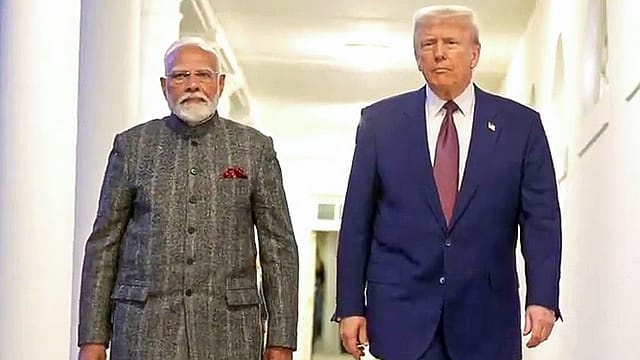
Last week, following a phone call between Prime Minister Narendra Modi and US President Donald Trump, Washington announced the framework for an interim reciprocal trade agreement meant to boost bilateral commerce. The initial fact-sheet was expansive, confident, almost declarative in tone.
It said India had committed to buy more American products — and not just that. It stated India would purchase over $500 billion worth of US energy, information and communication technology, agricultural goods, coal, and other products.

Losing Memory
16 Oct 2026 - Vol 05 | Issue 42
The making of a medical and social emergency
Twenty-four hours later, that commitment became an intention.
The revised document now says India “intends” to buy more American products. The word “agricultural” disappeared from the list entirely. A single edit — but one that changes the weight of the promise.
The pruning didn’t stop there.
In the tariff section, the original version had asserted that India would eliminate or reduce tariffs on all US industrial goods and a wide range of food and agricultural products. The list was detailed: dried distillers’ grains (DDGs), red sorghum, tree nuts, fresh and processed fruit, soybean oil, wine and spirits — and notably, certain pulses.
In the updated version, “certain pulses” were quietly removed.
In India, pulses are not just commodities; they are politically sensitive staples tied to food security and farmer livelihoods. Their disappearance from the list is not a technical tweak. It is a signal.
The digital trade section also underwent surgery.
The initial fact-sheet had declared that India “will remove its digital services taxes” and had committed to negotiate robust bilateral digital trade rules addressing discriminatory practices and barriers.
In the revised version, the categorical assurance that India would remove its digital services taxes is gone. What remains is a narrower line: India has committed to negotiate digital trade rules. Negotiation replaces obligation.
The broader architecture of the agreement remains intact. Under the proposed arrangement, the US will reduce tariffs on Indian goods to 18 per cent from the current 50 per cent. And in a separate but connected move, President Trump removed the 25 per cent tariffs imposed on India in August last year over its purchases of Russian oil, citing New Delhi’s commitment to halt direct or indirect imports from Moscow and acknowledging “significant steps” in that direction
But the edits to the fact-sheet matter because trade deals are built on precision. In such documents, verbs are policy. Lists are commitments. Omissions are strategy.
Was the original language too ambitious? Was it a negotiating position? Or was it an overstatement corrected after diplomatic back-and-forth?
Washington hasn’t framed the changes as a climbdown. There has been no public acknowledgment of a revision beyond the updated document itself. Yet the differences are clear.
For India, the recalibration may reflect domestic realities: protecting sensitive farm sectors, retaining policy space on digital taxation, and avoiding binding purchase pledges of a headline-grabbing $500 billion.
For the US, the framework still projects progress: lower tariffs on Indian goods, expanded market access ambitions, and a strategic alignment that now includes energy realignment away from Russian oil.
What remains unchanged is the political theatre of the moment. Trade, energy security, digital rules, agriculture, all wrapped into a larger geopolitical rebalancing between Washington and New Delhi.
(With inputs from ANI)