#UNTOLD | The Code Was Waiting. So Was His Father
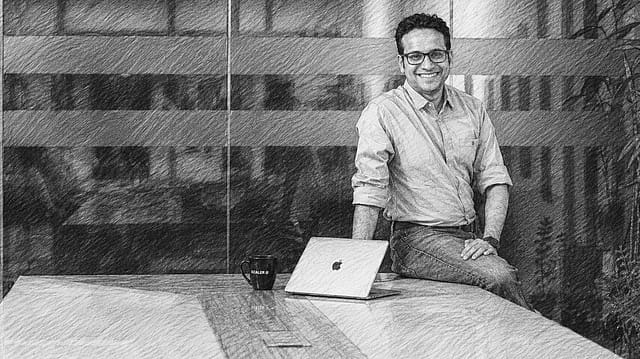
The cursor is blinking.
It has been blinking for a long time, inside an empty line on a laptop balanced on Abhimanyu Saxena’s knees. The screen throws a pale blue wash across a face that hasn’t slept properly in days. The air smells of antiseptic and warm steel. A trolley rattles past. Somewhere down the corridor, a nurse calls out a name.
His father lies on the bed beside him, exhausted by chemotherapy, eyes closed. Abhimanyu searches his face for some small sign of comfort. Finds none. Turns back to the screen.
An error glares at him in red. A bug to find. A feature to ship. A young company that needs its founder.

The Wealth Issue 2026
06 Nov 2026 - Vol 05 | Issue 45
Portraits of Dreamers and Doers under 35
Two clocks are running in this room. One lies in the bed beside him. He doesn’t know how long it has left. The other sits in his bank account: three years of savings, maybe four, all the runway he gave himself the day he quit.
He types half a line. Stops. He could shut the laptop and sit with his father every waking hour. But the company needs him too, and no employer is waiting to deposit another salary.
So he works. And keeps glancing at the bed.
Code, in a cancer ward, is a mercy. A bug is a problem with edges. Cancer is the opposite. Understanding it does not mean he can change it.
“I’m not sure, tum kabhi Tata Memorial gaye ho?” (I'm not sure, have you ever been to Tata Memorial?) he asks, years later, his eyes drifting past the room. “It’s a very different place on Earth.”
He remembers families on benches and floors, clutching paper files and plastic bags of reports.
And yet.
“Wahan par aap itna suffering dekhoge, itna pain dekhoge. But you will also see the people are still happy.” (You will see so much suffering there, so much pain. But you will also see people still happy.)
In 2015 and 2016, he estimates, 70 to 80 per cent of the code for his business is written here. In the chair beside the bed. Mostly on the benches outside, through the long hours of treatment.
His father is having chemotherapy, radiotherapy, surgeries. Abhimanyu is writing code. Both clocks are running faster than he expected.
HE QUIT HIS JOB. THEN CANCER SENT A BILL THREE TIMES HIS SALARY
Before leaving America, he did the sums.
Three years without a salary, maybe four. Savings. A co-founder, Anshuman Singh, an old college friend. Low costs, hard work, enough time to build something useful.
It was a sensible plan.
Then, barely two months after the company begins, his father is diagnosed with cancer. The spreadsheet had no row for that.
“First thing I realised, if I’m not on a job, that means no insurance.”
He had given up his salary on purpose. The insurance went with it, and he hadn’t noticed. The bills arrive at three times his old monthly salary. Three times what he once earned in a month, now spent in a month. Then again the next.
At the billing counter, the queue barely moves. He stands in it with a plastic folder under one arm and a laptop bag over his shoulder, doing division in his head. He pays. The receipt goes into the folder. The folder goes back into the bag, next to the laptop, as if both belong to the same project.
The folder gets thicker every week.
“Figure it out,” he says, recalling those days with an almost casual shrug.
There is no finance department. No corporate cover. The money comes from the same savings meant to keep the startup alive. “That was a hard time,” he says.
A pause.
“I must say that.”
FATHER OFFERED HIM EVERYTHING HE HAD SAVED
Months earlier, his father had done something Abhimanyu would never forget.
It began like an argument, though Abhimanyu remembers it less as anger than bewilderment. A frown. A long silence at home. Why would anybody with such a good job want to start a business?
His father had spent his working life in Madhya Pradesh’s tribal education department. He had watched his son bend over books for years. He knew how hard it was to reach a good engineering college, and how far the boy had travelled to end up in America.
And now he wanted to walk away.
“Papa, woh thoda sa yeh duniya ab hamari alag ho gayi hai,” Abhimanyu tried to explain. (Papa, our world has become a little different now.) Jobs can be found again.
His father wasn’t convinced. Not then.
Two days later, he came back to the conversation. All right, he said. If this is what you want, do it. Work hard.
Nobody knows what happens in those two days. Perhaps a conversation with his wife. Perhaps a long walk. Perhaps simply a father doing his own arithmetic. Whatever it is, he comes back changed.
Then he makes the offer.
₹10 lakh. Perhaps ₹20 lakh. A lifetime of government salary, gathered a little at a time.
“Zaroorat lage toh batana, le lena mere se.” (Tell me if you need it. Take it from me.)
Abhimanyu almost smiled. “Pitaji, usse aath-das guna zyada main kamata hoon already. Toh zaroorat nahi hai.” (I already earn eight to ten times that. I don’t need it.)
He remembers the gesture, not the sum. “Jo bhi unhone zindagi bhar mein joda tha... Utna bharosa hai.” (Everything he had saved in a lifetime. That much faith.)
He said no. He believed he could carry the risk himself. He refused his father’s savings.
Now the hospital is spending his own.
At midnight, the ward settles into its own kind of quiet. A monitor beeps somewhere. A cough. Someone praying under their breath. For once, Abhimanyu closes the laptop and does nothing at all except listen to his father breathe.
It is the only task of the day with no bug in it. It is also the one he cannot fix.
SIXTEEN HOURS OF STUDYING. ONE IIT DREAM. AND A MISSING MAP
How does a boy from Amarkantak end up here?
In the early 1990s, yesterday’s news arrives today. A paper dated the 24th shows up on the 25th, creased and soft from the road. The town once had no telephone line. Word of an aunt’s death comes by telegram: a thin slip of paper, a few clipped lines, and a silence over the family before anyone finishes reading.
The local schools stop at Class Eight, so his parents move the family to Shahdol. His father works in tribal education. His mother, a teacher, becomes a school principal. They know what education can do, and how unevenly it is handed out.
Their son wants computer science. He wants IIT.
Sixteen hours a day, sometimes. A pool of lamplight, books fanned around him like a barricade. But effort is not the problem. He doesn’t know how to prepare.
“Kota-vota jaane layak paisa nahi tha pitaji ke paas.” (His father didn’t have the money to send him to Kota.)
So, he prepares alone. The IIT result comes. The rank isn’t good enough for the course he wants. He reads the number. Reads it again, as if it might change.
“IIT mein selection nahi hua, toh zindagi jhand hai,” he says, laughing at his younger self. (When he missed IIT, it felt like life was over.)
He joins NIT Nagpur. There he meets students who prepared differently. They know which topics matter, which questions to attack.
“Hum padhte toh the din mein solah ghante, lekin kuch random hi kar rahe hote the.” (We studied sixteen hours a day, but much of it was random.)
He had believed effort was the answer. The other students had something he didn’t.
Information.
Six months later, he tries again, this time with a map. He makes IIIT Hyderabad, computer science.
The room next door belongs to Anshuman Singh.
Through the thin wall, at midnight, a keyboard clatters.
“Yaar kuch toh banayenge.” (Man, we’ll build something.)
Neither knows what.
JOINED A STARTUP THAT BECAME A BILLION-DOLLAR COMPANY. THEN WATCHED IT FALL
They are far too good at getting jobs.
Anshuman joins Facebook. Abhimanyu flies to New York to work at a startup called Fab, as its fifth employee.
For a boy from a town where the newspaper arrives a day late, New York is a collision. The language is familiar. The culture isn’t.
“Humse toh... hum toh na adjust ho payenge. Yeh kya chal raha hai?” (We won’t be able to adjust. What is going on here?)
He calls it an existential crisis. He adapts anyway.
By 2012, Fab is valued at a billion dollars. Money pours in. For a young engineer from India, it is intoxicating.
Then it collapses.
“Fab went nowhere,” he says, flat and quiet.
A valuation can make a startup famous. It cannot prove the business will last. He files that away. It will matter later.
On late-night calls, the old hostel promise keeps coming back. When? There is always a reason to wait. A better title. More experience. Another year of savings.
Then Anshuman asks a different question. What will we actually have created after another year?
In 2014, they stop waiting. Both decide to return to India.
Resigning ends the comfortable arrangement. For years, they could talk about their company without building it. The next time they sit down, nobody will be paying them to think. No large team. No famous name to open doors.
Whatever they build will have to survive on its own.
FROM TEN OUT OF TEN TO THREE
They settle in Pune. No investors. If the product breaks, they fix it. If the business fails, their savings pay for the failure.
If his standard of living in America was ten out of ten, Abhimanyu says, it falls to three.
Every expense becomes a decision. A meal. A taxi. A new shirt. Every rupee spent on himself is a rupee unavailable to the business.
Starting a company with an old friend, he says, is almost like getting married. You find out what the other person is like under pressure. You disagree. You still have to work together the next morning.
The product finds users. That is encouraging. But a user who loves a product doesn’t pay for it. Someone has to pay.
“We were also lucky,” he says. They find enough revenue to keep the lights on, one month at a time.
In 2015, another engineer joins, a former Facebook colleague who quits a successful career to bet on their young company.
Picture the conversation. Across a table, a man with a stable career and a decision to make. On the other side, two founders who aren’t drawing salaries, with a dashboard instead of a balance sheet. Nobody says it aloud: if this goes wrong, it goes wrong for three people, not two.
Abhimanyu can tell himself his own sacrifice is temporary. It is harder when someone else has trusted you with his livelihood. A salary must be paid whether the founders had a good month or a terrible one.
Four years pass without Abhimanyu drawing a salary. Four and a half years pass before the company raises its first institutional money.
There is no rank list. No promotion letter. Nobody tells him whether he is winning.
Asked how often he thinks about quitting, he doesn’t give the heroic answer.
“Every other day.”
He says it lightly.
The door is never locked. A man with his résumé can walk back into a salaried life with a single phone call: the salary, the insurance, the ten out of ten. He knows exactly where it is.
But what happens to the people who decided to stay?
And what would he tell his father?
“WHY DIDN’T YOU GO TO IIT?”
Even after years of building a company, one question from an investor takes Abhimanyu straight back to Shahdol.
“Why didn’t you go to IIT?”
For a second, everything since collapses. Shahdol. The lamplight. The rank that once made him feel his life had been decided by a number.
He answers politely. He remembers the question.
What he lacked at seventeen wasn’t hours. It was a map. Now he is building one for other people.
By 2019, investors who had followed the founders since 2015 were taking a closer interest. The company joined Sequoia’s Surge programme. At one stage, six major global funds were competing to invest.
The business that began with two friends living on savings was now attracting the attention of some of the world's biggest venture capital firms.
OFFERED A BILLION-DOLLAR VALUATION. THEN HE READ THE FINE PRINT
Then a number arrives that his father could never have imagined.
More than a billion dollars.
An investor is ready to value the company he and Anshuman built at a figure that would make them unicorn founders.
There is a catch. The money has conditions.
Abhimanyu examines the terms and runs the scenarios: the company grows, it struggles, it sells for less than anyone hopes.
One provision worries him. Liquidation preference. Depending on the agreement, investors may recover their money before founders and employees receive proceeds from a sale.
Consider a hypothetical investment of $100 million with a one-times non-participating liquidation preference.
If the company sells for $150 million, the investor may choose to take back the first $100 million rather than convert into ordinary shares. That leaves $50 million for other shareholders, subject to the rest of the capital structure.
The announcement would say a billion. The cheque might say something else.
He has seen this before. At Fab, he watched a billion-dollar valuation disappear.
He says no.
Years earlier, he declined his father’s savings because he believed he could carry the risk himself. Now he declines a billion-dollar valuation for the same reason. He knows exactly what the risk is, and exactly who would end up carrying it.
There is no announcement. No photographs of smiling founders. No entry into the unicorn club.
“VC funding is not a debt,” he says, then challenges himself. “It is a debt in a way.”
He and Anshuman together hold 51 per cent. He has no wish to give up control for the privilege of announcing a flattering number.
THE NUMBER HIS FATHER KEPT REPEATING
In the last months of his life, Abhimanyu’s father has a number he wants everyone to know.
Fifty.
That is how many people he believes his son employs.
He has spent three years fighting cancer. He has watched his son leave a successful American career and build something that is beginning to find its feet. He once asked why Abhimanyu wanted to give up such a good job.
Now, whenever a visitor comes, he has an answer ready. His son is doing something good. Fifty people have work because of the company he started.
It is a strange reversal. The man who once sat through a long silence at home now can’t stop telling strangers about it. He had asked for a reason. Now he had one, and it had fifty names.
Picture him telling it, weak from treatment, to someone who asked only about the son who went to America. There is pride in the telling. The kind that makes a father repeat the news long after everyone in the family has heard it.
In 2018, he dies. He never sees what comes next. Not the investors, not the valuations, not the number with nine digits. He only knows fifty.
Abhimanyu spent his childhood chasing numbers. A rank. A seat. A salary. Later, revenue, funding, valuation. He watched a billion-dollar company collapse and turned down a billion-dollar offer for his own.
His father had found the one measure that needed no spreadsheet. He told everyone he could. And he was proud.