Troovy’s ₹100-crore Bet on India’s Crowded Healthy-Snack Shelf
A children’s snack has to satisfy two customers. The parent decides whether to buy it. The child helps determine whether it gets bought again.
Troovy has built its product-development process around that negotiation. Its latest funding gives the company more capital to pursue it across a wider range of foods.
The Gurugram-based startup has raised ₹100 crore in a Series B round led by Fireside Ventures, with participation from Sharrp Ventures and other investors. The money will support research and development, manufacturing capacity and distribution across quick commerce and offline retail.
The opportunity extends beyond persuading families to try another millet chip. Troovy wants to turn its work on ingredients, taste and production into a brand that earns a regular place in household shopping.

Look Who's Talking Regime Change
23 Oct 2026 - Vol 05 | Issue 43
It is pursuing that ambition on an increasingly crowded shelf.
A PROBLEM WITH SEVERAL ANSWERS
Founded by Mansi Baranwal and Aditya Mukherjee, Troovy began by involving more than 100 parents and their children in discussions and tastings in Gurugram. The company says that community now includes more than 10,000 parents and children.
“We used to meet every week to brainstorm, taste, reject, re-taste, and debate ingredients for products that didn’t yet have a name,” underlines Baranwal in its funding release.
That interaction can help connect what parents want with what children will eat. Other businesses have recognised the same household tension.
Slurrp Farm offers millet-based children’s foods spanning cookies, cereals, puffs, pancake mixes, noodles and pasta. Early Foods sells porridges, millet cookies, teething sticks and milk mixes for children and families.
A wider group competes for spending on more health-conscious packaged food. The Whole Truth emphasises ingredient transparency across products including bars, chocolate and peanut butter. Farmley and Happilo offer nuts, dry fruits and other snacks.
These businesses occupy different positions. Some focus closely on children, others on family snacking or adult nutrition. Together, they show why millets, ingredient exclusions and parental concern provide a starting proposition rather than exclusive territory.
Several also predate the recent wave of launches. Slurrp Farm dates to 2016 and Farmley to 2017. Troovy is entering a category with accumulated product and distribution experience.
WHAT TROOVY IS TRYING TO BUILD
Troovy’s proposed distinction lies in how it develops familiar foods across several eating occasions: chips, cookies, sauces, spreads and milk mixes.
Its account of formulation describes the practical consequences of changing ingredients. Removing an oil, sweetener or preservative can affect flavour, texture, production and shelf life. The company says its first ketchup required 42 iterations and three failed production runs. Seasoning development involved further trials and changes to raw-material sourcing.
That work can build capabilities with uses beyond one product. A supplier relationship or manufacturing improvement developed for one recipe may help subsequent launches.
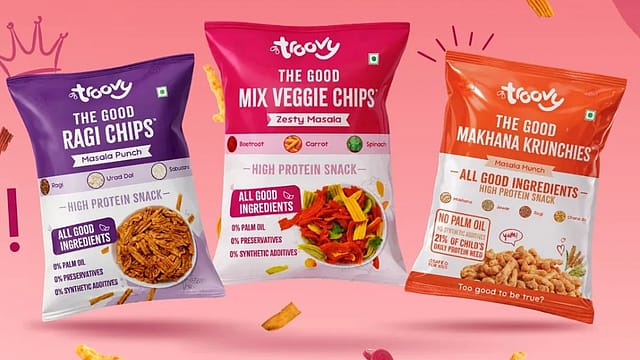
The products also make the proposition more specific. Troovy’s ragi chips claims a base containing 30% ragi flour alongside ingredients including tapioca flour, pea protein, rice flour and urad dal. Its chocolate spread lists 45% nut butter, with jaggery, oils and other ingredients.
These are choices about the composition of familiar products. Their appeal depends on the complete offer: taste, nutritional content, serving size, price and convenience.
The company also describes an improvement team that continues reformulating products after launch. Maintaining that feedback process as volumes grow could help it develop recognisable products that families return to.
The challenge is to make those improvements consistent and commercially repeatable across a larger portfolio.
GROWTH HAS NOT PRODUCED ONE FINANCIAL PATTERN
The financial record of neighbouring businesses explains both the opportunity and the investment required.
Wholsum Foods, the parent of Slurrp Farm, reportedly posted ₹95.6 crore in operating revenue and a ₹32.7-crore net loss in FY25. The Whole Truth reportedly recorded ₹216 crore in operating revenue, up from ₹65 crore, while its net loss rose to approximately ₹28 crore from ₹24 crore. Farmley, meanwhile, grew operating revenue to ₹394.2 crore from ₹230.2 crore while narrowing its net loss to ₹22.6 crore from ₹26.5 crore.
Happilo followed a different path. Operating revenue fell to ₹280 crore from ₹329 crore, but its net loss narrowed sharply to ₹9.5 crore. It reportedly became EBITDA-positive, which remains distinct from net profitability.
There are profitable examples too. Take, for instance. Let's Try. It reportedly posted ₹65 crore in FY25 operating income and ₹0.5 crore in profit after tax.
This selected comparison cannot establish a profitability rate for the entire market. It shows businesses at different stages, making different choices about growth and expenditure.
Troovy itself remains much smaller. It reportedly posted approximately ₹6.1 crore in revenue and a ₹10.1-crore net loss. That historical starting point helps explain the importance of building capacity and demand together.
ALLOWING TIME, WATCHING PROGRESS
Consumer brands require investment before their full commercial potential becomes visible.
Developing recipes, securing suppliers, testing shelf life, building distribution and persuading shoppers to switch all take time. New manufacturing capacity can initially add cost before higher utilisation improves its economics.
An early loss, therefore, needs to be understood alongside what the business is building.
The useful progression is whether established products attract repeat buyers, earn better margins and support further expansion. Growing production can improve purchasing and manufacturing efficiency; a broader range can give an existing customer more reasons to buy.
Distribution will matter equally. In a February investment note, Fireside said quick commerce contributed approximately half of Troovy’s revenue, up from 11% when it first invested. That was the investor’s assessment at the time.
Quick commerce offers convenient discovery and replenishment. Offline expansion adds another route to families, with its own requirements for retailer relationships, stock availability and working capital.
Troovy’s new funding supports these connected tasks. Product development can give shoppers a reason to choose the brand; manufacturing and distribution must make that choice dependable.
Its opportunity is to build on the demand that earlier health-oriented brands have helped establish, while developing a clearer place of its own.
The ₹100 crore gives Troovy more room to do that work. A lasting business will emerge through products that families keep choosing and economics that strengthen as those choices accumulate.