The Quadrant of the Stupid: Inside the High-Proof Mind of Jaydeep Barman
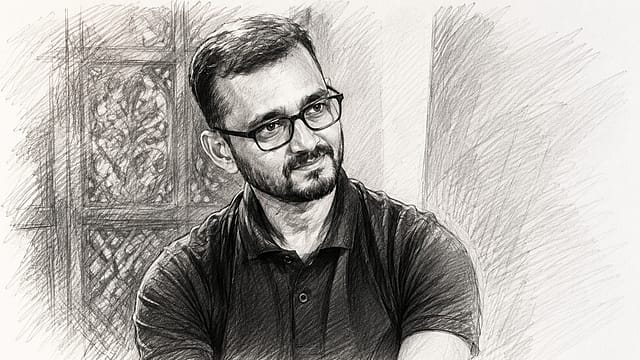
Ninety percent of the investors Jaydeep Barman meets do not understand what he is doing.
Let that sink in for a moment. We are talking about a founder who built a global internet restaurant giant, a unicorn backed by the most elite venture capital pools on the planet. Yet, when he sits across the table from institutional allocators, there is a state of cognitive disconnect. Room after room, the same thing happens: Confusion, slight pause, and more confusion.
And Barman is absolutely thrilled about it.
“I am misunderstood enough,” he says, his voice flat, completely clear of any defensive posture. And that’s a good thing. Why? Because when people don’t understand what you’re doing, they copy the wrong thing. “They don't really understand what Rebel is,” he underlines.
Look Who's Talking Regime Change
23 Oct 2026 - Vol 05 | Issue 43
Think about the psychological mechanics behind that statement.
In a startup ecosystem addicted to validation, Barman treats confusion like insulation. It’s his economic moat. If the world understands your blueprint too early, the market floods. Copycats follow. Capital piles in. Margins collapse. Misunderstanding buys time--and sometimes dominance—and invisibility keeps the wolves out of your yard.
To make sense of that isolation, Barman runs his thinking through a simple frame. Right or wrong. He discovered this framework while devouring the writings of American investor Howard Marks.
Picture a basic two-by-two matrix. On one axis: You are either Right or you are Wrong. On the opposing axis: The world either Agrees with you or Disagrees with you.
The Contrarian Bet: Why Startup Growth Doesn’t Fix Broken Margins
Now ask yourself—where are the real fortunes actually made? Not in the safe quadrant. If you’re right and the entire market agrees with you, the game is already over. The opportunity is priced in. The stock is expensive. The segment is crowded. The margins are gone.
“You will only make extraordinary returns when you are right and people don’t agree with you,” Barman says.
But getting there isn’t as clean as it sounds. That contrarian quadrant demands something most founders don’t have: Stamina. The kind where you’re willing to look completely, embarrassingly wrong—for a long time. Not for a week. Not for a quarter. Long enough for people to start writing you off. You hold your ground while analysts draft your obituary. While your own board starts wondering if you’ve lost it. And you stay there.
Out of ten contrarian bets, history suggests you will be dead wrong nine times. You have to absorb that cost. And on the one occasion where your data is right, the world will still call you an idiot until the infrastructure of the country catches up to your mind.
That’s the part nobody prepares you for. The waiting. Not the idea. Not the conviction. The stretch in between—where nothing moves, nothing validates, and everything around you suggests you’ve misread the game. You sit with it while the market moves on, while capital chases something else, and while people who once backed you begin to hedge their bets. And you don’t have proof yet. Only belief.
Barman didn't discover this philosophy in a comfortable university lecture hall. He had to be repeatedly doused in corporate gasoline before the switch finally clicked in his head.
That’s the story everyone tells you. The most dangerous lie an entrepreneur will ever hear is that margins will improve with growth.
It is a seductive, intoxicating myth whispered by venture capitalists looking for top-line hockey sticks: Just capture the ground now, burn the cash, scale the volume, and the economics will fix themselves later.
Barman bought into the lie early.
In October 2011, Faasos picked up a massive $5 million Series A funding round from Sequoia Capital. Suddenly, the bank account was overflowing, the media was celebrating his genius, and the mandate from the cap table was absolute: grow at all costs.
So, he grew. Barman built high-street retail stores across premium commercial strips. He watched his top-line revenue climb toward a ₹50 crore run-rate.
But underneath the vanity metrics, the shape of the business was completely broken. High retail rentals were eating the margins before the food even hit the counter. Average order values were stubbornly depressed.
“A bad shape is a bad shape,” Barman says, using a raw, visceral analogy from the gym. When you grow, the shape becomes worse. But when you are in good shape, growth makes good shape better.
Think about it this way. If you are out of condition, you don’t just go to the gym and start consuming massive amounts of protein. Without strength training, without running, without building the core muscle first, that protein doesn't build bicep tissue. It just turns into visceral fat.
Venture capital is the protein. And by 2014, Faasos was storing a lethal amount of visceral fat.
The 30-Day Runway: Cash Burn, Broken Unit Economics & the Cloud Kitchen Pivot
The cash was evaporating into premium real estate frontage. The kitchens were too small, un-airconditioned, and running at forty-five degrees. The operational environment was an absolute cell where cooks were passing out from heat exhaustion. The line items were bleeding out from a gradual, toxic convergence of rising rent, falling margins, and a steady exodus of talent.
Then the final text message from his finance head appeared on his screen: Thirty days.
One single month of operational cash left before the payroll would publicly bounce across India. He had a massive tech-backed brand on paper, and absolutely no money coming in.
“I had raised money from Sequoia, and I had to make it work, somehow,” he says, the memory carrying the heavy weight of a physical chain.
He looked back at the forty-five-degree kitchen, the heat rising off the iron griddles blurring his vision. He realized that forcing a broken architecture to run on pure, raw adrenaline wasn't optimism. Sticking to a track when you know it's fundamentally broken is pure madness. He had to stop playing safe. He had to swing the wheel into the dark.
When you are already going down, a strange, beautiful brand of leverage enters the room. The people holding the capital lose the energy to fight you. They look at your thirty-day runway and give you a license to be reckless because, either way, you are dying.
Barman walked into the boardroom in mid-2014 and stripped away the storefronts, the walk-ins, and the premium glass frontage entirely. He announced they were moving the entire operation into first floors, hidden back alleys, and anonymous industrial basements where the rent was low and no one was looking.
The industry thought he had committed commercial suicide. A food brand without a visible store didn’t make sense in 2014. To the investors, it read like a frantic suicide note. “Everyone thought we’d lost it,” he recounts. “Competitors thought we were dead.”
But down in those cheap, invisible spaces, the numbers finally began to cooperate. The rent dropped by eighty percent. The burn slowed to a crawl. This wasn’t growth. It wasn’t even success. It was pure oxygen.
By 2016, the cloud kitchen model had steadied enough for the team to draw a clean breath. And that is exactly when his internal vulnerability—what he terms being a "pathological dreamer"—tripped the accelerator again.
He dropped a new thesis onto the table: one single kitchen running multiple separate culinary brands out of the exact same stoves. “When we said we’ll do multiple brands from the same kitchen…all hell broke loose,” Barman recalls. The board went into an absolute mutiny. Investors slammed folders, calling it a hallucination that would fragment focus and destroy the core Faasos equity.
They didn't have a proof of concept. They just had a contrarian insight that a single consumer doesn't stay loyal to one flavor; they want a wrap for lunch, a biryani for dinner, a pizza for the weekend. One brand couldn't capture all those neural pathways.
Hypergrowth, Overreach & Recovery: Scaling Cloud Kitchens, the Wildfire Failure, and Lessons in Discipline
Barman launched the brands—Behrouz Biryani, Oven Story Pizza—and the economics scaled beautifully. But the "pathological dreamers" pushed too far. Intoxicated by the vertical growth, they launched a capex-light programme called Wildfire, outsourcing their proprietary brands to be cooked by third-party restaurant kitchens across the country.
It was a catastrophic car wreck. The partner kitchens had zero skin in the game. Product ratings nosedived on the aggregator apps instantly. The entire portfolio's reputation nearly burned to the ground over a single month. It was a silent, terrifying near-death expansion crisis. They had to execute a frantic, expensive retreat, pulling the plug on Wildfire and licking their wounds before the core disintegrated.
What saved them from total extinction through that forensic melt was a twelve-year-old recruitment strategy. Barman had sent a raw email years prior, hiring Ivy League MBAs under the Faasos Entrepreneur in Residence programme by telling them they would start by physically running a hot kitchen, sweeping grease off floors, and chopping onions before earning the right to run a city.
Because his leadership team had been built through that gruelling, street-level trial, they didn't run from the wreckage. They locked the doors, absorbed the losses, and refocused until the system clicked. The business changed its skin. The platform became an operating system for flavour. And the very people who once resisted the madness gave the empire its definitive name: Rebel.
By early 2020, the platform was doing ₹2,000 crore in revenue. The back-alley kitchens were a highly synchronized machine. And then, the pandemic struck, dropping an iron shutter on the national demand grid. “Revenue dipped by 80%,” Barman says.
Rebel Foods wasn't a centralized corporate office; it was hundreds of distributed kitchens locked under police curfews. Cooks couldn't get to work. Supply lines were frozen. The ground was shifting every hour, and the payroll was looming.
But when the chips are completely in the dirt, you stop looking outward. Validation doesn’t matter anymore. Narrative doesn’t matter. You look at one thing: Endurance.
That’s where Barman operated from. He stabilised the operations over the phone, locked down safety protocols, and opened the platform to global giants. By the end of 2020, he had acquired the master franchise of Wendy’s in India. But he didn’t play the old game. He didn’t chase high-street visibility or expensive real estate. He decoupled the brand from the street corner entirely and plugged it straight into his network of 200 cloud kitchens over a single weekend. The burger line alone scaled toward a ₹200 crore profitable run-rate.
From the outside, it looked like control had returned. Like the system had settled. But inside, something else was still moving. Because even when you get through it— even when the numbers begin to behave— the old instincts don’t disappear. They wait. And they return.
Recently, as quick commerce began to reshape consumer behaviour, Barman moved again. He launched a lightning-fast food delivery pilot in Mumbai: QuickiES.
On paper, it made sense. Speed was the new battlefield. But execution doesn’t care about logic. The system pushed back. The enterprise had grown too large. Too structured. Too layered. It couldn’t move like a street fighter anymore. And the mismatch showed up quickly.
The pilot began to bleed. Cash went out faster than expected. The numbers started pulling down the core. This wasn’t a side experiment anymore. It was becoming a threat.
Barman made a cold, immediate call. He pulled the plug on Mumbai. “We called it off for the right reason,” he reflects, his eyes narrowing slightly. It sounds resolved. It isn’t. “A part of my brain still keeps saying—we shouldn’t be doing this.” That tension doesn’t go away. Because that’s the real risk once you scale. It's not failure. It's caution. An incumbent doesn’t die because it makes one bad bet. It dies because it stops making the bets that could threaten its own business.
“If you lose that DNA,” he says, “you’re already waiting to be disrupted.”
Capital Discipline: Why Letting Cash Dictate Strategy Destroys Startups
That realization brought him back to one hard truth: The relationship between cash and strategy. “I raised and burnt too much money,” he admits with brutal honesty. “I let cash dictate strategy. Ki mere paas itne paise hain, toh abhi main isko jala deta hoon,” he says. It should have been the other way around. “I should have let strategy dictate cash,” he rues.
That inversion changes everything. Because once cash starts driving decisions, the system begins to distort.
Barman sees it clearly now. Founders raise too much, too early, and then spend the next few years trying to justify that capital. Growing when they shouldn’t. Expanding where they shouldn’t. Forcing moves the business isn’t ready to absorb. Unless you’re sitting on a natural network effect—where one winner takes most of the market—this doesn’t build a flywheel.
It builds pressure. And over time, a noose.
Barman didn’t learn this in a classroom. He learned that the hard way.
Over the last ten years, Barman has completely detached himself from the valuation game. He stopped checking if they were a unicorn yet. He stopped letting the market's metric dictate his night's sleep.
Instead, he spent a decade devouring every single annual letter written by Warren Buffett. “If you read Buffett’s annual letters, it almost feels like he’s trying to reduce the valuation of his own company,” Barman says, a faint smile breaking through.
Buffett keeps talking about mistakes. Constantly. And yet, over sixty years, the market cap compounded at roughly 20% a year. “And in no single year did it jump 500%,” he adds.
Think about the life that sits behind that. The Omaha billionaire who drinks twenty Cokes a day. Eats the same steak every morning. Lives with a kind of quiet clarity most founders never experience. “He never lost a single night of sleep over market valuations,” Barman says.
That stayed with Barman. It shifted something fundamental—the way he began to think about cash, growth, and what actually matters. If return on capital employed is healthy, everything else—every number flying across LinkedIn or Dalal Street—starts to look like noise.
Markets will swing. Sometimes the company will look overvalued. Sometimes it will look undervalued. Over time, the ledger corrects itself. “I’m not in this to make a 10x and disappear somewhere,” Barman says, his voice quieter now. This isn’t about an exit. It’s about direction. Are we moving right? Are we protecting the DNA? That’s what stayed.
From Tiger to Cat: Founder Evolution, Leadership Shift & the Discipline to Let Go
That philosophical truce allowed him to execute the single biggest transition of his career: moving from ‘how’ to ‘what,’ and finally, to ‘who.’
During his Series A funding days, he was a micromanager, standing in kitchens and telling people how to chop onions, how to open a stall, and how to run the floor. As the business grew, he graduated to the ‘what’—dictating where the empire should expand next.
But today, at Series F, he’s stepped out of the machine. The day-to-day doesn’t run through him anymore. The calls, the execution, the constant motion—that sits elsewhere. He handed the CEO role to Ankush, his longtime partner on the ground. “Ankush is the biggest ‘who’ decision in my life,” says Barman.
The transition from a white-hot tiger to a strategic cat wasn’t an intellectual choice. It came from fifteen years of terrain.
He remembers a morning from those early, chaotic high-street years. Back when patience was thin, the temper shorter, and the pressure of a broken real estate model sat on him all day.
His driver walked up to the car carrying a heavy plastic motorcycle helmet. They were travelling in a luxury sedan. Barman looked up, irritated. “Arre, hum log toh gaadi mein jaa rahe the, tu helmet kyu laya (We are traveling by car, why did you bring a helmet?)”
The driver adjusted his grip, careful, almost guarded.
“Sir, sometimes you get so angry, you throw your mobile straight through the windscreen,” he said quietly. “I’m just protecting my head.”
Barman doesn’t throw phones anymore.
He wakes up at 9:00 AM. Sleeps at 2:00 AM. Spends his nights reading under a single light. The noise has dropped. The edges have softened. “In the early years, I was like a tiger,” he says, looking out at the Mumbai traffic sliding past.
Back then, the weight of the business made him volatile. People hesitated before walking into his office. They knew what they might walk into. But a startup doesn’t survive on fury alone. What saves you in a thirty-day crash can destroy you if you carry it too long.
“Now, I’m a cat.” The line lands without effort. “You need a tiger to survive the crash. You need a cat to guide the empire.”
He knows what that takes. He has lived through it. The mountain is not abstract to him. He knows its shape. Its cost. And he knows this: most startup playbooks are written by people who have never stood in the debris. “Highs come once or twice every couple of years,” he says, his voice quieter now. “Otherwise, it’s mostly pain.” Endurance is about your capacity to hurt.
Later that night, he drives home through Mumbai. The glowing storefronts pass by. The neon signs. The glass. The noise. He doesn’t look at them. He knows what sits behind that surface. This isn’t about visibility anymore. Or vanity. It’s an endurance test. The real work happens elsewhere. Out of sight. In the dark. Where things keep running. Keep surviving. Long enough to be right.