Tata, OpenAI, Volkswagen: When Boardrooms Become Battlegrounds
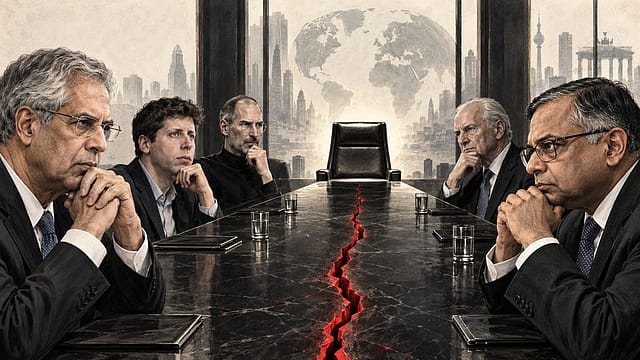
Four votes for the chairman. One against. And a declaration that the decision was illegal.
At Tata Sons on September 17, the numbers produced a resolution and a confrontation. The board voted to give N Chandrasekaran another five years as executive chairman after his current term ends in February 2027. Tata Trusts, whose chairman Noel Tata cast the dissenting vote, rejected the outcome. Its contention: the company's appointment rules required support that the resolution had not received.
For the Tata Group, the immediate question concerns its leadership. For anyone watching the exercise of corporate power, the spectacle raises something more fundamental. How much does winning a boardroom vote settle when another centre of authority refuses to accept it?
Other companies have discovered the answer painfully. A founder can lose his responsibilities in the company he created. A board can dismiss a chief executive and find itself reconstituted days later. A powerful chairman can challenge the boss and become the person who leaves. Workers can turn a shareholder quarrel into a commercial emergency.

Zeroing In on ECI
09 Oct 2026 - Vol 05 | Issue 41
Constitutional legitimacy versus political opportunism
The histories of Apple, OpenAI, Volkswagen, Uber, Ben & Jerry's, Market Basket and Hewlett-Packard offer different versions of this struggle. Their ownership arrangements and legal systems differ. So do the merits of their disputes. What connects them is the moment when people who once agreed on who should run the business begin contesting the authority to decide.
Tata Sons and the disputed authority behind a 4–1 vote
Tata Trusts collectively holds approximately 66% of Tata Sons, the group's principal holding company. According to the Trusts' statement, a chairman's appointment or reappointment requires the backing of a majority of the Trusts' nominee directors under the Articles of Association. Noel Tata's opposition, it argued, made the September 17 resolution a legal nullity.
That is the Trusts' position. Tata Sons announced that its board had approved Chandrasekaran's reappointment by a majority. The two statements leave the central disagreement exposed: whether that majority satisfied the company's specific appointment requirements.
The division also ran between the Trusts' own representatives. According to media reports, Venu Srinivasan, identified alongside Noel Tata as a Trust nominee on the Tata Sons board, supported Chandrasekaran's reappointment. That reported split makes the distinction between an overall board majority and the required support among nominee directors central to the dispute.
The dispute also reaches backwards. Chandrasekaran had informed the board on August 12 that he would not seek reappointment when his term ended on February 20, 2027. The Trusts said it accepted that decision the following day and asked for the process of selecting a successor to begin. It now maintains that his earlier decision had attained finality.
Noel Tata also questioned the sequence of approvals. In a statement quoted in media coverage, he argued that Chandrasekaran's position as a director remained unresolved because the relevant general meeting had been unable to proceed for want of quorum. Since the chairman must be a director, Noel contended that deciding the chairmanship first exposed the company to a potential shareholder challenge. This was a separate objection to the foundation of the appointment, alongside the Trusts' argument about the board vote.
The shareholder meeting, therefore, represents another potential flashpoint. Media reports describe the August 18 AGM being adjourned amid restrictions affecting the Sir Ratan Tata Trust's ability to provide the required representation. The leadership dispute has become entangled with the machinery through which shareholders exercise their rights.
An additional flashpoint was a legal opinion from former Chief Justice of India D Y Chandrachud. The Trusts said Noel Tata submitted the opinion in support of its position and that the board did not take note of it. A legal opinion supporting one side does not itself resolve a contested appointment; it establishes the argument that side is advancing.
The sequence makes this more complicated than a familiar disagreement over a chief executive's performance. A departure had been communicated, a succession process requested and a fresh term subsequently approved by the board. The Trusts is disputing the validity of that last step.
For employees and counterparties, uncertainty begins where those competing assertions meet. Which leadership plan should they expect the institution to follow? For the directors and shareholder representatives, the challenge is more exacting: they must establish how the company's rules apply to the decision actually taken.
History offers useful comparisons. It cannot supply a verdict on Tata Sons' Articles of Association.
Apple and Steve Jobs: the founder who lost the board
Steve Jobs would eventually tell the story in a sentence that captured the emotional absurdity of his predicament: “How can you get fired from a company you started?”
Speaking at Stanford on June 12, 2005, he recalled the rupture with the executive recruited to help run Apple. Their visions diverged. The relationship broke down. The board took the other man's side. Jobs described the experience as devastating.
The executive was John Sculley. During their 1985 struggle, Jobs lost operational authority. His departure then unfolded over months, culminating in his resignation as chairman in September. Those stages matter: the familiar story of Jobs being fired compresses a loss of executive power and a subsequent formal resignation into a single event.
His September 17 resignation letter to Mike Markkula captures a founder trying to reclaim the ability to act. Jobs said he had already offered his resignation at a board meeting, agreed to defer it, and was proceeding with a new venture. He argued that Apple's reorganisation had left him without work or even access to regular management reports. This was his account of being rendered peripheral to the business he had helped create.
The letter makes the humiliation tangible. A title remained, but the work that had given the title meaning had disappeared. Corporate authority could be removed without immediately erasing the name on the organisation chart.
Jobs built NeXT. Apple later bought it, bringing him back. In his Stanford telling, the intervening years became a period of renewal and the technology developed at NeXT helped Apple's revival.
That ending makes the earlier board decision tempting to judge entirely through hindsight. Yet the governance question is harder than deciding whether a famous founder deserved permanent control. Directors must be able to challenge founders; they must also understand the consequences of sidelining the people around whom a company's products and identity have formed.
Apple supplies the long arc of exile and return. At OpenAI, the reversal arrived with startling speed.
OpenAI and Sam Altman: the dismissal that rebounded on the board
On November 17, 2023, OpenAI announced that Sam Altman was leaving as chief executive. The board said he had not been consistently candid in his communications, impairing its ability to perform its responsibilities. It said it no longer had confidence in his leadership.
The announcement emphasised the organisation's unusual structure. A nonprofit board oversaw an enterprise that had raised commercial capital while retaining a mission centred on ensuring that artificial general intelligence benefited humanity. The directors presented their intervention as an exercise of that responsibility.
The decision did not hold. Employee opposition and pressure from investors, including Microsoft, helped drive negotiations for Altman's return. By November 22, a return agreement had been announced. OpenAI's November 29 statement confirmed him as CEO alongside a new initial board: Bret Taylor, Larry Summers and Adam D'Angelo.
The chief executive had come back. The board overseeing him had changed.
The episode exposed a difficult operational limit on governance. Directors may possess the authority to remove a leader, yet depend on employees, partners and investors to sustain the enterprise after that removal. If those constituencies reject the decision, a board faces the prospect of exercising control over a rapidly weakening organisation.
That does not mean employees acquire a legal veto over directors. It means their willingness to stay can become decisive in negotiations about who leads them.
The explanation of the original dismissal also requires care. In March 2024, OpenAI published a summary of a review by WilmerHale, commissioned by a special committee of its board. According to that summary, the rupture arose from a breakdown in trust. It did not arise from concerns about product safety, the pace of development or OpenAI's finances. The review found that the previous board acted within its broad discretion, while concluding that Altman's conduct did not require removal.
OpenAI demonstrates how a decision can be formally available to a board and still prove impossible to sustain. Volkswagen offers a different reversal: the challenge failed before the targeted executive had to leave.
Volkswagen and Ferdinand Piëch: the chairman who lost his coalition
In April 2015, Ferdinand Piëch challenged Volkswagen chief executive Martin Winterkorn. Piëch was the supervisory-board chairman and a member of the powerful Porsche-Piëch family. But labour representatives, Lower Saxony and his cousin Wolfgang Porsche backed Winterkorn. Reuters reported that Piëch was isolated in a 5–1 steering-committee vote. On April 25, he resigned.
The supervisory board's leadership committee had supported Winterkorn's continuation and proposed extending his contract. The man challenging the chief executive had failed to assemble the support to carry the challenge through.
The comparison with Tata lies in the competing sources of authority, rather than in matching one personality to another. A family figure, a professional executive, directors and other institutional interests can occupy the same corporate structure while possessing different kinds of influence. A reputation for dominance is powerful only while enough participants continue to accept it.
Piëch's position made his defeat striking. It also made the outcome easy to misread as a permanent endorsement of Winterkorn. In September that year, Winterkorn resigned as the diesel-emissions scandal engulfed Volkswagen. His survival in April and his departure in September belong to distinct episodes.
The distinction matters to any account of boardroom winners. A leader can win a contest over support and subsequently face a separate crisis that makes the earlier victory almost incidental. Counting who remains in the chair on the day of a vote captures only one moment in the company's history.
Uber and Travis Kalanick: the fight continued after the resignation
At Uber, the battle spread from the chief executive's position to the composition of the board itself.
Travis Kalanick resigned as CEO in June 2017 under investor pressure. In August, investor Benchmark sued him, seeking to undo an arrangement that had given him control over three board appointments. Kalanick rejected the allegations. The litigation demonstrated that his departure as CEO had left a substantial argument about influence unresolved.
Stanford researchers David Larcker and Brian Tayan documented the next manoeuvre. Kalanick appointed former Xerox CEO Ursula Burns and former CIT chief John Thain to the board as changes to Uber's governance were being considered. The eventual agreement around SoftBank's investment included changes to voting rights and an expanded board.
Benchmark dropped its lawsuit in January 2018 as part of the investment arrangement. The resolution came through a negotiated restructuring of power, rather than a court finding establishing its allegations.
Uber makes a useful distinction between an executive job and the instruments of control. A founder can surrender day-to-day leadership while retaining shares, appointment rights and allies. An investor can support a new CEO and still believe the surrounding governance arrangements need to change.
That is why the apparently technical detail of a board seat can become the centre of a fierce dispute. It affects who participates in the next decision, who helps choose the next leader and whether a promised change in direction can survive opposition.
Ben & Jerry's takes that question into another setting: what happens when a company has been sold, but some powers have deliberately been preserved for an independent board?
Ben & Jerry's and Unilever: the parent company meets a protected mission
Unilever bought Ben & Jerry's in 2000 under arrangements preserving an independent board and responsibilities for the brand's social mission. In July 2022, Ben & Jerry's sued its parent over the sale of its Israeli business, arguing that the transaction conflicted with those protected responsibilities. Unilever maintained it had the right to make the arrangement.
The dispute illustrates a tension built into certain acquisitions. A buyer takes ownership while accepting that some decisions will remain subject to special protections. As long as both sides agree on how the brand should behave, those provisions can seem reassuringly remote. Once they disagree, the precise boundaries become central.
Here, political speech and the social mission became entangled with questions about who could act for the company and who could shape its independent board.
The conflict continued after Unilever's ice-cream business was spun off into Magnum. Former directors challenged changes to board membership and eligibility. Magnum defended its governance changes.
The legal position moved significantly on August 21, 2026. US District Judge P Kevin Castel dismissed seven claims and part of an eighth in the later lawsuit. Certain challenges concerning independent directors and appointment requirements survived, alongside payment claims. The court also substituted Magnum and Ben & Jerry's HoldCo for Unilever and Conopco as defendants.
The ruling prevents an easy story of one side having already vindicated every claim to independence. Some arguments were rejected; others remained alive. It also demonstrates why the words used in the original agreement matter so much. A board can possess defined powers over a mission without possessing every power it believes necessary to defend that mission.
The Tata dispute involves different documents, ownership arrangements and law. The common question is how much authority each institution has actually been given, and what happens when its interpretation is contested.
Market Basket: when employees and customers joined the fight
In July 2014, a supermarket in Burlington, Massachusetts, offered an unusual sight: employees asking people not to shop there.
Reporting from Market Basket, WBUR described staff urging customers to stay away, disrupted deliveries and depleted shelves. Many store employees were still at work. The revolt was not a simple story of every worker walking out; it combined supply disruption, protests and a customer boycott.
The demand was the return of Arthur T. Demoulas, removed as CEO during a family struggle involving his cousin Arthur S. Demoulas. A leadership dispute had reached the produce aisle.
Arthur T. returned after an agreement for his side of the family to buy out the rival faction. The 2014 comeback became a celebrated example of employees and customers helping overturn the practical consequences of a board's decision.
The power they exercised was different from a director's vote or an owner's shares. Their actions affected whether the business could continue trading normally. The boardroom confrontation acquired a cost that appeared in deliveries, shelves and sales.
There is a later chapter, however. Arthur T. was removed again in 2025 amid another dispute with the board. That subsequent rupture is a reason to resist treating the 2014 victory as a permanent settlement of the company's governance.
The case also unsettles a comfortable assumption about corporate accountability. Employee loyalty can protect a leader from an unpopular decision. It cannot, on its own, determine whether every demand made by directors is justified or every act of resistance is defensible. Those questions still depend on evidence.
Market Basket shows how quickly a private argument can acquire a public constituency. HP shows how a board's attempt to contain its own quarrels can produce a much larger scandal.
Hewlett-Packard: when the hunt for leaks became the scandal
At Hewlett-Packard, mistrust among directors led to an investigation into boardroom leaks. Investigators used pretexting, impersonating people to obtain private telephone records, and the inquiry reached directors and journalists. The methods of the leak hunt became a public scandal in 2006.
At congressional hearings, former chairwoman Patricia Dunn said she had relied on legal assurances about the investigative methods. Her account and those of other participants exposed disputes about knowledge, authorisation and responsibility. Criminal charges against Dunn were dismissed in March 2007.
HP belongs in this history for a specific reason. A board needs confidentiality to deliberate effectively. But a demand for confidentiality does not remove the need to scrutinise how an investigation is conducted. Once directors distrust one another, even efforts presented as protecting the institution can deepen the damage.
The facts also demand separation. The use of deceptive investigative methods, the decisions of the people commissioning the investigation and an individual's criminal liability are different questions. Reporting the scandal without its subsequent legal outcome would leave the reader with an incomplete account.
What global boardroom battles reveal about the Tata dispute
Taken together, these confrontations show how many different answers a company can produce to the question of who is in charge.
A director may point to a vote. A controlling shareholder may point to appointment rights. A founder may point to the business he built. Employees may point to the leader they trust. A mission board may point to promises written into an acquisition agreement. Each can command attention. Their claims do not carry identical legal force.
That is what makes the distinction between authority and support so consequential. An organisation needs a lawful way to decide. It also needs enough cooperation to implement the decision. When those two requirements pull apart, removing a person or passing a resolution may begin the confrontation rather than finish it.
The outcomes provide no universal hero. Jobs' return does not establish that founders should always prevail. Altman's reinstatement does not make every board objection illegitimate. Piëch's departure does not turn Winterkorn's survival into a lasting certificate of sound leadership. Market Basket's rebellion does not settle every subsequent argument about oversight.
Nor does a historic parallel establish who is right at Tata. That depends on its governing documents, the relevant decisions and the process by which the dispute is resolved.
What the global record supplies is a warning about the point at which a company starts spending its institutional energy on deciding who can give orders. Employees still need direction. Customers still expect delivery. The enterprise must keep functioning while those at the top contest control.
The most revealing question in these battles is who gets to speak for the institution. A chairman invokes the board; a controlling shareholder invokes ownership; each claims to defend the company's future. When even the shareholder's nominees divide, those claims deserve closer scrutiny. Tata's stakeholders deserve to see the rules governing this decision and how each side applies them. The eventual winner should leave behind a process that can withstand the next disagreement.
At Tata Sons, four directors voted for another term and the Trusts challenged the decision. The next test is whether the institutions around that vote can produce an accepted way forward.
The resolution has been passed. The struggle over its authority continues.