Skip Pisa, Start After 10: Anecdotes’ Business of Saying 'No'
TASHKENT. EARLY MORNING.
The train leaves. Some of the guests are not on it.
Anecdotes is moving a group of more than 15 travellers from Tashkent to Samarkand, and the programme has run into the oldest enemy of every itinerary: traffic. Vehicles are delayed. Some guests miss the departure.
For Aditi Chadha’s team, a new clock starts. Find the next train. Secure the seats. And take one lesson into future itineraries: where connections are limited, leave yourself a later one.
This is the part of a holiday nobody photographs. Behind the monuments, the meals and the thoughtfully chosen hotel, somebody is worrying about the train.
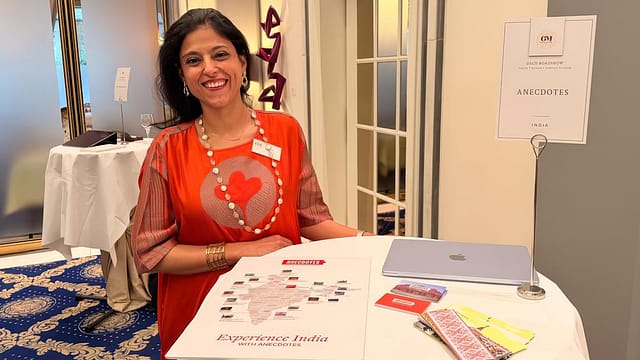
Chadha, cofounder and CEO of Anecdotes--a leisure travel design company that creates discovery-led journeys--has built her proposition on the attention that goes into those decisions. “Through travel operations, our role is always to be the only ones in the room thinking about the next hour, next step, next day and the overall experience of the itinerary,” she says.

Look Who's Talking Regime Change
23 Oct 2026 - Vol 05 | Issue 43
Sometimes that means rescuing an arrangement. Sometimes it means advising against it in the first place.
THE BUSINESS OF 'NO'
Two guests, both over 60, are planning their first visit to Italy. Tuscany and the Amalfi Coast are on the list. Pisa is familiar from their research. Visiting every Amalfi town has its own pull.
Chadha’s team advises against trying to do it all.
The guests’ pace, the limited time and the need to keep walking to a minimum count for more than another tick on a list. Driving to a famous tower would eat hours that could be spent differently. “The reaction from customers tends to always be why not,” she says.
Other people have recommended these places. The guests have heard about them. The company’s job, she explains, is to let them decide with all the details in front of them.
The same thinking has led the team to leave an Alexandria excursion out of some programmes for guests staying in Cairo. A long day on the road might offer little pleasure to somebody with limited interest in the sights and little appetite for the drive. Similar conversations arise with foreign guests keen on a Delhi-to-Agra train journey: the experience has appeal, but road travel may better suit their schedule and desire for flexibility.
Travel planning comes with an invisible entourage: the friend who insists, the relative who went last year, the list that promises ten things nobody should miss. A traveller may be paying somebody to help negotiate with all of them.
The appeal also lies in escaping the holiday that feels suspiciously like another working day: an early start, a crowded schedule and the nagging sense of falling behind.
Marketing and branding experts reckon that travellers can have plenty of information and still struggle to decide what is right for them.
"For those with limited holiday time and the means to pay for help, the value lies in having somebody understand their preferences and make the choices less exhausting,” says Ashita Aggarwal, professor of marketing at SP Jain Institute of Management & Research. Personalisation, she adds, becomes meaningful when it changes the trip. A later start, fewer hotel changes or an afternoon left free can matter more than another attraction squeezed into the programme.
For Anecdotes, deciding what suits the traveller also means deciding which bookings suit the business.
Anecdotes declines flight-only and hotel-only bookings because it sells end-to-end experiences. It has turned down low-budget travel requests from overseas partners where it did not believe the proposed hotel category could deliver consistent service. Clients who want to book every hotel and activity themselves, then hand over a transfer, may also be directed elsewhere.
“We are not for every budget traveller,” Chadha says. Her test for a request is straightforward: “How can we add value?”
If the team cannot improve the experience, the arrangements, the economics of the stay or the time spent planning it, the company acknowledges that it may be the wrong partner.
THE GIRAFFE BEFORE THE BUSINESS PLAN
Dusk is giving way to night on the return from an evening safari in South Africa’s Kruger.
Chadha has seen a pride of lions for the first time. A giraffe has appeared above the trees. As stars emerge, she remembers a few seconds of complete fulfilment.
This is what she wants travel to make possible. The animals supplied the spectacle. The feeling on the way back was what she carried home.
Other journeys deepened it. Walking through Kolkata’s Durga Puja pandals, she was struck by the scale of artistic expression and the faith behind it. On the Ganges at sunrise, the sound of a flute became part of how she experienced the river.
These are the moments she wants to build journeys around.
Her background spans marketing, consulting, entrepreneurship and travel. She has lived and studied across countries, with hospitality and travel part of her environment growing up. An alumna of Columbia University and Warwick Business School, she now leads Anecdotes’ brand strategy and experience philosophy.
She and co-founder Sandeep Dayal began talking during the pandemic, when travel was nearly impossible. Dayal brought more than four decades in destination management, including work developing charter tourism into Goa and relationships across international markets. As co-founder and chief mentor, he supplies the long view of destinations and the people who bring them alive.
Their first signature journey, in 2021, was a professor-led trans-Himalayan expedition from Kashmir to Ladakh. Around 20 guests joined despite the pandemic’s influence. Chadha regards it as the validation that kept them going. The brand became fully operational in 2022.
It was launched within the established travel business JourneyMart, funded through the co-founders’ capital and work. “We had everything at risk at the time, as we began at a time when everything was uncertain,” she says. The business took shape journey by journey.
THE BRIEF BEHIND THE BRIEF
Some clients begin with a place. Others begin with a condition.
One guest supplies a temperature range, roughly 12–20 degrees, for the chosen travel period. The destination will follow.
That sends the team looking at different regions and seasons: Japan towards the end of the year, for instance, or the southern Mediterranean in autumn to avoid the hottest summer months.
Anecdotes is being asked to work backwards from how somebody wants to feel.
A couple interested in golf, food and landscapes gives the team a month, a budget and their preferences. The search runs through golfing destinations from Asia to Europe and settles on Scotland and Ireland.
Chadha says an AI-generated route offered familiar courses and connections. Then the couple’s habits began rewriting it.
They will not begin a journey before 10 am. Flights need to accommodate their seating preferences. Their interest in food shapes hotel choices and adds a Michelin dining stop to the route. Golf requires suitable courses and selected tee times. Castle stays add another layer.
The map can hold a great deal. The couple’s mornings have to hold breakfast.
This is where the business has to justify its fee. Producing a route is increasingly easy. Choosing and securing arrangements that fit the person following it takes more work. Anecdotes incorporates service fees into some product prices and charges a separate design fee for assignments involving extensive curation or management.
A business that understands a traveller’s interests can become useful across several holidays. Food might shape one journey, wildlife another and a family celebration the next. "The opportunity is to build a relationship in which the customer trusts the company’s judgement enough to return with a different brief,” says Aggarwal.
Technology raises the standard for earning that trust, she adds. When a suggested route is easily available, the paid service must prove its worth through better choices, dependable arrangements and help when plans unravel.
Some briefs make that distinction particularly clear. A group of international students wants to explore ancient Indian civilisation, taking the planning towards places including Sanchi and Dholavira.
They also want a cricket match with a local team. A site can be added to a programme. A match requires somebody willing to field a side.
NO, WITHIN THE GROUP
Personal attention gets harder with every person added to the vehicle.
Anecdotes’ fixed-date group departures average 12–16 guests. Chadha says the team speaks to travellers personally before departure to understand their interests and help establish a shared purpose.
But preferences can diverge on the road.
During a Kolkata Durga Puja journey, some guests want to visit other pandals they have discovered through their own research. The group already has shared vehicles, timings and arrangements. Changing course would affect everyone.
The team explains the constraints and offers the option of separate private arrangements to those who want to branch out.
Personal attention has to account for the other people in the vehicle.
YES, WITH CONDITIONS
Elsewhere, an unusual brief opens up an overlooked destination.
A request for heritage, music and food leads to Bhopal, a city Chadha says many of the prospective guests had neither visited nor considered for a leisure holiday.
Out of that conversation comes “Begums of Bhopal”: a predominantly female group, heritage accommodation, walks with storytellers, thematic culinary evenings and a Sufi music performance arranged for the guests.
In Agra, a walk through Itimad-ud-Daulah, commissioned by Empress Nur Jahan in memory of her father, introduces the influence of women in Mughal history before the travellers reach the Taj Mahal.
Elsewhere, the encounters turn intimate. In Meghalaya, a young choir sings for guests in a local resident’s home. In Varanasi, Kabir Panthis perform for a group by the ghats during Dev Deepawali. In Kutch, a sunset musical experience brings guests into contact with a local tradition.
Access also comes with boundaries. At private collections in Agra and Jaipur, guests are allowed to visit, but photography is restricted.
The right of refusal belongs to the people opening their homes and collections. A camera does not acquire privileges simply because its owner has paid for the trip.
Younger guests bring ideas worth hearing, too. On a three-generation Southern Africa journey, researched recommendations from the Gen Z members change restaurants, activities, routing and time spent along the way.
Most Anecdotes travellers are 40 or older. The elders generally retain the final booking and payment decisions, but younger family members increasingly influence the experience.
And when social media turns a hidden gem into everybody’s discovery, the company has to keep looking.
WHEN THE CITY STOPS
Then come the days when every preference gives way to logistics.
Chadha describes a rain-related disruption that brings a city to a standstill. Close to 30 vehicles meant to take guests to the airport are blocked.
Flights are still scheduled. Around 100 people need to get there.
Within hours, the team has to gather available vehicles and buses through its network and reorganise the transfers. The task is to move guests safely while keeping them informed and reassured.
The guests see the changed arrangement. Behind it are the calls, the available capacity and the decisions about what can still be made to work.
Another time, a Delhi programme has to change overnight after the team learns of road closures affecting planned heritage visits. Alternative experiences must be found, overseas partners consulted and approval secured.
Such interventions demand attention before their financial cost can be counted. Chadha says safety and the continuity of the guests’ experience dictated the decisions.
The company says it recorded approximately ₹18.6–19 crore in total booked revenue in FY26 across international land tours, cruises and India travel experiences. From its inception in 2021 through March 2026, it served close to 5,000 guests, with approximately 1,500 travelling in the last year. Repeat customers and referrals account for 30–40% of its business, it says. The team has grown from approximately three members in 2021 to close to 20 today.
The operating challenge is easier to identify: more customers bring more chances for several journeys to develop problems at once.
THE PERSON STILL HAS TO ANSWER
Chadha does not point to one spectacular low.
She describes an accumulation: cancellations of trips for which deposits had been paid, flight disruptions, several ongoing journeys developing concerns together, and strains with colleagues or partners.
Some expensive early lessons involved trust. The team accepted business in anticipation of referrals, worked with partners whose outlook later proved incompatible, and invested in products or regions because they were trending.
“We lived and learnt through each,” she says.
The fear that follows her is of letting the company down. She speaks of Anecdotes as a living being the team has nurtured, and worries about it losing the trust of guests, the support of colleagues and the value it has created.
“I’ve learnt to accept the roller coaster, well at least try,” she says.
Talking through problems with her co-founders helps. The following morning, her job is to show up and keep moving.
Bootstrapping puts its own limits on the itinerary. Technology, recruitment, product development and customer acquisition compete for investment. Supplier terms vary across countries, while disruption and cancellations complicate cash flow. Chadha says the company has not approached outside investors, though it would consider a partner with the right fit.
Growth also means letting go. She remains involved in complex routing and collaborations, and sometimes leads a group herself when a journey has, in her words, “multiple moving parts to a seamless experience”.
The task is to make the team capable of delivering the attention customers expect without every difficult decision returning to a founder.
But personal attention has a cost, and a growing business has to recognise it in its pricing, staffing and partner arrangements. "If every complicated request needs a founder, growth can stretch the very service customers are paying for,” says Aggarwal.
The discipline, she adds, lies in making the underlying work repeatable: recording preferences, briefing partners, preparing alternatives and giving employees the authority to resolve problems. That creates room for individual attention without requiring every journey to be managed from scratch.
For Chadha, the next stage is to make more of that judgement available without being present herself.
The traveller may remember the choir in a Meghalaya home, the evening in Bhopal or the pleasure of an unhurried morning. Delivering those memories requires a team capable of handling the less memorable work.
In Uzbekistan, it came down to an immediate assignment. Get them on the next train.