Samsung’s TV Crown Under Siege: How TCL, MiniLED Rivals and India’s Price Wars Are Squeezing Profits
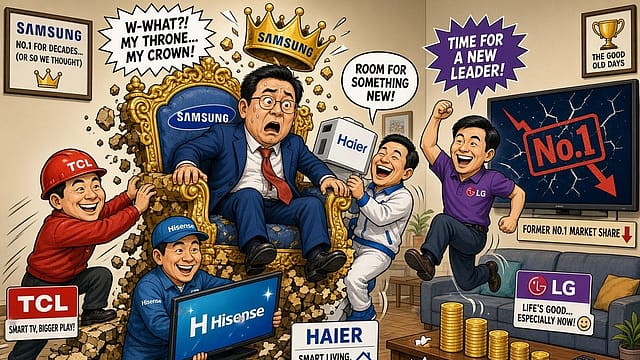
For almost two decades, the television set had one answer to every question.
Who owned the living room? Samsung.
Who could persuade a family to replace a perfectly functional screen with something larger, thinner, brighter and considerably more expensive? Samsung.
Who transformed QLED, Neo QLED, OLED, 4K, 8K and artificial intelligence from engineering terms into reasons to visit an electronics store? Samsung.
The South Korean company has remained the world’s largest television brand since 2006. In 2025, it controlled 29.1 per cent of the global TV market by value, according to Omdia. Among televisions priced above $2,500, its share was an extraordinary 54.3 per cent.
Then came a number that turned this 20-year victory lap into a warning.
Zeroing In on ECI
09 Oct 2026 - Vol 05 | Issue 41
Constitutional legitimacy versus political opportunism
During the quarter ended June 2026, Samsung’s visual-display and digital-appliances businesses generated KRW 14.5 trillion in revenue—and recorded a slight operating loss. The television king was still selling televisions. It had stopped making money from the kingdom.
The warning has now travelled to India.
Samsung India has reportedly asked between 80 and 100 executives in its television and home-appliance businesses to leave. Director-level employees, team leaders, branch managers and area managers are among those affected. As much as 25 per cent of the electronics sales-and-marketing workforce, including employees hired through staffing agencies, could eventually be affected.
Another round may follow Diwali.
Regional offices are being combined. Ranchi is reportedly being folded into Patna; Delhi into Gurgaon; Punjab into Chandigarh. Samsung has also considered merging the sales operations of its television and home-appliance businesses, which use many of the same retailers and distribution channels.
Read together, these are more than cost cuts. They raise a larger question about one of the world’s most successful consumer-electronics companies:
What is happening to Samsung’s original empire?
A Crown Under Siege
Samsung has certainly not collapsed in televisions.
It remained the global shipment leader with a 17 per cent share during the first quarter of 2026. Its TV shipments increased 8 per cent from a year earlier, the company’s strongest growth in nearly two years.
The trouble was visible immediately behind it.
TCL’s shipments grew 22 per cent during the same quarter. The Chinese company reached a 14 per cent share, reducing Samsung’s lead to fewer than three percentage points.
By June, the challenger had crossed one of the gates.
Counterpoint Research found that TCL held 13.8 per cent of global LCD-TV shipments that month, against Samsung’s 13.7 per cent.
The comparison does not mean TCL has taken Samsung’s overall television crown. It does mean that in LCD—the technology underpinning most televisions sold worldwide—the two companies are effectively tied. Counterpoint analyst Hyunwoo Kang said they are now competing across virtually every price tier, from entry-level screens to premium MiniLED and RGB MiniLED models.
Samsung had spent years looking down at its challengers. One of them was now standing beside it.
The fight has also shifted into technologies Samsung once used to defend its premium prices. Samsung introduced MiniLED televisions in 2021 and quickly became the category leader. It still led the market in 2023.
Then the hierarchy overturned.
TCL passed Samsung in 2024. Hisense followed. So did Xiaomi. By the first quarter of 2025, Counterpoint ranked Samsung fourth in MiniLED unit shipments and third by revenue.
The company that helped legitimise MiniLED had become the premium-priced follower in a technology it once dominated.
Counterpoint research director Bob O’Brien identified the consumer arithmetic driving the shift. At similar prices, a buyer is increasingly offered a choice between a smaller OLED television and a larger MiniLED screen.
“An increasing number of consumers are choosing MiniLEDs,” he said.
TCL says its MiniLED television shipments increased 118 per cent in 2025, giving it 31.1 per cent of that global category. Hisense claims 57.1 per cent of worldwide shipments in televisions measuring 100 inches or more. LG remains the entrenched name in OLED screens and continues to hold more than half of that global market.
These companies have attacked different walls of Samsung’s fortress.
TCL offers MiniLED performance at aggressive prices. Hisense has seized the ultra-large-screen market. LG retains formidable brand equity in appliances and OLED televisions. Haier has been the world’s largest major-appliance brand by sales volume for 17 consecutive years.
The competitive hostility is no longer confined to retail shelves.
On September 1, TCL sued Samsung in the United States, alleging that certain Samsung televisions were falsely marketed as using MiniLED technology. Samsung rejected the allegations and said it would vigorously defend the accuracy and quality of its products.
A television technology that Samsung once used to command premium prices has become the subject of a price war, a market-share battle and a courtroom fight.
The company still dominates the global television market by value. Its lead by units is considerably less comfortable.
That gap explains both Samsung’s strength and its vulnerability: it can still sell expensive televisions, but Chinese rivals are acquiring scale, closing the technology gap and invading the premium categories where Samsung earns its margin.
Samsung & the India Promise
India was supposed to produce a very different story.
In January 2025, J B Park, Samsung’s president and chief executive for Southwest Asia, predicted that televisions and home appliances would grow rapidly enough to match the company’s mobile-phone business in India within three years.
The ambition was effectively a 50:50 revenue split. The starting point revealed how enormous that leap would be.
In FY24, Samsung India generated approximately ₹71,158 crore from mobile phones and accessories. Home appliances produced ₹11,350 crore, while the audio-visual division, principally televisions, contributed another ₹7,115 crore.
Together, televisions and home appliances brought in approximately ₹18,465 crore. Mobile phones were nearly four times larger.
Samsung expected low product penetration, rising middle-class incomes, smaller cities, consumer financing and AI-equipped appliances to close the distance. It planned to double its network of economy-focused Samsung Experience Stores and push financing deeper into states where monthly instalments were crucial to purchases.
The company had also declared that AI-powered models would produce 70 per cent of its appliance sales by 2025.
Its confidence was understandable. India’s consumer-durables market is expected to grow rapidly through the decade. Refrigerator and washing-machine penetration remains far below developed-market levels. Consumers are buying larger televisions, energy-efficient air conditioners, front-loading washing machines and premium refrigerators.
But India is not one market moving in one direction.
Counterpoint analysts Umang Jain and Anshika Jain found that Indian smart-TV shipments declined 3 per cent during the first quarter of 2026, principally because weaker household budgets hurt entry-level demand.
Premiumisation continued inside that slowdown
Televisions measuring 55 inches and above became the fastest-growing category and approached one-third of total shipments. QLED accounted for approximately 30 per cent of the market. MiniLED shipments increased more than thirteenfold from a small base.
Indian consumers were not abandoning television upgrades. They were splitting into two camps: those delaying a large discretionary purchase, and those using financing and falling technology prices to buy a much larger screen.
That is attractive terrain for every manufacturer chasing premium margins.
TCL and Samsung maintained their lead in Indian QLED shipments while Xiaomi recorded significant growth. MiniLED was increasingly positioned as an affordable alternative to OLED—precisely the technological trade-off that has helped Chinese manufacturers attack Samsung globally.
The market is growing. Samsung’s problem is the number of companies growing inside it.
LG’s listing documents describe it as India’s offline-market leader across washing machines, refrigerators, panel televisions, inverter air conditioners and microwaves. The offline channel represented approximately 80 per cent of India’s major-appliance and consumer-electronics market, excluding mobile phones, when the prospectus was prepared.
Haier, Whirlpool, Godrej, Voltas, Blue Star, Xiaomi, TCL and a growing set of online-first brands crowd different price bands. LG is investing heavily in additional Indian manufacturing. Warburg Pincus and Bharti Enterprises agreed to acquire a combined 49 per cent of Haier India in a transaction reportedly valuing the company at approximately ₹15,000 crore.
Capital, factories and distribution muscle are gathering around Samsung’s old shelves.
By FY25, home appliances still represented only around 11 per cent of Samsung India’s sales. The company has not publicly supplied the product-level FY26 numbers required to measure its progress towards the promised 50:50 mix.
The organisational direction, however, is difficult to miss. A business expected to expand rapidly is removing managerial layers, combining branch offices and preparing to merge sales functions.
The Price of Defending Share
Samsung appears to have chosen an aggressive defence in India.
Television and air-conditioner prices across the industry reportedly increased by approximately 15–20 per cent as component costs rose. Samsung limited its increases to around 10–14 per cent.
That may help protect sales. It also places more pressure on margins.
Counterpoint found that the early stages of memory inflation had only a limited effect on Indian television prices because leading brands initially used existing inventory to absorb the increase.
By April, that protection had begun to disappear.
Prices of entry-level 32-inch televisions increased by approximately 14–15 per cent. Counterpoint warned that rising component costs would make aggressive pricing increasingly difficult, particularly in the highly competitive budget segment.
Samsung faces an uncomfortable choice. It can pass those costs to households already postponing purchases—or absorb them while defending market share from cheaper rivals.
Either decision punishes the business.
A growing portion of Samsung’s television and appliance sales is reportedly generated online, where shoppers can compare models and prices within seconds. Premium branding becomes harder to monetise when a competing 55-inch television offers MiniLED, 4K resolution, built-in streaming applications and a long warranty for substantially less.
Televisions have become larger and smarter. They have also become brutally comparable.
Counterpoint associate director Sujeong Lim attributed TCL’s international progress to its ability to offer advanced technologies such as MiniLED at competitive prices, particularly in cost-sensitive emerging markets.
That description could just as easily be a warning addressed to Samsung India. The same pressure has spread through refrigerators and washing machines. Connected features, inverter compressors, app controls and AI-branded washing cycles once distinguished premium machines. Rivals now offer similar language and increasingly similar features at lower prices.
Samsung’s technological vocabulary is being democratised faster than Samsung can defend its premium.
Its global results show the deterioration. In the June 2025 quarter, the television-and-appliance businesses generated KRW 14.1 trillion of revenue and KRW 0.2 trillion of operating profit. In the March 2026 quarter, revenue reached KRW 14.3 trillion while operating profit remained KRW 0.2 trillion.
Three months later, revenue edged up to KRW 14.5 trillion—and the division slipped into an operating loss.
More sales did not rescue the margin.
Samsung had already decided to stop selling certain televisions and home appliances in mainland China, where local companies had eroded its price competitiveness. Its Chinese factories could continue supplying overseas markets, but the withdrawal from the world’s largest television market carried an unmistakable message.
Samsung’s old formula of global technology, premium branding and enormous distribution could no longer guarantee victory everywhere.
India is not China. The Samsung brand remains powerful here, and the company continues to rank among the leading names in televisions, refrigerators and washing machines.
Yet the forces that defeated it in China have begun travelling: Chinese scale, improved product quality, access to domestically produced LCD panels, local manufacturing, online pricing and rapid movement into premium categories.
The Chip Division’s Cruel Gift
Samsung’s predicament contains an extraordinary corporate irony. The company is making more money than ever.
It reported KRW 89.5 trillion in operating profit for the June 2026 quarter. Its semiconductor division alone contributed KRW 89.2 trillion—approximately 99.7 per cent of the group total.
AI infrastructure has created voracious demand for memory. Prices have soared. Samsung’s semiconductor factories are enjoying one of the greatest profit booms in the company’s history.
Those same memory prices are raising the cost of making televisions, appliances and smartphones.
The business producing almost all the profit is helping make life harder for the businesses through which most consumers recognise the Samsung name.
Samsung’s mobile-and-networks operation also recorded an operating loss of KRW 0.7 trillion during the June quarter, despite year-on-year revenue growth driven by its Galaxy S26 and Galaxy A devices. The company attributed the pressure partly to elevated component costs.
India’s smartphone market presents a similar complication.
Phones still contribute the overwhelming majority of Samsung India’s revenue. Yet Indian smartphone shipments fell 4.1 per cent during the March quarter and another 11 per cent during the June quarter as rising prices damaged affordability.
Samsung slipped from second to third place in the June quarter, with a 16 per cent shipment share behind Vivo and Oppo.
IDC India found that the country’s average smartphone selling price reached a record $302 in the March quarter, an increase of 10.4 per cent. Senior research analyst Aditya Rampal said persistent memory inflation had restricted the discounts and channel promotions brands normally use to stimulate demand.
The distinction is not that smartphones are flying through an uncomplicated boom. They are proving more defendable than televisions and appliances.
Phones have shorter replacement cycles, stronger festive pull and a mature financing machine.
Counterpoint Research expects financed purchases to account for 42 per cent of Indian smartphone sales in 2026, up from 35 per cent a year earlier. Samsung leads the market in units sold through financing.
Counterpoint senior analyst Prachir Singh credits Samsung Finance+, long repayment tenures and the company’s extensive mainline retail network. Research director Tarun Pathak expects financing, upfront discounts, exchange programmes and festive offers to become increasingly important as memory costs intensify.
A smartphone can, therefore, be protected by a monthly instalment, a trade-in and a replacement habit that has become difficult to break.
A television, refrigerator or washing machine is easier to postpone.
The mobile organisation has reportedly been spared from the present layoffs because Samsung expects festive demand to improve. Its protection may depend on what happens over Diwali.
The television and appliance cuts could therefore be the first act of a wider consumer-device restructuring.
From Selling Screens to Selling Attention
Samsung’s answer may eventually lie beyond hardware.
The company says it intends to expand Samsung TV Plus, diversify its content and grow its television-advertising business. That turns every television already installed in a home into a potential source of continuing revenue.
The economic logic is compelling. A manufacturer earns from a conventional television once. A connected-TV platform can keep earning through advertising, content partnerships, viewing data, services and commerce long after the screen leaves the store.
Samsung’s new television leadership has reportedly been asked to emphasise platform businesses alongside hardware. The company that mastered selling screens now wants to monetise the attention flowing through them.
That transition will not be simple.
Amazon, Google, Roku and operating-system providers are competing for the same connected-TV advertising pool. Television manufacturers must also persuade consumers, advertisers and content companies to remain inside their ecosystems.
Chinese manufacturers are attacking from the other direction. Their growing installed bases could eventually support advertising and platform businesses of their own.
Samsung possesses a vast installed base. What it no longer possesses is an uncontested route to the revenue generated by that base.
The Layoff Is the Clue
Samsung India remains hugely profitable as a consolidated company. Its FY25 operating revenue rose 12 per cent to approximately ₹1.11 lakh crore, while net profit increased 38 per cent to ₹11,286 crore.
Those numbers make the workforce reduction more revealing.
Samsung is not cutting television and appliance employees to rescue a collapsing company. It is cutting them while deciding how much organisation its weakening hardware margins can support.
The immediate questions concern the affected people: How many positions will ultimately disappear? How many are on Samsung’s payroll and how many work through agencies? Which regional offices and management layers will be removed? What specific performance after Diwali will determine whether another round begins?
The strategic questions are even larger.
Samsung must disclose whether its television and appliance revenue in India is growing, how much margin it earns from each product category, whether online discounting is destroying profitability and whether the promised 50:50 revenue mix remains achievable.
It must also explain how a vertically integrated conglomerate allocates the burden of surging component prices.
If Samsung’s semiconductor division is earning record margins from memory, do its consumer businesses buy those components at market-linked prices? Does the chip windfall provide any cushion to the divisions being squeezed by that same market? Or is the profit simply moving from the products bearing Samsung’s name to the components buried inside them?
For 20 years, Samsung’s television crown represented innovation, aspiration and pricing power.
The crown remains.
But TCL has drawn level in LCD shipments. Chinese manufacturers have passed Samsung in MiniLED units. India’s television market has contracted even as premium technologies have flourished. The appliance business remains a fraction of the mobile operation it was supposed to match.
The pricing power is under attack. The profit has disappeared. The organisation beneath it is beginning to shrink.
Samsung spent two decades making the television the centre of the home. Its next battle is to stop the centre of the home from becoming a loss leader.