Quick Commerce’s Next Big Test: Can You Trust What Arrives?
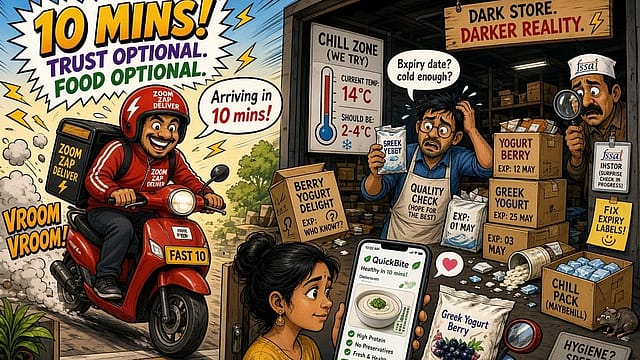
The delivery countdown answers one question very well: when will your groceries arrive?
It tells you much less about what happened before you placed the order. Was the yoghurt stored at the right temperature? How much usable life remains in the bread? Does the “healthy” claim on the screen match the information on the packet?
Those questions are moving closer to the centre of India’s quick-commerce business.
In a recent report, Jefferies reportedly warns that tighter scrutiny by the Food Safety and Standards Authority of India could increase compliance costs and create operational delays for food companies, restaurants and delivery platforms. Advertising, labelling, product authenticity, online listings and warehouse conditions are all coming under greater examination. The implications reach beyond another inspection or another warning notice. Quick commerce has built its appeal around making shopping effortless. Meeting tougher expectations means doing considerably more work behind the screen.

Zeroing In on ECI
09 Oct 2026 - Vol 05 | Issue 41
Constitutional legitimacy versus political opportunism
WHAT IS ACTUALLY CHANGING?
First, an important distinction: existing food-safety obligations, stronger enforcement and proposed new requirements are different things.
In November 2024, FSSAI was already telling e-commerce food businesses to ensure adequate remaining shelf life at delivery, avoid unsupported claims and keep online product information consistent with physical labels. These responsibilities did not suddenly appear with the latest regulatory push.
What is developing is a more detailed argument about how much responsibility platforms should carry—and what customers should know before paying.
Recently, FSSAI chief executive Rajit Punhani reportedly said the regulator was planning changes so customers could see manufacturing dates, expiry dates and batch numbers before ordering. He also said inspections of dark stores and cloud kitchens had begun.
Jefferies’ report reportedly refers to more than 150 notices involving food, beverage, dairy and nutraceutical businesses, and more than 30 involving food-service establishments. Those figures cover a wider food industry; they should not be presented as notices issued exclusively to quick-commerce companies.
The proposed red hexagonal warnings on packaged foods high in sugar, salt or fat also require careful description. Punhani said FSSAI had put the proposal before the Supreme Court and was awaiting a decision. That is a proposal, rather than a packaging requirement already in force.
For businesses, however, even the direction of travel matters. A company planning packaging, software or warehouse expansion must consider what compliance could require next.
WHY AN EXPIRY DATE IS A BIGGER JOB THAN IT SOUNDS
Putting an expiry date on an app sounds straightforward. But keeping it accurate for the actual packet delivered is harder.
Consider a hypothetical order for yoghurt. A nearby warehouse may hold several batches of the same product, each with a different expiry date. The app may show one product page, but the picker must select one particular packet.
If batch-specific information becomes mandatory before purchase, the catalogue, warehouse inventory and picking process would need to stay closely aligned. Substituting another batch could also require the information shown to the buyer to change.
That is an operational implication of the proposal, rather than a claim about its final legal wording. It explains why a seemingly small disclosure can demand investment across several systems.
And the printed date answers only part of the question. Food that requires refrigeration still needs appropriate storage and transport. Government guidance for delivery businesses in England, Wales and Northern Ireland explicitly stresses temperature control and preventing contamination throughout the delivery process.
A fast journey from warehouse to doorstep cannot compensate for poor handling earlier.
THE DARK STORE COMES INTO VIEW
Dark stores—the local warehouses that fulfil online orders—make rapid delivery possible. Customers rarely enter them, which makes their internal processes especially important.
In September, quick-commerce companies were reportedly recruiting quality checkers as scrutiny intensified. Media reports pointed out inspections of 86 facilities in Maharashtra in August, with 14 licences suspended. Those were enforcement actions at particular facilities, rather than proof that every store or platform had failed.
The work involved is unglamorous: checking incoming stock, maintaining temperatures, controlling pests, rotating inventory, removing damaged products and keeping records. It also has to happen repeatedly. A warehouse can pass an inspection and still require close supervision every day afterwards.
For companies, this creates a different kind of expansion challenge. Opening another store adds delivery capacity, but also another location whose practices must be monitored. Central software can help; it cannot replace every physical check.
WHAT THE REST OF THE WORLD SHOWS
India’s debate belongs to a wider reassessment of fast delivery. Different countries are testing different parts of the model.
China offers a particularly direct lesson in platform responsibility. In April 2026, its market regulator announced approximately 3.6 billion yuan in fines and confiscations involving seven e-commerce and food-delivery platforms over failures connected with unverified food vendors and “ghost kitchen” operations. The regulator’s account said platforms had inadequately checked merchants’ business licences.
That case concerned online food vendors, rather than an identical version of India’s grocery-delivery model. Its relevance is nevertheless clear: operating the marketplace can bring obligations to check the businesses selling through it.
France has challenged the physical footprint. In March 2023, the Conseil d’État ruled that the dark stores involved in a Paris dispute were warehouses under the applicable planning rules. Converting conventional shops into them required authorisation, which the city could refuse.
That was a planning dispute, not a food-hygiene ruling. But it exposed another constraint on rapid delivery: companies cannot assume every convenient neighbourhood property can become a fulfilment centre.
Britain provides a useful comparison on information before purchase. Government guidance for food-delivery businesses in England, Wales and Northern Ireland requires allergen information both before the purchase is completed and when the food is delivered.
The principle matters for India’s emerging debate: information that affects a buying decision needs to reach the customer while that decision is still being made.
GROWTH DOES NOT SETTLE THE BUSINESS MODEL
There is also a commercial warning from overseas.
In April 2024, Turkish rapid-delivery company Getir announced its withdrawal from Britain, Germany, the Netherlands and the United States to focus on Turkey. It had once been valued at $12 billion. That retreat illustrates how dramatically expansion plans can change; it does not establish that regulation caused the withdrawal or that Indian platforms will follow the same path.
China, meanwhile, has also confronted the economics of aggressive competition. In June 2026, its market regulator proposed rules addressing food-delivery subsidies and price wars, including measures against forcing merchants to bear promotional costs. That was a separate intervention from its food-safety enforcement.
Together, these developments show the range of pressures on instant delivery: safe products, accountable sellers, permitted premises and a business that can support its promises.
WHO PAYS FOR TRUST?
Jefferies’ warning about compliance costs is plausible. More inspections, training, documentation and stock controls require money and management attention.
But higher costs do not automatically mean a higher delivery fee. Companies could absorb some spending, reduce discounts, change supplier terms or improve efficiency. The eventual outcome will depend on competition and each operator’s finances.
There can also be savings. Better inventory controls could reduce spoilage and refunds. More accurate records could help isolate a problematic batch. Earlier detection of failures could prevent a larger disruption.
Established platforms may find it easier to spread technology and audit costs across many orders. Their scale also exposes them to a harder consistency test: reliable processes must work across every location, including newly opened stores.
For consumers, the useful outcome would be greater confidence in ordinary purchases—clearer information, dependable storage and a way to trace problems when they occur.
None of that inherently requires a rider to travel faster or a customer to wait longer. Much of the work should happen before the order arrives.
Quick commerce taught shoppers to watch the clock. Its next test is whether the business behind that countdown can withstand a closer look.