Investing Is Not Just About Risk and Return, but Also Value Alignment
A few months ago, the Bombay Stock Exchange (BSE) and the National Stock Exchange launched indices that tracked companies based a new ethical framework. BSE’s Saatvik 100 Index monitored stocks that aligned with ‘Sattvik’ principles, and the NSE Nifty500 Ahimsa Index tracked companies based on the principle of Ahimsa. The idea was to allow consumers and the financial markets to cater to a new form of ethical investing, one that stayed clear of businesses engaged in activities that were harmful to animals or those that dealt in addictive substances like tobacco and alcohol.
What will be crucial for such a form of ethical investing to go mainstream is the development of financial products like mutual funds that will allow more investors to go this route. It is still early days, but some such products have begun to emerge. The Wealth Company Mutual Fund, the asset management arm of Pantomath Group, was among the first to offer a fund called The Ethical Fund in 2024.

The Era of Forever Wars
30 Oct 2026 - Vol 05 | Issue 44
Coping with an explosive Middle East
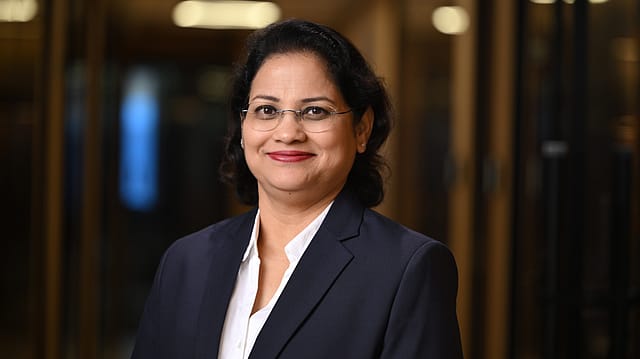
In this interview, Aparna Shanker, the Chief Investment Officer – Equity at The Wealth Company Mutual Fund, talks about how their ethical fund allows investors to build wealth without having to compromise on their values.
What impact will these new indices have?
The launch of both the BSE Saatvik 100 and the NSE Nifty500 Ahimsa Index is a defining moment for ethical investing in India. Until recently, ethical investing was largely viewed as a niche concept. Investors who wanted their portfolios to reflect their values had limited benchmarks and very few products. The creation of dedicated Ahimsa and Saatvik indices changes that by bringing structure.
The two indices serve different needs. The BSE Saatvik 100 is a more concentrated large-cap oriented universe, while the NSE Nifty500 Ahimsa Index provides a broader opportunity set of over 300 stocks across market capitalisations. Together, they create a much stronger ecosystem for belief-based investing.
The indices provide framework, reliability and tool to evaluate performance systematically.
Tell us how The Wealth Company got involved in this concept?
Our work on faith-based investing started much before the launch of these indices. When we began conceptualising The Wealth Company Ethical Fund, our objective was to create a framework that went beyond conventional faith-based screening and was rooted in universal value-based principles. We spent significant time studying global ethical-investing models, ESG approaches, exclusion-based frameworks and Indian philosophical concepts before developing our own Ahimsa-led methodology.
The starting point is identifying activities that are inconsistent with the principles of Ahimsa and Saatvik living. Companies deriving meaningful revenues from cohol, tobacco, gambling, animal cruelty, meat processing, leather, narcotic substances and certain harmful products or practices are excluded from the investible universe.
However, faith-based investing cannot stop at exclusions alone. Once a company clears our filtration screen, it must still qualify on traditional investment parameters including corporate governance, balance-sheet strength, cash-flow generation, capital allocation, competitive advantage and growth visibility.
In other words, we apply two filters: a faith-based filter and an investment-quality filter. A company must satisfy both to become eligible for investment.
The Wealth Company was the first to launch an ethical fund based on Ahimsa and Saatvik philosophy. What led to it?
Many investors consciously make choices about the food they consume, the products they buy and the lifestyles they follow. Yet when it comes to investing, they do not have explicit choice and their investments often end up supporting businesses that may not align with those same beliefs.
We felt there was a need to bridge this gap.
At the same time, we believed India deserved a faith based-investing framework that was not merely imported from global markets. Concepts like Ahimsa, conscious consumption and responsible wealth creation are deeply embedded in Indian culture and have remained relevant for centuries.
The Ethical Fund was therefore created with an aim to give investors the opportunity to build wealth without having to compromise on their values. The idea was not to restrict investors, but to empower them with better choice.
What has been particularly encouraging is that the appeal extends far beyond any specific religious or community background. Investors from diverse backgrounds have connected with the idea of investing in businesses that contribute positively while avoiding sectors they may find difficult to support.
Can you talk about how you shortlist companies for the fund?
Our portfolio construction follows a disciplined two-stage process.
The first stage is faith-based screening. This determines the companies that are eligible for investment under our Ahimsa framework.
The second stage is a combination of fundamental and quantitative research. Here we analyse businesses using the same level of rigour expected from any actively managed equity fund. We evaluate management quality, corporate governance, industry structure, return on capital, earnings sustainability, free cash flow generation, growth opportunities and valuation with anendeavour that the returns are not compromised under the umbrella of faith-based investing.
The faith-based filter determines the universe. Investment merit determines the portfolio.
Only companies that satisfy both requirements make it into the final portfolio.
How receptive have investors been? Have you seen growing interest?
The investor response has been highly encouraging and validates a trend we have been observing globally: investors increasingly want alignment between their capital and their values.
Over time, the conversations have evolved. Investors are now asking deeper questions about faith-based capital allocation, sustainability of business models and long-term societal impact.
We are also seeing interest from investors who may not necessarily be looking for a faith-based solution, but who appreciate avoiding businesses associated with addictive products, animal cruelty or other activities they do not wish to support.
The launch of dedicated faith-based indices by both major exchanges is likely to further accelerate awareness and acceptance. It validates that ethical investing is evolving from a niche idea into a recognised investment category.
Many people may feel ethical investing would underperform compared to traditional investing. What has your experience been?
I believe this is one of the most persistent myths in investing.
The assumption is that excluding certain sectors automatically reduces return potential. Our experience says long-term wealth creation is driven by business quality, earnings growth, governance standards, capital allocation and valuation discipline.
Over long periods, disciplined stock selection and sound portfolio construction matter far more than whether the investment universe is filtered through an ethical lens.