Pernia’s Sells Luxury. Its ₹680-crore IPO Will Help Pay the Rent
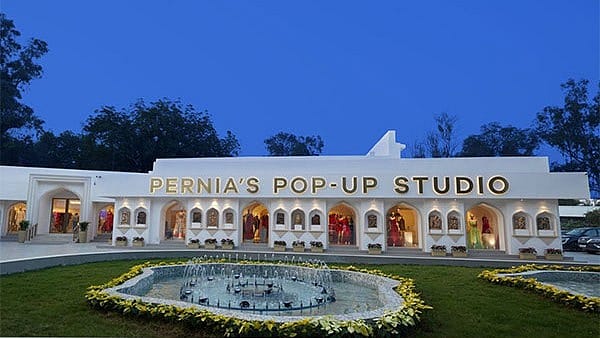
Pernia’s Pop-Up Shop sells lehengas that can cost more than a small car, jewellery designed for large weddings and the reassuring privilege of not having to ask the price too loudly.
Its parent company is now selling something else: equity.
Purple Style Labs will open its ₹680-crore initial public offering on August 31 at a price band of ₹546 to ₹575 per share. At the upper end, the company will command a post-issue valuation of approximately ₹4,604 crore.
The issue has already dressed well for the occasion. Purple Style Labs raised ₹306 crore from anchor investors, including funds connected to ICICI Prudential, Aditya Birla Sun Life, Jupiter, Morgan Stanley and Bank of America. The entire IPO is a fresh issue. Existing shareholders are not selling their stakes.
That is the flattering mirror.

Zeroing In on ECI
09 Oct 2026 - Vol 05 | Issue 41
Constitutional legitimacy versus political opportunism
But the trial-room light is less forgiving. Purple Style Labs reported a loss of ₹285.4 crore in FY26 on revenue of ₹557.8 crore. It has generated negative operating cash flow for three consecutive years. Borrowings more than tripled during FY26, finance costs surged and total equity turned negative.
The most provocative disclosure concerns the use of the IPO money. The company plans to spend ₹371.13 crore on rentals for its Indian experience centres and back-end offices through part of FY30. Another ₹138.9 crore is intended for sales and marketing.
Pernia’s sells luxury. Public shareholders will help pay for the rooms in which it is displayed.
The Loss Looks Terrible. The Explanation is Better
The ₹285.4-crore loss is large enough to exceed half the company’s FY26 revenue. It is also a number that requires dissection.
According to Purple Style Labs’ red herring prospectus, ₹117.93 crore of the FY26 loss arose from an exceptional employee share-based-payment expense. Depreciation and amortisation increased 84 per cent to ₹100.75 crore, while finance costs rose 83 per cent to ₹97.09 crore.
Several large-format experience centres operated for only part of the financial year. Their costs arrived before a full year of revenue.
The underlying business, therefore, looks less alarming than the bottom line suggests. Purple Style Labs reported EBITDA of ₹30.37 crore in FY26. Its operating profit before working-capital changes remained positive at ₹38.81 crore. Revenue also recovered 13.9 per cent after declining in FY25.
This distinction matters. Purple Style Labs is not an enterprise without sales, customers or operating profit asking the market to finance a fantasy. It is an established luxury retailer attempting an expensive transformation.
The uncomfortable part is that the transformation has weakened its immediate operating economics. EBITDA declined from ₹41.99 crore in FY25 to ₹30.37 crore in FY26. The EBITDA margin contracted from 8.57 per cent to 5.44 per cent.
The stores may need time to mature. The IPO will partly finance that time.
An Online Marketplace Walked into a Very Expensive Store
Purple Style Labs acquired Pernia’s Pop-Up Shop in 2018, when the business was predominantly digital. It subsequently expanded into large physical experience centres in India and stores in London and New York.
The shift rests on a sensible understanding of luxury.
A wedding garment costing several lakhs is rarely purchased like a phone charger. Customers want to touch the fabric, inspect the embroidery, discuss alterations and receive reassurance that the outfit will arrive before the baraat.
Physical retail can deepen trust, increase order values and create a theatrical experience that a website cannot reproduce. Luxury has always understood the commercial value of chandeliers.
Pernia’s numbers offer some support for the strategy.
Its average order value increased from ₹45,513 in FY24 to ₹75,505 in FY26. Repeat customers rose from 22.29 per cent to 28.8 per cent of the total customer base. The proportion of orders placed by repeat customers increased from 28.4 per cent to 34.72 per cent.
“These stores are not merely distribution points; they are part of the luxury product,” says Ashita Aggarwal, professor of marketing at SP Jain Institute of Management & Research. For high-value occasionwear, the setting, curation, personal attention and confidence of delivery influence what the customer is willing to pay. A powerful physical experience can strengthen both trust and pricing power.
But the same strategy has transformed the nature of the company.
Online channels contributed 15.68 per cent of Pernia’s gross merchandise value in FY24. By FY26, their share had fallen to 9.05 per cent. More than 90 per cent of GMV now comes from offline channels. Pernia’s may retain the reach and convenience of a digital marketplace, but its economics increasingly resemble those of a physical luxury retailer: premium locations, long leases, security deposits, fit-outs, staff, inventory and rising fixed costs.
The internet brought Pernia’s customers. The stores brought it rent.
The IPO Is Not Metaphorically Paying Rent
The largest proposed use of the IPO proceeds deserves precise treatment.
Purple Style Labs intends to invest ₹371.13 crore in its retail subsidiary to meet lease rentals for 12 Indian experience centres and two back-end offices from FY27 through the first three quarters of FY30.
These are actual rental payments under existing lease agreements, not merely an accounting adjustment. The leases provide for rental escalations of up to 15 per cent every one to three years.
The company’s large-format centres account for a growing proportion of its lease expenditure. These stores may eventually generate enough revenue and operating leverage to justify the cost. Public capital will finance much of the intervening period.
“Using equity capital for rent is not inherently improper when the stores are central to the expansion strategy,” underlines Jai Vardhan, senior writer and cofounder of Entrackr, a media venture tracking startups and the internet economy in India. But lease commitments and marketing are recurring features of retail. "The important question is what happens after the IPO money is exhausted," he says. The new stores must begin producing enough cash to sustain themselves.
Purple Style Labs can reasonably argue that it is not using IPO money to preserve an unchanged business. It is funding the infrastructure and customer acquisition required to create a much larger one.
But the distinction remains critical: the proceeds will finance an expansion strategy while also meeting recurring expenses that the business cannot yet comfortably carry from its own cash flows.
₹139 Crore to Make Luxury Feel Desirable
The company also proposes to spend ₹138.9 crore on sales and marketing between FY27 and FY30.
Luxury cannot survive on product alone. It requires storytelling, aspiration, curation, celebrity, events and a steady reinforcement of exclusivity. Pernia’s competes not merely for transactions but for a place inside the Indian wedding imagination.
Purple Style Labs has actually reduced its sales and marketing expenditure over the past three years. It declined from ₹54.11 crore in FY24 to ₹30.16 crore in FY26, falling from 10.73 per cent to 5.41 per cent of revenue.
The proposed IPO allocation therefore represents a deliberate reacceleration.
That could work. Pernia’s has a recognised name, access to more than a thousand active designer brands and a customer base willing to spend heavily on occasionwear. Strategic marketing could increase traffic to stores whose costs have already been incurred.
It could also become a treadmill.
“A luxury brand must purchase attention before it earns memory, but marketing cannot permanently compensate for weak store economics,” Aggarwal says. The strongest outcome would be a cycle in which experience creates loyalty, loyalty produces repeat purchases and repeat purchases reduce the amount the company must spend to reacquire growth.
The measure of success will not be how many customers marketing brings through the doors, but how many return without having to be purchased all over again.
Fewer Customers, Much Larger Bills
One of the most interesting transformations is visible in the customer count. Pernia’s served 92,672 customers in FY24. That fell to 70,651 in FY25 and 66,713 in FY26. Meanwhile, average order value rose 66 per cent across those two years.
This is partly intentional. Since early 2024, the company has reduced lower-value products and designers and concentrated on more premium brands capable of generating higher sales and profitability.
The strategy gives Pernia’s a sharper luxury identity. It may also improve unit economics by attracting customers who place larger orders and require fewer discounts.
Yet it creates concentration risk. The company is increasingly dependent on a smaller pool of affluent shoppers spending far more on every visit.
Nearly 78 per cent of FY26 GMV came from womenswear. The business remains heavily exposed to Indian weddings and occasionwear. A slowdown in discretionary spending, change in fashion preferences or moderation in extravagant wedding consumption could travel quickly through its stores.
“Reducing low-value customers can be intelligent if the customers retained are loyal and profitable,” reckons Vardhan. But a rising average order value does not automatically establish a stronger franchise. It must be accompanied by improvements in customer lifetime value, store productivity and contribution margins.
Luxury sometimes succeeds by selling more to fewer people. Pernia’s now has to prove that its fewer people are enough.
A ₹75,000-Order Can Still Produce Poor Economics
High ticket sizes create their own optical illusion.
A ₹75,000 average order sounds luxurious. It does not reveal how much cash survives after payments to designers, premium rent, employees, logistics, alterations, marketing, finance costs and inventory losses.
Purple Style Labs held inventory worth ₹163.38 crore at the end of FY26, equivalent to approximately 171 inventory days. Its provision for inventory obsolescence almost doubled in two years, rising from ₹9.28 crore in FY24 to ₹18.36 crore in FY26.
The company partly operates on a back-order model, which reduces the need to hold every product. It also purchases some merchandise outright from designers for display and sale at its experience centres.
Large stores need large collections. Large collections trap capital. Designer fashion may not perish like food, but it can age rapidly when tastes, colours, silhouettes and wedding trends move elsewhere.
“Brand glamour does not repeal retail mathematics,” underlines Vardhan.“A high-value order may still generate modest cash after designer commissions, inventory, premium rentals and customer-acquisition costs. GMV and average order value reveal only part of the economics. "The cash produced by each mature store will reveal much more,” he adds.
Debt Arrived Before Operating Leverage
The store expansion has already changed the balance sheet.
Purple Style Labs’ borrowings increased from ₹112.79 crore in FY25 to ₹371.4 crore in FY26. Finance costs rose to ₹97.09 crore. Its debt-service coverage ratio fell to 0.08, while total equity became negative at ₹52.28 crore.
The company also carried negative retained earnings of ₹710.29 crore as of March 2026.
Its operating cash flow has remained negative for three consecutive years: ₹31.34 crore used in FY24; ₹45.19 crore used in FY25; and ₹34.9 crore used in FY26. Purple Style Labs attributes the cash consumption to security deposits, accumulated GST input credit and the inventory required for its large-format expansion. It also points out that operating profit before working-capital changes remained positive.
Both statements can be true.
The core operations can generate a modest profit before working capital while the chosen growth model consumes cash through rent, deposits and clothes waiting to be sold.
"That is precisely why the IPO matters. It shifts much of the immediate financing burden from an already stretched balance sheet to fresh equity capital," says Vardhan.
Pernia’s Owns the Room, Not Every Reason People Enter It
Pernia’s has built a powerful aggregation model by bringing numerous Indian designers beneath one roof. A customer preparing for a wedding can explore multiple labels without travelling among individual studios.
But the platform does not own many of the brands that create the desire.
Purple Style Labs depends on third-party designers for product appeal, quality, production and delivery. A designer can suffer reputational damage, experience manufacturing delays or decide to invest more aggressively in a proprietary retail and digital presence.
The strongest labels have increasing opportunities to reach customers directly.
Pernia’s must therefore offer lasting value to both sides. Designers must see it as an efficient route to affluent buyers. Shoppers must see its curation, service and convenience as superior to dealing with designers independently.
Its defensibility will depend less on the number of labels listed and more on the customer relationship it owns across them.
What Works, What Does Not
The bull case is real.
India’s affluent population is expanding. Weddings remain one of the country’s most resilient displays of consumption. Indian designers are gaining international recognition, and the global Indian diaspora provides a natural market for occasionwear.
Pernia’s has brand recognition, a rising average order value, improving repeat-customer metrics and a physical footprint capable of turning discovery into high-value sales.
The IPO contains no offer for sale. Existing investors are staying aboard. The anchor book has attracted credible institutions. The reported loss is inflated by a large non-cash employee share expense, while the operating business remains EBITDA-positive.
The concerns are equally real.
The customer base is shrinking. EBITDA and margins deteriorated in FY26. Debt and finance costs have risen sharply. Inventory remains heavy. Operating cash flow has been negative for three years. The company’s digital share is declining as it moves into a more capital-hungry physical model.
At the upper end of the price band, Purple Style Labs will be valued at more than eight times its FY26 revenue while durable profitability remains unproved.
That valuation embeds expectations that the new stores will mature, revenue will catch up with fixed costs, repeat purchasing will deepen and luxury consumption will continue expanding. It is a considerable amount of tomorrow built into today’s price.
The Trial Room Is Now Public
Purple Style Labs may be right that Indian luxury cannot be built through a browser alone.
The clothes need rooms. The rooms need theatre. The theatre needs prime addresses. And prime addresses rarely accept aspiration in place of rent.
The company has created a recognisable luxury platform, raised order values and assembled designers, affluent consumers and physical experiences under one increasingly valuable brand. Its investment in stores could eventually produce operating leverage and turn Pernia’s into a global home for Indian fashion.
But the IPO arrives before that argument has been fully demonstrated in cash.
The company may be building a valuable luxury platform, but the issue also reveals how expensive that platform is to build. If the stores deepen loyalty, increase repeat purchases and improve margins, this capital can create a formidable business. If growth continues to depend on fresh spending on rent and marketing, public shareholders will have financed scale without proving sustainability.
That is the wager inside the ₹680-crore issue. Pernia’s knows how to make luxury look effortless. Its IPO reveals the extraordinarily expensive machinery backstage.