Melody Itni Chocolaty Kyun Hai?
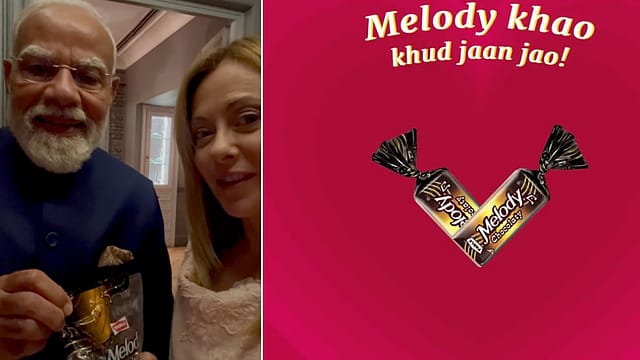
No agency pitched this. No brief was written. No mood board was made.
Just the Prime Minister Narendra Modi reaching into what we can only imagine was a very deliberate pocket, pulling out a packet of Melody toffees, and handing it to Italy’s Giorgia Meloni — a woman the Indian internet had already decided was his destiny.
That’s it. That’s the campaign.
The “Melodi” meme was already old by the time it became real. For months, social media had been doing what social media does — finding a pun, running it into the ground, finding it funny again. Modi. Meloni. Melody. The joke practically wrote itself, which is probably why it survived so long. But memes live on screens. They don’t usually cross over into actual diplomatic protocol.
And then they did.
When the clip surfaced — Modi handing Meloni that unmistakable black and gold packet, Meloni’s expression a polite ambassador’s smile as she processed what was happening — the internet did not merely react. It consecrated the moment. Screenshots became wallpapers. Clips looped endlessly. People who hadn’t thought about Melody since Class 5 were suddenly having feelings about it.
This is branding, 2026 edition. You don’t manufacture it. You stumble into it — if you’re lucky.
Here’s what made this work when it had no business working:
Melody is not aspirational. It’s not positioned anywhere near premium. It sits in a glass jar on a kirana counter, priced at one rupee, bought in fistfuls, eaten in the back of autorickshaws. There is no influencer who “curates” Melody into a morning routine. No aesthetic around it. It just exists — like chalk, or monsoon, or the specific sound of a school bell.

Open Minds 2026
26 Jun 2026 - Vol 05 | Issue 26
The power of ideas and arguments in 50 portraits
Which is exactly why it hit.
Compare it to what Modi could have gifted instead: a box of artisanal mithai, perhaps. Or a heritage-packaged tea from Darjeeling. Respectable choices. Forgettable choices. Nobody would have screenshotted those. Nobody would have made a meme. The gift would have appeared in a wire photo with a diplomatic caption and then died quietly.
Melody made people laugh. And laughter, unlike admiration, travels.
Diet Coke did something similar, though with considerably more time and a much larger marketing budget behind it. A drink that had been on shelves since the ‘80s was suddenly a personality type — not because the product changed, but because culture decided to pick it up and carry it somewhere new. People weren’t just drinking Diet Coke. They were performing Diet Coke. The can became a prop in its own cultural production.
Melody’s moment was faster, messier, and entirely unplanned — but the mechanism was identical.
Both cases point to the same uncomfortable truth for modern marketers: the most powerful thing you can do for a brand is to make it mean something beyond itself. Not a product promise. Not a feature. A reference. An inside joke. A thing you bring up and people immediately know what you mean.
Once a brand becomes that, you can’t buy your way in. The internet either grants it or it doesn’t.
Then came the stock market.
Shares of Parle Industries — which, let’s be absolutely clear, manufactures neither Melody nor anything connected to it — surged after the clip went viral. A different Parle entirely. Totally unrelated. Didn’t matter. The name rhymed with the moment and retail investors, apparently working entirely on vibes, piled in anyway.
You could read this as absurdity. Or you could read it as a very honest X-ray of the attention economy: virality now moves so fast and so hard that proximity to a moment is enough. Logic is optional. The association is everything.
Parle Products — the actual company, the one that makes Melody — didn’t even need to say much. Which brings us to the smartest thing they did.
They didn’t ruin it.
This deserves more credit than it gets.
Most brands in this situation would have panicked into action. A special edition pack. A hashtag campaign. A letter from the CEO about how “honoured” they are. A limited-run “diplomati edition” with Modi’s face on the wrapper, sold exclusively on their website.
Parle did none of this, atleast as of now. They acknowledged the moment with restraint — a statement here, a post there — and then got out of the way.
The instinct to monetise virality is almost always wrong. Because the moment a brand inserts itself too aggressively into the thing that made it viral, it kills the very quality that created the virality in the first place: the feeling that this wasn’t manufactured. Authenticity doesn’t survive a press release. The joke stops being funny when someone explains it.
Parle understood this, perhaps intuitively, and let the internet do what the internet does best — run with it, exhaust it, archive it as a beautiful thing.
There’s a soft power reading here too, if you want to go there.
India’s cultural exports have traditionally been the big, slow-moving kind: Bollywood, yoga, cuisine, the occasional IPL match. These take decades to travel. But memes about Melody toffees crossed borders in hours. Diplomacy, whether its practitioners acknowledge it or not, is now partly conducted in the language of content. Leaders speak not just to governments but to timelines. To algorithms. To the sixteen-year-old in Milan who is now, inexplicably, aware that Melody is “a chocolate eclairs-type toffee from India.”
That’s not nothing.
A one-rupee candy went global this month, and it didn’t run a single ad.
The lesson — if there is one — isn’t that you should stop advertising. It’s that the things people actually talk about are almost never the things you made them talk about. They’re the things that snuck up sideways. The things that felt real because they were. The things that made someone laugh and immediately made them want to send it to someone else.
Marketers spend years chasing that quality. Some call it authenticity. Some call it resonance. Some call it earned media.
The internet, in its infinite bluntness, has a simpler name for it.
It calls it the Melody moment.
And that, as any brand manager will quietly tell you, is not something you can put in a brief.