Made in India. But How Much?
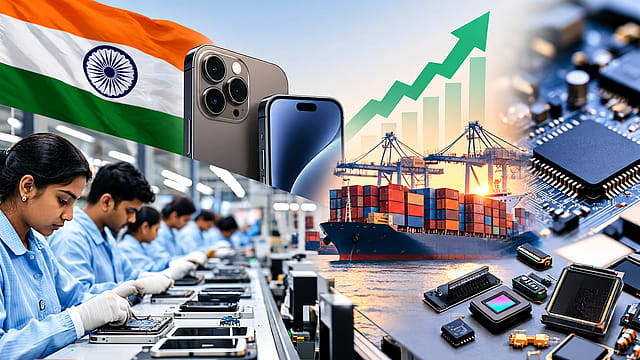
India’s electronics ambitions now come wrapped in a number big enough to command attention: Rs 99,128 crore. That is the FY26 export revenue reported by three Tata Electronics entities, according to company filings cited by The Economic Times. Apple’s India push has helped deliver an industrial milestone. But the nationality of a shipment does not settle the nationality of its value.
The distinction is between scale and depth. India has learnt to turn out phones in enormous volumes. The harder question is how much of the technology, engineering and component value belongs to the economy hosting the assembly line.
Former Reserve Bank of India Governor Raghuram Rajan and his co-authors Rahul Chauhan and Rohit Lamba challenged that equation in 2023: “We certainly cannot claim the rise in exports of finished cell phones is evidence of India’s prowess in manufacturing.” Their concern was that rising handset exports accompanied substantial imports of the parts needed to produce them.

Anatomy Of A Stillborn Revolution
20 Nov 2026 - Vol 01 | Issue 01
Whatever Happened To The Cockroach Janta Party?
That critique requires a qualification. Component-import categories also serve industries beyond mobile phones, making a precise handset trade balance difficult to establish. The government disputed Rajan’s allocation of those imports. The underlying question—how much value India actually retains—nevertheless remains central.
Industry estimates put domestic value addition in mobile phones at 18–20 per cent, according to India Cellular & Electronics Association Chairman Pankaj Mohindroo, as reported in July. Advanced display panels, memory chips, image sensors and specialised components remain substantially sourced overseas. Assembling the device is not the same as manufacturing its technological core.
Trade-policy analyst Ajay Srivastava, founder of the Global Trade Research Initiative, describes the wider weakness plainly: “Much of the value addition remained outside India because critical components continued to be imported.” His argument reaches beyond phones—manufacturing competitiveness depends on supplier ecosystems, not isolated assembly plants.
Yet dismissing assembly as worthless misses its role as an entry point. Anchor manufacturers create demand around which component suppliers can invest. The industry’s defence is that this transition is now beginning.
“The middle ground, which was earlier not fully evolved, is now getting set up,” Mohindroo said. “The entire sub-assembly and component supply chain is getting established.” That is an industry assessment of progress—not proof that import dependence has disappeared.
The next test is whether component incentives and semiconductor programmes translate into competitive factories, deeper engineering and locally generated intellectual property. India needs more than components carrying a domestic invoice; it needs the materials, processes and design capabilities behind them.
Ashok Chandak, president of the India Electronics and Semiconductor Association, sets a measurable ambition: “India should be targeting, all schemes put together, 35 per cent to 40 per cent of domestic value addition.” He presents that as a potential outcome of coordinated policies, not today’s achievement.
India need not make everything inside every phone. But the next manufacturing milestone should measure more than boxes crossing borders. It should capture how much capability—and value—stays behind.