Lab-grown meat could soon be a reality in restaurants across India
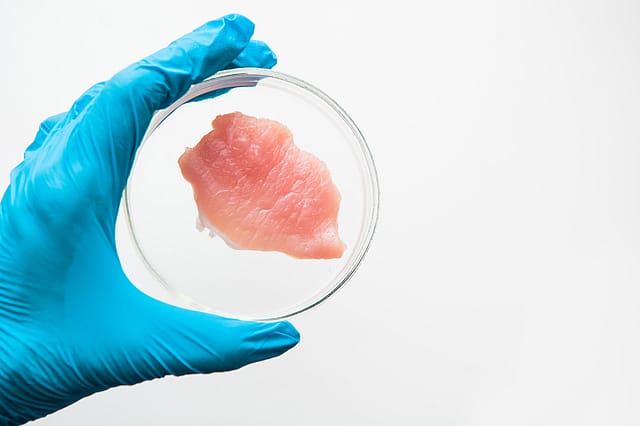
A little over a month ago, ten students from various institutes gathered in the kitchen of a culinary institute in Navi Mumbai—their wares and ingredients lined up in front of them. The event at DY Patil University’s School of Hospitality & Tourism Studies looked like any other cooking competition, which, in a way, it was. There had originally been 50 participants before the number was trimmed down to a final list of 10. But as the young chefs went about whipping up roulades and tikka skewers, street-style stir-fries and sizzling kebabs, what was unique was that the core ingredient they all had to work with — the chicken — had not been sourced from a supermarket shelf.
It had been grown in a lab.
This lab-grown chicken, or cultivated chicken as it is often called, had been developed by the Mumbai-based startup Biokraft Foods, also the sponsor of the event.
To Demetrius Cordeiro D’Souza — a chef himself, and the product and business development chef at Biokraft Foods, who has used his firm’s cultivated chicken to prepare a variety of dishes in his kitchen — watching the young chefs work with this novel meat was deeply overwhelming. “I know we can do so much with it [cultivated chicken]. And to see it being used by all these young chefs to make all these different dishes, it was an amazing feeling,” D’Souza says.

Greening the Future
23 Jul 2026 - Vol 05 | Issue 30
Securing a sustainable India
The prospect of meat grown in a lab — one that could reduce the vast carbon footprint of poultry and livestock farming while eliminating cruelty and slaughter — has prompted a flurry of headlines and drawn billions in investment worldwide. But the optimism has cooled in recent times.
In the US, cultivated meat, still very much in its infancy, has become entangled in the country’s culture wars, with Texas becoming the latest in a string of Republican-controlled states to ban it. Meanwhile, sky-high production costs and difficulties in scaling have led many to question whether such meat can ever become commercially viable. There are, however, still many who believe such a future is possible — including startups in Singapore, Israel, and the US, and now, a growing cultivated meat scene in India.

“The meat industry, although established, remains deeply inefficient and environmentally taxing. It is also responsible for high greenhouse gas emissions, excessive water consumption, and the misuse of antibiotics,” says Kamalnayan Tibrewal, the founder of Biokraft Foods. “I thought, what if we could recreate that system — one that provides a realistic, viable solution delivering authentic meat without compromising on taste, nutrition, or values.”
Biokraft Foods, launched in 2023, is looking to introduce a lab-grown variant of chicken breast into the market as early as next year. They chose chicken breast, Tibrewal says, not just because it is simpler to grow, but also because it is the most demanded meat product in the market. “It is widely consumed, easy to standardise by weight, and commercially useful for portion control,” he says. The firm plans to first collaborate with restaurants and hotels, introducing the meat through them, and later expanding the business by partnering with food manufacturers, retailers, and restaurant chains. “Additionally, we plan to strategically license our technology to international partners, enabling faster global adoption and localised production. This combined model of direct collaboration and technology sharing will help us scale sustainably while maintaining control over quality and innovation,” he adds.
The taste and texture of their meat, Tibrewal claims, is “almost on par” with conventional chicken. The company continues to refine the product through internal trials and consumer feedback sessions. “In practical terms, chefs and our sensory panels describe the product as being over 80 per cent similar to conventional chicken breast, with taste and cooking behaviour already comparable in many recipes,” he says. “Every week, we are getting a little closer to the exact taste and texture of a conventional chicken breast.” Along with perfecting the chicken breast, the company is also well advanced in developing lab-grown trout fillets and hopes to expand to more meat products in the future.
Cultivated meat is grown, broadly speaking, by taking cells from livestock or poultry animals and then growing them in bioreactors where they are nourished with nutrients. Many problems, of course, still persist. It takes time to grow even small quantities of meat, and scaling from a lab setting to facilities with giant bioreactors capable of churning out market-scale quantities remains a huge challenge. A particularly big hurdle is that the cells are grown in an animal serum, most commonly foetal bovine serum (FBS), harvested from the blood of foetuses excised from pregnant cows. This serum isn’t just one of the most expensive components that go into growing meat; it also goes against the very principle this new industry seeks to promote — ending animal cruelty.
A few firms have developed alternative serums, such as synthetic or chemically induced ones, but these too are expensive and, in the long run, not considered a viable solution. “When we talk of [cultivated] meat today, we are talking of meat that is only a single cell type. By which I mean, if I want to grow <keema> from chicken muscles, I will be taking muscle cells of a chicken and growing them. But keeping in mind 10 to 20 years down the line, if these [chemically induced alternative] products are able to penetrate any manufacturing setup, they will only provide energy to one specific cell type. That means if I want to grow muscle cells, I will need to use only muscle cell-specific synthetic ingredients. But if you speak of cultivated meat, it is actually a pool of multiple cell types. So for a longer vision, you need products which can work on multiple cell types,” says Siddharth Manvati, the co-founder of Delhi-based Clear Meat.
Manvati’s firm, which has been operating in this space for several years, has developed a plant extract-based alternative, ClearX9, that is far cheaper and as effective as FBS. “The supply of nutrition to the cells [which includes FBS] becomes a crucial ingredient. This supply is responsible for 60 per cent of the production cost. And a country like India imports FBS… So if you are able to find solutions for this particular problem statement, getting the final product becomes easy and scalable,” Manvati says. “What Clear Meat has done is create a plant extract-based replacement. These extracts mimic the requirement of cells to grow and provide them with the right natural source to grow.”
Launched last year, this plant extract-based alternative is now sold both across India and to foreign firms and institutes. These include seven cultivated meat startups abroad, as well as pharmaceutical companies for vaccine production, hospitals for human stem cell therapy, and several research institutes.
Manvati, a biotechnologist from Jawaharlal Nehru University (JNU), established his firm along with Pawan Dhar, professor and dean at JNU’s School of Biotechnology, in 2019. The duo had been working on a drug discovery incubatory cell at JNU since 2015, creating therapeutic solutions for the pharma industry — from issues related to breast cancer, tuberculosis and diabetes to other ailments — when one of their strategies appeared to work better in the alt-protein space.
When Manvati originally started Clear Meat, he conceived it as a cultivated meat company. But today, he sees it as a cultivated meat technology business — one that provides ingredients and technology to those interested in growing meat in their setup. It is also in the midst of expanding operations by building a new facility. Currently, it can produce about 200 litres of ClearX9 and between three and five kilograms of meat every month. It is now building a new facility — along with the National Institute of Food Technology Entrepreneurship and Management (NIFTEM) at Sonipat in Haryana — which will be able to produce around 1,000 litres of ClearX9, along with over 1,000 kilograms of meat every month.
One reason for moving to a larger facility, interestingly, is that the firm has signed agreements with two large FMCG companies that plan to launch meat products — most likely pre-cooked varieties — made from Clear Meat’s lab-grown chicken. “The FMCG companies have already completed the internal tasting and product validation stages. We now have to respond to a soft order before it can be launched in the market,” Manvati says.
For a long time, their chicken was said to be very close to the taste and texture of regular chicken. But today, Manvati says, it is indistinguishable from what’s available in the market. The firm is also working on growing mutton and meat from crab (after a request from a stakeholder in Goa) and camel (from a firm in Saudi Arabia). It is also collaborating with other cultivated meat firms abroad to create hybrid meat, combining cultivated animal protein with cheaper plant protein to make it more cost-effective. “We are currently focused on making chicken our success story, and then taking it one step at a time as we launch more products,” he says.
Advocates for cultivated meat argue that switching to this form of meat will be essential for environmental sustainability and animal welfare. But can people be persuaded to try something so novel? Sandeep Sharma, the CEO and co-founder of Neat Meatt, a cultivated meat startup based in Hyderabad, thinks so. There will be a significant market, he says, even if a small percentage of non-vegetarians in India switch to lab-grown meat. “Let’s say, in about five years, I can provide cultivated chicken that is only a bit more expensive than the chicken currently available in the market. And the chicken that I will provide will be guaranteed to be hygienic, free of animal cruelty, antibiotics, and disease — which are not things you can say about regular chicken today. I think there will be quite a big market for it,” he says.
Sharma’s Neat Meatt, established in 2022, and is developing chicken and two species of commonly consumed fish. Originally a vaccine scientist for over two decades, he moved to this new sector because he saw its potential to benefit society. Sharma and his colleagues have tied up with several research institutes across the country and have already grown small batches of meat in their laboratory. Not only can cultivated chicken match the texture and taste of regular chicken, Sharma says, it can also surpass it with additional flavours. “When you buy chips in the market, you get all these additional flavours like peri peri or masala or pani puri. Let me tell you, we will be able to do all these flavours with cultivated meat too,” he says with a laugh.
If all goes to plan, Sharma hopes to begin producing chicken on a small scale in the next year and a half, followed by commercial production within another one to three years. “But that will depend upon funding and on how regulatory bodies frame laws,” he says.
The regulatory framework is indeed likely to be a challenge given that this will be an entirely new category of food. Manvati, who is working closely with government bodies, says the authorities are examining all aspects of the field carefully. “The government wants to push these alternative proteins, but at the same time, it wants to regulate each and every ingredient, which might be difficult for a company like ours. But I personally feel that, as part of a broader vision, it is the right strategy to have to become world leaders in this technology. Because that is how you control the quality of the product,” Manvati says. He adds that certain elements in the cultivation process might involve genetically modified organisms, making it essential for government bodies to review every detail.
Cells used in growing meat have a certain lifespan. But cultivated meat firms might want to genetically modify these cells to extend their lifespan and output, Manvati explains — making it necessary for governments to take an exhaustive approach.
For now, Manvati is focused on preparations for his new facility and setting up production for the two FMCG companies. When these products hit the market, he says, they will be marketed as protein-rich chicken.
Is this just marketing hype, or can cultivated chicken really have more protein than regular chicken?
“That’s the beauty of cultivated chicken,” Manvati says. “Any meat is just a pool of blood cells, raw cells and fat cells. The fat content depends on how the cells vary in the raw meat, which in turn depends on how the chicken was grown on the farm. And since you can’t control how the chicken was fed, you can’t be sure of the exact protein, carbohydrate, or fat content. But in a cultivated meat setup, because the current technology does not provide us the right opportunity to add fat cells, there is no fat, and you are able to increase the protein mass and control the carbohydrate content.”
And then, after a brief pause, he explains it more simply. “It gives you a better product than regular meat.”