Jensen Huang and the Price of Betting on One Man
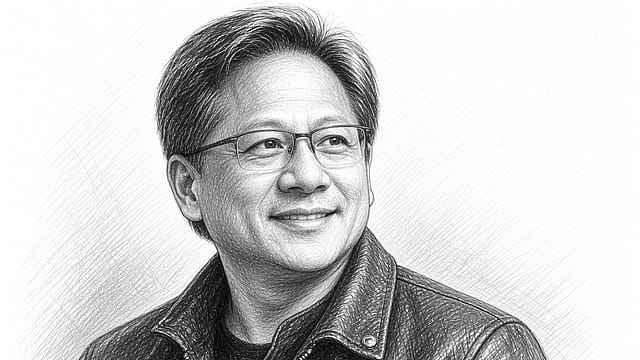
By lunchtime in New York on Monday, the Nasdaq was up 2.6 per cent. Advanced Micro Devices was up 11.7 per cent. Nvidia was down 4.7 per cent. If you owned Nvidia, a good day for chip stocks had turned into a day to think about the person running yours.
The previous day, Jensen Huang had told employees he had been unfaithful to his wife. Nvidia’s board announced an independent inquiry into reports that Huang had been targeted by a foreign intelligence effort. It said it had no reason at that point to believe national security or company secrets had been compromised, and expressed confidence in Huang and his leadership team.

The Era of Forever Wars
30 Oct 2026 - Vol 05 | Issue 44
Coping with an explosive Middle East
There is a reason the prospect of disruption at the top gets a hearing in the market. Huang co-founded Nvidia in 1993 and has been its CEO ever since. He told Reuters that more than 60 executives report to him, almost all in engineering roles. He has also become one of the chip industry’s most visible voices in Washington on export controls. The keynote is the part the public gets to see. Nvidia’s directors have to account for how much engineering judgment, customer trust and political access run through that office.
When the founder is the brand
In July 2018, John Schnatter resigned as chairman of Papa John’s after reports that he had used a racial slur. The next day, the pizza chain’s stock rose 11 per cent. Schnatter still owned roughly 30 per cent of the company. By Forbes’ estimate, he was about $50 million richer on paper after stepping down.
Read the company’s annual filing and the story looks different. Sales at comparable company-owned restaurants fell 9 per cent that fiscal year. Papa John’s said negative publicity around statements Schnatter made in late 2017 and July 2018 contributed to the sales decline. It also reported losing sports and university partnerships and said it needed a new marketing strategy after removing him as its spokesman. Investors could put a higher price on the company the day after he stepped aside. The people running the pizza shops still had to win customers back.
Martha Stewart had built an even more personal business. In March 2004, when she was convicted in a case that began with her personal sale of ImClone shares, Martha Stewart Living Omnimedia closed nearly 23 per cent lower. The company sold magazines and products built around her taste and judgment. A verdict over a personal stock trade had investors repricing magazines and homewares.
Hewlett-Packard lost a CEO and raised its forecasts in the same announcement. Mark Hurd resigned in August 2010 after an investigation into a former contractor’s sexual harassment claim. HP said the inquiry found breaches of its business-conduct standards and cleared Hurd under its sexual harassment policy. It raised its full-year sales and earnings forecasts that day. In the first regular trading session after the announcement, HP shares closed 8 per cent lower. A CEO hired by the board can become every bit as central to the investment case as a founder.
The other jobs a CEO does
In 2025, Elon Musk demonstrated what happens when the relationship at risk is in Washington.
Tesla closed down 14.3 per cent on June 5 as Musk and Donald Trump fell out in public. The Nasdaq fell 0.8 per cent. Their row came amid a fight over a tax bill, and Trump threatened to cut government contracts with Musk’s companies.
The episode showed how quickly investors could have to rethink the value of political access they had come to associate with the man at the top.
Back home, Paytm shows how trouble can travel between two businesses that share a founder and a name. In January 2024, the RBI ordered Paytm Payments Bank to stop accepting fresh deposits and wallet top-ups, citing persistent compliance failures. Shares of listed One 97 Communications, which runs the Paytm app, fell 36 per cent in two trading sessions.
Vijay Shekhar Sharma stepped down as the bank’s chair and stayed on as One 97’s CEO. One 97 wrote down its investment in the bank by ₹227 crore that quarter. When the RBI cancelled the bank’s licence in April 2026, One 97 said its own operations and finances were unaffected by the cancellation. By then, One 97 said it had no material business arrangements with the bank.
With Vijay Mallya’s Kingfisher, the fallout crossed from aviation into liquor. The airline was already grounded when India’s aviation regulator suspended its operating licence in October 2012. The fallout reached United Spirits, where an internal inquiry reported that funds had been diverted to group companies including Kingfisher Airlines.
Mallya resigned as United Spirits chair in February 2016 under an agreement with Diageo, which paid him $40 million at signing and later sought the money back. United Spirits shares closed 2.45 per cent higher the day after he quit. For the liquor company’s investors, his departure was a different event from the collapse of his airline.
Then there is Satyam that sits at the far end of this spectrum. In January 2009, founder B Ramalinga Raju disclosed that the company’s accounts had been falsified. The stock fell from ₹179.10 to ₹39.95 in a day, a drop of 77.7 per cent. Shareholders had to rethink the basic numbers on which they had valued the business. The operations ultimately became part of Tech Mahindra. An operating company can survive even after much of the value that shareholders thought they owned disappears.
These episodes capture different kinds of exposure. The research helps establish that the risk extends beyond a handful of famous names.
Finance researchers Brandon Cline, Ralph Walkling and Adam Yore examined 113 instances involving CEOs in a wider study of executives’ personal conduct. Over the three trading days around disclosure, shares in those CEO cases underperformed the market by an average of 4.1 per cent. The median shortfall was 1.8 per cent.
The researchers also found an association with weaker operating performance and fewer new major customers and joint ventures. A share-price drop can be measured by the closing bell. Losing a customer can take quarters to show up.
Who takes the calls?
In March, Huang told the Lex Fridman podcast, “I don’t believe in succession planning.” His explanation was that he tries to prepare the people around him by sharing what he learns as soon as he learns it and letting them hear how he reasons through decisions. That may help build a strong team. The board still has to decide who gets the authority to act in an emergency.
Nvidia’s own annual filing says the company depends heavily on its longstanding executive team and flags the risk of poor succession planning. Nvidia said in 2019 that CEO succession planning was in place.
As Reuters reported on Monday, the company has yet to say publicly who would succeed Huang. The details of any current plan remain private. Nvidia booked $215.9 billion in revenue in the year ended January 25, 2026. Customers buy its chips and build their businesses around its software. Nvidia has engineers who can keep both working. The question is how much authority those people already have.
Other superstar CEOs have approached the handover differently.
Tesla’s 2026 proxy says the board reviews both emergency and longer-term succession. Amazon announced in February 2021 that Andy Jassy would take over from Jeff Bezos in the third quarter. Warren Buffett’s handover at Berkshire Hathaway was public months in advance. The board appointed Greg Abel in May 2025 and he took over on January 1, 2026.
The broader numbers suggest that handing over a founder’s job is hard even when someone gets the title. Spencer Stuart found that 21 per cent of CEOs who succeeded founders at S&P 1500 companies between 2015 and 2022 were replaced within two years. The figure was 16 per cent for all CEOs appointed in the index over that period. Those figures tell us how often a handover came unstuck. How many superstar CEOs have a workable emergency plan is harder to establish from public filings.
A board can start with an ordinary week in the CEO’s calendar. Who has the authority to settle a product decision when engineering teams disagree? Which executive already knows the biggest customers well enough to call them directly? Who can explain the company’s position on export controls in Washington and make commitments on its behalf? An emergency successor can be named in a meeting. The judgment and relationships that make those calls possible take years to build.
Huang’s ability to do so much has helped make Nvidia the company it is. That gives its board an unusually good reason to put other people in the room while he is still there.