Indian Stock Market Opens Flat as DII Inflows Counter Global Pressures
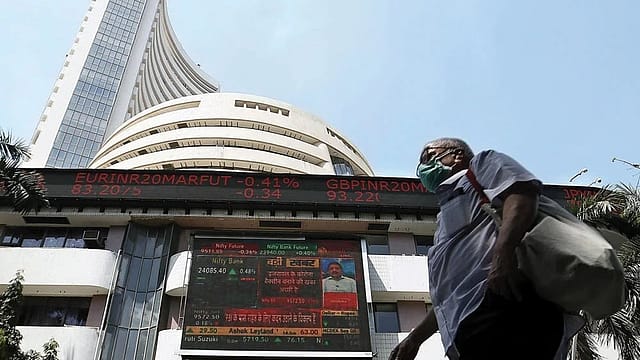
Indian benchmark equity indices opened largely flat on Wednesday as investors balanced strong domestic inflows against persistent global uncertainties, foreign investor outflows and concerns surrounding India’s fiscal outlook.
The BSE Sensex opened at 75,948.49, down 61.21 points or 0.08 per cent, while the Nifty 50 slipped 35.60 points or 0.15 per cent to 23,878.10.
Despite the subdued opening, analysts said sustained buying by domestic institutional investors (DIIs) and strong retail participation through SIPs continue to provide stability to Indian equities.
Why Indian Markets Are Holding Steady
Banking and market expert Ajay Bagga said Indian markets have remained resilient largely because of strong domestic investor participation, even as foreign portfolio investors (FPIs) continue to sell.
"Despite heavy macro headwinds, developed-market equities--specifically in the US--remain resilient, though intraday volatility is rising. The only reason the Nifty 50 hasn't suffered a full-scale meltdown below 23,500 is the massive counter-cyclical buying by Domestic Institutional Investors (DIIs) and robust retail SIP (Strategic Investment Plan) inflows, which continue to absorb the foreign selling," Bagga said.
According to analysts, retail investors and domestic funds have increasingly become the backbone of Indian equity markets, cushioning the impact of global risk-off sentiment and FPI withdrawals.
Fuel Tax Cuts and Oil Losses Raise Fiscal Concerns
Bagga also pointed to emerging fiscal challenges stemming from reduced fuel tax collections and losses faced by oil marketing companies.

I.N.D.I.A. Falling
12 Jun 2026 - Vol 04 | Issue 75
The Unravelling of an Alliance
"Despite retail fuel price hikes of ~ Rs 7.50 per litre implemented across May, Oil Marketing Companies (OMCs) are still running under-recoveries and absorbing massive processing losses of roughly Rs 600 crore per day. This bleeding will sharply contract corporate advance tax payouts from the state-owned energy sector in Q1 and Q2," he noted.
The Centre’s recent decision to reduce excise duty on petrol and diesel has reportedly led to a revenue loss of nearly Rs 14,000 crore, adding pressure on government finances.
Experts Warn of Fiscal Deficit Slippage
Analysts now expect India’s fiscal deficit target to come under strain due to a combination of lower fuel tax collections, rising subsidies and softer economic growth projections.
"The combination of missing fuel tax revenues, soaring fertiliser/LPG subsidies, and down-revised economic growth is forcing a major rewrite of the Union Budget math. We are now forecasting a fiscal slippage of approximately Rs 1.1 trillion (Rs 1.1 lakh crore). This 30-basis-point overshoot is expected to push the actual fiscal deficit to 4.6% to 4.7% of GDP," Bagga added.
The comments highlight growing concerns that higher welfare and subsidy expenditures could complicate the government’s fiscal consolidation roadmap.
Commodities Market Sees Decline in Oil and Gold Prices
In the commodities market, crude oil and gold prices traded lower at the time of reporting.
Crude Oil declined 1.73 per cent to USD 92.26, while Brent Crude fell 1.55 per cent to USD 98.04. Gold prices also slipped 0.14 per cent to USD 4,504.27.
Lower crude prices are generally seen as positive for India, which imports a majority of its oil requirements, though volatility in global energy markets continues to remain a concern for investors.
Metal and Media Stocks Lead Gains
Among sectoral indices, metal stocks emerged as the top gainers.
The Nifty Metal index rose 1.05 per cent to 13,634.40, while Nifty Media gained 0.64 per cent at 1,384.00.
Other sectors trading in positive territory included pharma, FMCG, healthcare, consumer durables, auto, PSU banks and IT.
On the other hand, oil and gas stocks remained under pressure, with the Nifty Oil & Gas index declining 0.68 per cent to 11,437.85. Financial services, private banks and realty stocks also traded lower.
Key Levels Traders Are Watching
Shrikant Chouhan, Head of Equity Research at Kotak Securities, said the market’s short-term structure remains positive as long as support levels are maintained.
"However, the short-term outlook remains positive. We believe the 20-day SMA (Simple Moving Average) at 23,875/75900 and 23,850/75800 would act as important support zones for day traders. As long as the market trades above these levels, the uptrend will remain intact. On the upside, 24,100/76600 could be an immediate resistance zone for bulls," he said.
He added that a fall below the 23,850 mark on the Nifty could trigger additional selling pressure.
Chouhan added that a break below the 23,850 mark could trigger further downside towards the 23,700-23,600 range, making level-based trading crucial during the current consolidation phase.
(With inputs from ANI)