India Has 70 Lab-Grown Diamond Startups, More Than Any Other Country. Could the Platinum Story Repeat?
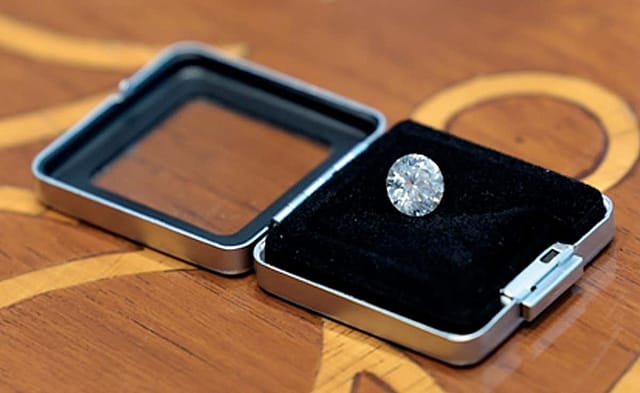
For much of modern history, the diamond business depended on an idea as important as the stone itself: scarcity. Diamonds took billions of years to form, had to be mined at considerable cost, and passed through a complex network before reaching a consumer. Their rarity was not merely geological; it was central to how diamonds were valued, marketed and understood.
Lab-grown diamonds have disrupted that equation.
A diamond created in a laboratory has essentially the same chemical, physical and optical characteristics as one extracted from the earth. To the naked eye, the difference is impossible to detect. Yet the economics are fundamentally different. One depends on finding a natural resource that took geological time to form; the other depends on technology that can be replicated, improved and deployed at scale.

The Modi Years
02 Oct 2026 - Vol 05 | Issue 40
A Nation Rebuilt
That difference has created a major business opportunity—and a potentially uncomfortable problem.
As technology improves, diamonds can become cheaper to produce. As production becomes cheaper, more diamonds can enter the market. And as supply increases, the industry must confront a question traditional diamond businesses rarely had to answer: how do you preserve the value of a luxury product when the technology used to make it is constantly becoming more efficient?
"Gold in India isn't just jewelry, it's a financial instrument with 5,000 years of cultural backing. it's the thing you can pawn or resell at 22k purity anywhere in the country," says Ashita Agarwal, Professor- marketing, SP Jain Institute of Management and Research.
A sector finding its footing
The numbers suggest investors still see a substantial opportunity.
According to startup intelligence platform Traxcn, the global Lab Grown Diamond Brands sector comprises 158 companies, including 23 funded companies that have collectively raised more than $229 million over the past decade. Of these, 12 have reached Series A funding or beyond, indicating the category has moved well beyond experimental startups.
India has emerged as the most important startup market in the sector.
India leads in company count
India is home to 70 lab-grown diamond companies—the highest number in any country. The United States follows with 37, the United Kingdom has 14, the UAE nine, Australia five, and China three.
The numbers underline India’s considerable advantage. The country has long been one of the world’s most important centres for the diamond business, particularly in cutting and polishing. Surat has developed an extensive ecosystem of manufacturers, skilled workers, exporters and jewellery businesses over several decades. Lab-grown diamonds give this ecosystem an opportunity to move into a new segment of the global diamond economy.
The startup boom, however, has been relatively recent.
Data shows 22 lab-grown diamond companies were founded in 2023—the highest number in any year over the past decade. That was followed by 11 in 2024 and seven in 2025. In 2026, only one new startup had been founded so far, according to Traxcn.
At first glance, the decline may suggest the initial excitement is slowing. But it may also indicate the market is moving into a different phase.
The early years of a new consumer category are usually defined by experimentation. Entrepreneurs enter because they see an opportunity. New brands emerge quickly, each attempting to establish a slightly different proposition—some focusing on affordability, others positioning as premium; some operating primarily online, others investing heavily in physical stores.
Eventually, however, the market becomes more competitive. The question changes from whether there is an opportunity to who can build a sustainable business around it.
That may be where India’s lab-grown diamond industry is heading now.
Funding is back—and volatile
The sector’s growth has been accompanied by significant, if uneven, investor interest.
According to several media reports, lab-grown diamond brands have collectively received more than $250 million in funding over the past 10 years. The pattern has been far from linear.
The sector’s strongest year was 2022, when companies received more than $58 million. Investment remained strong in 2025 at $56.4 million, while companies had already received $35.6 million in 2026 to date, according to Traxcn.
The intervening years demonstrate how volatile investment in a relatively new industry can be.
The sector received approximately $43.6 million in 2019, before funding fell sharply to $4.76 million in 2020. It recovered to $16.4 million in 2021 before peaking in 2022. Funding then dropped substantially—just $1.1 million in 2023 and $7.1 million in 2024—before rebounding sharply in 2025.
This volatility suggests investors are still trying to understand the long-term economics of the industry.
Lab-grown diamonds do not fit neatly into one conventional business category. At one end are companies involved in technology and manufacturing. At another are jewellery brands selling directly to consumers. Between them are retailers, exporters, manufacturers and businesses attempting to control several parts of the value chain.
A company manufacturing diamonds faces a very different set of risks from a company selling jewellery. Manufacturing requires technology, machinery and production capacity, while a consumer-facing jewellery company must spend on branding, marketing, stores and customer acquisition.
The future profitability of these businesses may therefore look very different, even though they all operate under the broad umbrella of lab-grown diamonds.
India has more companies; the US has more capital
One of the most interesting findings in the Traxcn data is the difference between where companies are being created and where capital is flowing.
The United States has received the highest amount of funding in the sector—approximately $126 million over the past decade. India follows with $97.2 million, while the UK, despite having 14 companies, has received just $1.52 million.
The comparison reveals two different kinds of strength.
India has the largest number of companies, reflecting its established position in the diamond industry and growing interest among entrepreneurs and jewellery businesses. The US, however, has attracted more capital.
This matters because the lab-grown diamond market is increasingly becoming a competition between brands.
Companies are not simply competing to manufacture diamonds. They are competing for consumers, store locations, online visibility and brand recognition. Building a national jewellery brand can require significant capital, particularly in a market such as India where consumer trust and physical retail remain important.
That is why the funding rounds announced over the past two years have attracted attention.
Aukera raised $15 million in a Series B round in 2025. Lucira Jewellery raised $5.5 million, while Jewelbox secured $3.2 million. Firefly Diamonds and True Diamond also raised around $3 million each. Limelight Diamonds has announced substantial capital infusions as it expands its retail presence.
The size of some investments has increased significantly as larger companies and established industry groups enter the sector. Dholakia Lab Grown Diamond, for example, secured an investment of more than ₹800 crore in 2026, although it is important to distinguish such businesses from conventional consumer-facing startups because its operations extend across manufacturing, retail and industrial applications.
Similarly, not every funding announcement represents venture capital flowing into a pure-play lab-grown diamond startup. Some transactions involve promoter capital, debt, listed companies or jewellery businesses with operations beyond lab-grown diamonds.
Nevertheless, the broader direction is clear: capital is increasingly being committed to the industry.
But the product is becoming cheaper
The growth of lab-grown diamonds is closely connected to their affordability. Consumers can purchase larger stones for a fraction of the price of comparable natural diamonds. This has expanded the potential market, particularly among younger buyers who want the appearance and physical characteristics of a diamond without paying the premium associated with a mined stone.
That affordability is the industry’s greatest advantage.
It may also become its biggest challenge.
The technology used to create lab-grown diamonds is improving, and manufacturing capacity has expanded substantially over the past decade. As production technology becomes more efficient, the cost of producing a diamond can fall. Increased competition among manufacturers can further place pressure on prices.
This is fundamentally different from the economics of a natural resource.
A natural diamond cannot be manufactured simply because demand increases. Lab-grown diamonds, however, can theoretically be produced in greater quantities by increasing capacity and improving technology.
The result is a paradox at the centre of the business.
Lower prices can increase consumer demand because more people can afford diamonds. However, falling prices can also create pressure on manufacturers and retailers because the value of their inventory may decline.
A company can therefore sell more diamonds while earning less money on every diamond.
That distinction is crucial when evaluating the industry’s growth.
Rapid growth in the number of consumers does not automatically mean that every company in the sector will become more profitable. Revenue, margins and the long-term value of inventory can move in different directions.
A company selling a diamond for ₹1 lakh today may find that a similar stone sells for significantly less a few years later. Consumers may welcome that change, but the company will need to sell a greater number of products to maintain the same revenue.
The challenge becomes even more difficult when several companies are selling diamonds with similar specifications.
The real battle may be for the brand, not the diamond
This may explain why so much of the recent investment is going into retail expansion and consumer brands.
As the underlying technology becomes more widely available, the diamond itself could become increasingly standardised. Two companies may sell stones with nearly identical specifications, making it difficult for consumers to understand why one should command a significantly higher price than another.
The competitive advantage must then come from elsewhere.
It can come from jewellery design, trust, certification, after-sales service and the overall customer experience. It can also come from the ability to build a brand that consumers recognise and are willing to return to.
This is where the lab-grown diamond business could undergo its most significant transformation.
The long-term winners may not necessarily be the companies that produce the largest number of diamonds. They may be the companies that develop the strongest consumer brands.
In such a market, the stone becomes only one component of the final product. The value of the business increasingly lies in how the product is designed, marketed and sold.
That could fundamentally change the economics of the diamond industry.
Traditionally, enormous value was attached to the stone itself. In the lab-grown diamond market, some of that value may eventually move towards the company selling the jewellery.
What platinum can teach the industry
The comparison with platinum offers a useful lesson. Platinum, too, had to be deliberately marketed into becoming a major jewellery category. For decades, gold dominated the precious jewellery market, while platinum—despite being rarer and naturally durable—lacked the same consumer association with wealth and aspiration.
The industry spent years changing that perception, particularly through organisations such as Platinum Guild International, which positioned platinum as a premium, modern and exclusive alternative to gold and built powerful associations around purity, rarity, love and durability. The strategy was particularly successful in markets such as China, where platinum jewellery demand grew dramatically from the 1990s. For a period, platinum appeared to have established itself as the next major precious metal after gold. "Platinum never tried to compete on that turf, because it can't win it. Platinum Guild International spent roughly two decades building platinum into something else entirely: the metal of "modern love." Engagement rings, couple bands, men's jewelry, basically the categories that barely existed as gift occasions in Indian jewelry retail. Gold says wealth and tradition. Platinum says commitment and minimalism, usually aimed at younger, urban, more Westernized buyers," Agarwal opines.
Lab diamonds were never investment and neither are natural ones. Lab grown diamond jewelry demand is projected to keep climbing through FY28, she added. As per experts, these brands stopped selling scarcity (which was always a stretch for a stone literally engineered to be un-scarce) and started selling design, everyday wearability, and accessible self-expression instead. Smaller stackable pieces, Tier 2/3 city accessibility, "buy it because it's pretty and you can afford it" rather than "buy it because it'll appreciate. "Lab-grown diamonds don't just fail a scarcity test, that was never really the consumer pitch to begin with. They fail the price-as-signal test, which is the mechanism that actually mattered. It's targeted to someone who seeks accessible luxury "buy it because it's pretty and you can afford it" rather than "buy it because it'll appreciate," Agarwal pointed.
Yet its subsequent journey also demonstrated the limits of marketing. Consumer preferences changed, gold regained prominence, prices fluctuated and platinum jewellery demand declined sharply from its peak, particularly in China. Platinum did not disappear, but its history showed that marketing can create demand without permanently guaranteeing a product’s position in the luxury hierarchy.
That is where the lesson becomes relevant for lab-grown diamonds.
Today’s LGD companies are similarly spending heavily to create a new consumer proposition, positioning their products as modern, technologically advanced and more accessible than natural diamonds. However, lab-grown diamonds face an even more complicated challenge because, unlike platinum, their scarcity is not inherent. As production technology improves and supply expands, the product can become increasingly abundant and cheaper.
Marketing may successfully make lab-grown diamonds desirable, just as it helped make platinum desirable, but it cannot indefinitely control consumer perception or the underlying economics of the product. The real challenge for the industry, therefore, will not simply be creating demand, but maintaining desirability, margins and brand value once novelty fades, competition intensifies and diamonds become easier to produce.
The industry’s greatest success could become its biggest risk
The Traxcn data demonstrates that the lab-grown diamond sector has become a serious business category: 158 companies globally, more than $229 million in cumulative funding and an increasingly competitive landscape.
India has emerged as the largest market by number of companies, with 70 startups and brands operating in the sector. Investment has accelerated again after a period of volatility, reaching $56.4 million in 2025 and $35.6 million in 2026 to date.
The opportunity is clearly substantial.
However, the industry’s long-term challenge will not simply be convincing consumers that lab-grown diamonds are real diamonds. That battle is already being won, particularly among younger consumers who are increasingly comfortable with products created through technology.
The more difficult challenge will be economic.
Technology is responsible for making lab-grown diamonds accessible to a larger market. Yet the same technology could continue to increase supply and place pressure on prices. More companies are entering the business, more brands are competing for consumers and manufacturing technology is becoming increasingly sophisticated.
The industry, therefore, faces an unusual paradox. Its success depends on making diamonds more accessible, but the growing abundance of those diamonds could eventually challenge the scarcity traditionally associated with luxury.
That does not mean the lab-grown diamond business is headed for decline. The market could become substantially larger as falling prices bring new consumers into the category. India could strengthen its position as a global centre for manufacturing and jewellery, while successful brands could build large and profitable businesses.
However, the nature of those businesses may be very different from the traditional diamond industry.
The most valuable companies may not be the ones that own the most diamonds or even manufacture them at the lowest cost. They may be the companies that understand how to create value after the technology has made the stone itself cheaper.
For investors currently pouring money into the sector, that may be the most important question of all: Can a company build a lasting luxury brand around a product whose greatest technological advantage is that it can become increasingly abundant?
The answer will determine whether the lab-grown diamond boom becomes the next major transformation in jewellery—or whether the industry’s greatest technological achievement ultimately makes its core product too easy to reproduce.