The Uses of Adversity
In the late spring of 2020, when the Covid-19 pandemic hit India, Prime Minister Narendra Modi addressed the nation. In his speech, he highlighted the global conjuncture at which India found itself. With every nation acting in its interest, Modi did not shy away from India playing a helpful role in the world but, at the same time, he gave a clarion call for self-reliance, or Atmanirbhar Bharat.
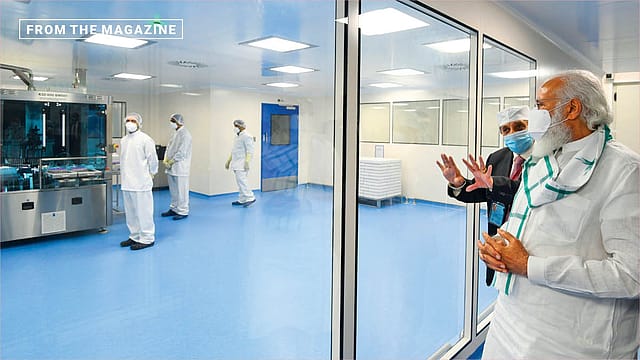
At the time, India was dependent on global supply chains to such an extent that even simple surgical masks were imported. Suddenly, all the items needed to manage the pandemic—from a number of active pharmaceutical ingredients to vaccines against the Covid-19 virus—were not available in the country. Yet, within a year, all that India required was made available domestically.
This was two years before the conflict in Ukraine erupted, a conflict that would test India on the supply of fertilisers and other commodities. Four years after the start of that war, another war, this time much closer to home—in West Asia—affected India at a particularly difficult spot: energy security.
Yet India never looked back after the summer of 2020. The idea of Atmanirbhar Bharat has caught on even as India’s economic growth continues unimpeded. The latest quarterly GDP data—for the first quarter of 2026-27—showed the Indian economy growing at 7.8 per cent, a pace unmatched by any peer economy.
Strong economic growth in the face of exceptional adversity might well be the summation of Modi’s achievement as a leader. There are plenty of naysayers who question everything that Modi’s government has done—from data on growth to much more—but that has never shaken his single-minded resolve to take India into the ranks of developed countries by 2047. Twelve years after he became prime minister, and a quarter of a century into public life, the strategy behind that vision is clearly visible.
At the core of Modi’s economic strategy lie three distinct but pragmatic elements. At the heart of making space for economic resilience lay the realisation that the world of the 1990s—free trade, a rules-based global order and a benign global economic environment—had frayed by 2020. Modi was the first among world leaders to realise this and to act to change course instead of accepting drift. Multiple initiatives geared towards revitalising industrialisation were launched over time. These, apart from the exceptionally large capital expenditure on infrastructure, were the building blocks of economic resilience. Two such initiatives are the Performance Linked Incentives (PLI) scheme, launched at the time of the first Covid-19 wave in April 2020 with an outlay of `1.76 lakh crore across 14 sectors; and the Semicon 1.0 initiative, launched in December 2021 with an outlay of `76,000 crore for the basic building blocks of a semiconductor ecosystem. Now Semicon 2.0 is in the wings, with an expected outlay of `1.27 lakh crore, even as PLI has been extended.
The second, equally important, part of the strategy is prudent macroeconomic management. In 2020-21, the pandemic year, the economy experienced a sudden stop and GDP growth collapsed. It shrank by 5.78 per cent, only the fourth instance of negative growth since Independence. [The other years were 1965 (-2.64 per cent), 1972 (-0.55 per cent) and 1979 (-5.24 per cent)]. That had a large and negative consequence for economic management. Revenue growth also collapsed in the wake of the growth collapse, and the fiscal deficit shot up to 9.2 per cent of GDP. But by the next year, 2021-22, fiscal consolidation had begun in earnest: the fiscal deficit was brought down to 6.7 per cent and, over the next five years—from 2022-23 to 2026-27—it was pared down further. This year, the fiscal deficit is expected at 4.3 per cent of GDP. All this was done along with prudent management of the inflationary pressures that arose from massive increases in the prices of commodities, from crude oil to fertilisers and from imported intermediate goods to other raw materials.
All this happened even as the government launched a massive capital expenditure programme beginning in 2020-21. Until 2019-20, the government’s capital expenditure had hardly crossed 2.5 per cent of GDP. In the pandemic year, it rose to 3.3 per cent of GDP and has never gone below that level since. In 2026-27, it is budgeted at 4.4 per cent of GDP.
This combination of fiscal consolidation and large, continued expansion of capital expenditure is unique in independent India’s history. This, more than anything else, is the hallmark of prudent macroeconomic management.
Finally, the last leg of the economic strategy tripod is the huge expenditure on “social welfare” schemes. To give just one set of figures, `4.46 lakh crore has been spent since 2019 on the PM-Kisan scheme, which distributes` 6,000 every year to eligible farmers. Since 2014-15, `7.8 lakh crore has been spent on the now defunct MGNREGA. This is over and above the gigantic sums spent on direct cash transfers to women voters on the eve of elections. If one adds the annual outflow of subsidies on fuel and fertilisers, and producer subsidies for farmers in the form of ever-rising Minimum Support Prices (MSPs) for wheat and rice, the sums involved are overwhelming. These expenditures must be considered a part of Modi’s economic strategy: they perform the vital function of keeping political temperatures low. If this spending were to be reduced, let alone eliminated, the demands for “distributive justice” in a hypercompetitive political system would destroy any effort towards growth and the building of resilience.
It is instructive to note the timing and sequencing of these distinct parts of the Modi government’s economic strategy. Fiscal prudence was baked into the government as soon as it took charge in May 2014. Initial steps towards industrialisation, such as the repeal of the Right to Fair Compensation and Transparency in Land Acquisition, Rehabilitation and Resettlement (LARR) Act, 2013, foundered because the government did not have the required strength in Rajya Sabha. This was a poison-pill Act designed to derail any effort towards the industrialisation that was expected when the Bharatiya Janata Party (BJP) government came to power. Given the political logjam, a direct attempt at rejuvenating industrialisation had to be given up for the moment. Instead, Modi focused his energies on cleaning up the banking system, a prerequisite for ending the “twin balance sheet” crisis that had hit the economy. Consultations towards early passage of the Goods and Services Tax (GST) were completed and the law enacted in 2017. These “ground-clearing” steps were an essential part of the growth take-off experienced in the later years of the third Modi government.
Each part of the strategy—the investment strategy, the political-and-policy strategy and the macroeconomic management of the economy—was essential if high growth was to be realised. These efforts bore fruit in Modi’s third term and can now be seen in stark relief against the global economic upheaval. India remains an oasis of economic stability amid all-round global turbulence.
Much has been said about the Modi government not having a vision in the sense of a “grand plan” as in the heyday of socialist planning in India. In this world pragmatism comes close to not having a ‘vision’. The record of the time when India acted on grand plans tells its own story. From 1952—when the heavy industries strategy under the Jawaharlal Nehru-PC Mahalanobis plan was begun—till 1977, there were hardly any two consecutive years when India posted GDP growth of 5 per cent. Kaushik Basu, an ardent critic of the Modi government, has noted: “Not surprisingly, while (South) Korea produced some of the most effective plans, India produced some of the best-written plans.”
If one were to sum up the economic philosophy of that age, it was prose over profits even as poverty went skyward. The fact that Modi decisively reversed this situation has not gone down well with many economists and commentators.
On September 28, External Affairs Minister S Jaishankar spoke before an audience at the Asia Society in New York. He was in the city for the 81st annual session of the United Nations. In his remarks, Jaishankar said, “The state of the world looks pretty grim because we have two major ongoing conflicts, each one of whom has a consequence for every country of the world… A large part of the world faces what I call the 4F crisis: which is of food, fuel, fertilisers, and finance. On top of this supply chain vulnerabilities are growing…” These words capture the essence of the economic problems confronted by India. At one time, these problems were domestic in nature. In the odd year, a shortfall in the monsoon would upset growth and budgetary calculations; in a year or even two before elections, the government in power would try to spend its way to victory, fuelling inflation in its wake. This made for difficult choices for the Reserve Bank of India (RBI). Occasionally, once in a decade or so, the Current Account Deficit (CAD) would assume dangerous proportions, leading to unpredictable gyrations in the exchange rate. Overall, at least since 1991, India’s economy has remained on an even keel, even if there was a constant “growth longing” among economic commentators.
Then came 2020 and 2022. Since then, India has had to contend with not only difficult domestic choices but also much more unpredictable external shocks. A full bill of the costs of the pandemic, direct and indirect, as well as of the continuing consequences of the Ukraine war, is yet to be drawn up. But the costs to the government, and in turn the country, are substantial. These costs, however, have led to a creative refashioning of India’s economic management at the hands of the Modi government. The results are for everyone to see. In the five years after the pandemic-marred 2020-21, the GDP growth rate averaged 8.08 per cent between 2021-22 and 2025-26, the estimate for the last year being an advance estimate (all based on the 2011-12 base year). Lest one be accused of cherry-picking data, the decadal average of growth from 2014-15 to 2023-24, which includes the pandemic year (2020-21), still comes to a very decent 5.96 per cent per annum. Compare this with the UPA era, from 2004-05 to 2013-14, when the decadal average of annual GDP growth stood at 6.82 per cent. On paper, this performance looks better than the Modi years. But that’s just paper. The years from 2004-05 to 2006-07, when India’s economic performance was superlative, marked the zenith of globalisation. External Commercial Borrowing (ECB) could be availed of at very reasonable rates. Technology sharing and financial flows were at their apogee. Geopolitical friction and geo-economic fragmentation were beyond anyone’s horizon. It was high growth in fair-weather conditions.

What Modi achieved was much more difficult: high growth in the face of global headwinds and active hostility on the part of two superpowers, the US and China. One has erected tariff walls against Indian exports and has now passed a law to sanction India via tariffs just for ensuring its own energy security. The other has gone for conflict with India: at Doklam (2017) and in Galwan (2020). Economic strategy, statecraft and national security—always distinct domains of governance—are now entangled to such an extent that energy security must be managed and monitored on almost a ship-to-ship basis. That this has been done without any major disruption bespeaks the efforts undertaken to ensure that growth continues on its upward trajectory. The goal is clear: a developed India—Viksit Bharat—by 2047.
Growth at this pace when the world is floundering is not a fluke but the product of carefully built buffers and resilience, developed over time in the face of adversity. It is unique that India grew rapidly after the pandemic, a period in which much of the world has moved from one crisis to another.