India, EU Seal Historic FTA: What the Landmark Deal Means
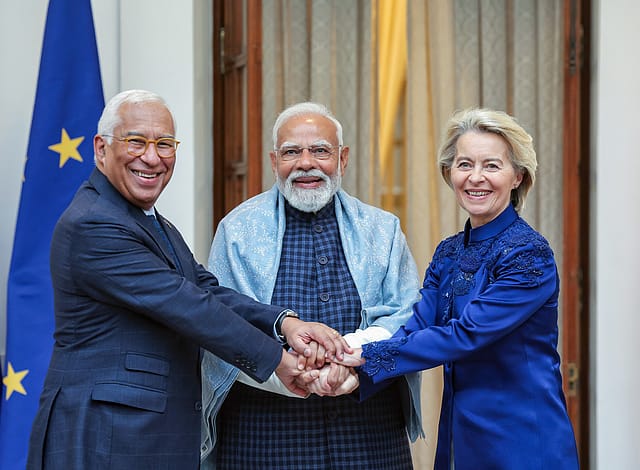
India and the European Union on Tuesday formally concluded the long-awaited India–EU Free Trade Agreement (FTA), marking a decisive moment in India’s global trade engagement and one of the most consequential trade pacts signed by New Delhi to date.
The agreement was announced at the 16th India–EU Summit, attended by Prime Minister Narendra Modi, European Commission President Ursula von der Leyen, and European Council President Antonio Costa. Documents formalising the conclusion of negotiations were exchanged between EU Trade Commissioner Maroš Šefčovič and Commerce Minister Piyush Goyal, sealing years of negotiations relaunched in 2022.
Describing the FTA as a defining achievement, Goyal said the deal reflects India’s strategy of building trusted, balanced and future-ready economic partnerships. Beyond a conventional trade pact, the agreement carries strategic weight, bringing together the world’s fourth- and second-largest economies, which together account for 25% of global GDP and one-third of global trade.
Market Access, Manufacturing and Services
The FTA delivers unprecedented market access for India, securing duty-free entry for over 99% of Indian exports by trade value to the EU. This is expected to give a strong push to the Make in India programme, especially across labour-intensive sectors such as textiles, apparel, leather, footwear, marine products, gems and jewellery, handicrafts, engineering goods and automobiles.
Tariffs of up to 10% on nearly $33 billion of exports will be eliminated upon the agreement’s entry into force, significantly boosting competitiveness while integrating Indian firms deeper into European and global value chains.
In automobiles, a calibrated, quota-based liberalisation framework allows EU manufacturers access to India’s premium segments, while opening future opportunities for India-made vehicles to enter the EU market—benefiting consumers, manufacturers and exporters alike.

India's Action Hero
27 Mar 2026 - Vol 04 | Issue 64
Riding the Dhurandhar Wave
A Services- and Talent-Led Agreement
Services—already the fastest-growing component of India–EU trade—emerge as a major winner. The FTA secures expanded commitments across IT and IT-enabled services, professional services, education, financial services, tourism, construction and business services. India gains predictable access across 144 EU service sub-sectors, while EU firms receive access to 102 Indian sub-sectors.
A comprehensive mobility framework underpins the services pact, enabling smoother movement of professionals, including intra-corporate transferees, business visitors, contractual service suppliers and independent professionals, along with rights for dependents. The agreement also opens doors for student mobility, post-study opportunities, and even access for practitioners of Indian traditional medicine in EU member states where such practices are recognised.
Indian agriculture and processed food exports—including tea, coffee, spices, fruits, vegetables and processed foods—stand to gain from improved access, while sensitive sectors such as dairy, cereals and poultry have been carefully safeguarded.
A Gateway to Europe
The FTA also addresses non-tariff barriers, regulatory cooperation, customs facilitation, and emerging challenges such as the EU’s Carbon Border Adjustment Mechanism (CBAM), securing flexibilities, technical cooperation and financial support for emissions compliance.
Beyond trade, the agreement lays the foundation for collaboration in artificial intelligence, clean technologies and semiconductors, while reinforcing intellectual property protections and safeguarding India’s Traditional Knowledge Digital Library (TKDL).
With this pact, the EU becomes India’s 22nd FTA partner. Alongside FTAs with the UK and EFTA, the India–EU deal effectively opens up the entire European market to Indian businesses, exporters and entrepreneurs.
Aligned with India’s vision of Viksit Bharat 2047, the agreement signals a new phase in India–EU relations—one that blends commerce with strategy, growth with resilience, and market access with long-term trust.
(With inputs from ANI and yMedia)