India Can Save Rs 1 Lakh Crore In Crude Imports By 2030 Through EV Adoption: SBI Report
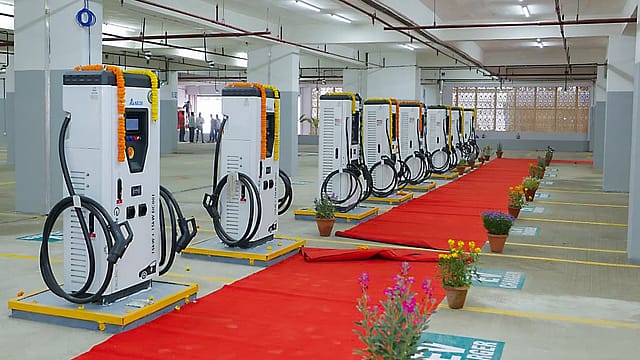
India could save nearly Rs 1 lakh crore in crude oil import costs by 2030 if electric vehicles (EVs) account for 20 per cent of the country's vehicle market, according to a report by the State Bank of India (SBI). The report estimates that 35 lakh additional EVs will replace petrol vehicles between 2027 and 2030, driven by faster adoption and supported by stronger charging infrastructure and policy measures.
EV adoption gathers pace after West Asia conflict
The SBI report said EV adoption has accelerated significantly following the onset of the West Asia conflict in February 2026, with registrations rising sharply.
It stated, "Our estimate indicates that during the four-year period of 2027-2030, 35 lakh more EVs are expected to replace the petrol vehicles.... EV vehicles have now reached more than an 8 per cent share in 2026. A 20 per cent share by 2030 could save Rs 1 lakh crore of the import bill."

Freedom Issue 2026
14 Aug 2026 - Vol 05 | Issue 33
Shashi Tharoor on being radical liberal | Ram Madhav on how Gandhi used his Hinduism | TCA Raghavan on a diplomat's travels in history | Sumana Roy on the novel beyond the Booker | Carlo Pizzati on the dissolution of Borders
According to the report, average monthly EV registrations increased to 2.3 lakh during March-June 2026, compared with an average of 1.3 lakh in 2025—an increase of around one lakh vehicles every month.
Based on the current trajectory, SBI expects total EV registrations to surpass 25 lakh in 2026.
The report noted that the growing market share of electric passenger cars, two-wheelers and three-wheelers after February 2026 suggests that the West Asia conflict has accelerated consumer interest in electric mobility.
Charging infrastructure remains key challenge
While highlighting the rapid rise in EV adoption, SBI stressed that expanding charging infrastructure, particularly fast chargers, will be critical to sustaining long-term growth.
The report pointed out that fast chargers currently account for only around 30 per cent of India's charging network and called for a comprehensive 10-15-year EV roadmap with clear targets covering vehicle segments, charging infrastructure, regulatory policies and battery manufacturing.
It also recommended the creation of an EV Credit Guarantee Fund, concessional land allotment for public charging stations, higher government procurement of electric vehicles and the introduction of a dedicated green mobility category to strengthen the EV ecosystem.
Wide state-level disparities in charging network
The report observed significant differences in charging infrastructure across states. In some states, each charging station serves more than 200 EVs, while in others, the number is around 50 vehicles per charging station.
India currently has 29,151 charging stations, with Karnataka and Maharashtra accounting for 35 per cent of the country's charging infrastructure.
According to the report, Tamil Nadu, Telangana, Andhra Pradesh and Goa have performed better in fast-charging deployment, with fast chargers making up more than 50 per cent of their total charging stations.
The report also highlighted the Delhi government's plan to install 32,000 charging points over the next four years under its new EV policy.
SBI said the long-term success of electric mobility in India will depend largely on the availability of adequate charging infrastructure across the country.
(With inputs from ANI)