Full Seats, Thin Margins: IntrCity’s Fight for Profitable Growth
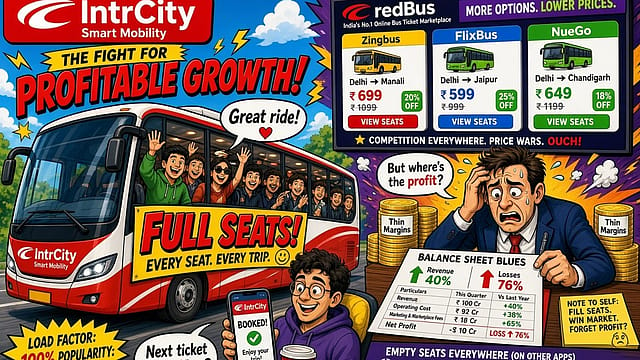
A passenger can choose IntrCity for the journey and redBus for the ticket.
That small distinction captures a large problem for India’s branded bus businesses. A company can put its name on the coach, improve the boarding experience and work to make the ride dependable. Yet the passenger’s next journey can begin on a marketplace, with competing services lined up on the same screen.
IntrCity is trying to build a business that passengers seek out by name. Its latest financial numbers show how expensive that ambition remains.
Operating revenue at parent Stelling Technologies reportedly rose 40.1% to ₹690.9 crore in FY26. Net loss increased 76% to ₹27.9 crore. The business is growing, but the distance between growth and profit has widened.

Zeroing In on ECI
09 Oct 2026 - Vol 05 | Issue 41
Constitutional legitimacy versus political opportunism
The challenge extends beyond the accounts. IntrCity faces branded rivals pursuing a similar promise of better bus travel, regional operators defending familiar routes and a powerful ticketing platform through which passengers can compare them all.
MORE REVENUE, MORE PRESSURE
The appeal of IntrCity’s proposition is easy to understand. Long-distance bus travel can involve uncertainty over boarding points, vehicle quality, cleanliness and the journey itself. A dependable brand has something valuable to sell.
IntrCity markets features including tracking, boarding lounges, bus captains and onboard washrooms on select services. It works with operator partners, adding technology and service standards to their vehicles. Its operator tools monitor maintenance, fuel consumption and fleet utilisation.
There is a plausible business logic here: better service can encourage repeat travel; better information can improve operations; a recognisable brand can help fill seats.
The FY26 numbers nevertheless show that expansion has yet to translate into an overall profit. Bus operating costs and agent commissions reportedly grew faster than revenue. The consolidated EBITDA loss widened to approximately ₹28 crore.
These figures also sit uneasily beside management’s earlier confidence. In April 2025, IntrCity announced a tenfold increase in adjusted EBITDA profit and said it had cracked profitable scaling. An adjusted measure can differ from consolidated earnings, so the two cannot simply be treated as identical. But the commercial test remains straightforward: can the expanding network produce a profit after the wider business pays its bills?
Technology can improve a route’s economics. It cannot make the cost of delivering a journey disappear.
THE RIVALS WANT THE SAME PASSENGER
IntrCity’s opportunity has attracted competitors with different ways of organising the business.
Zingbus is a close strategic challenger. Its operator proposition combines booking, pricing and passenger experience with support for route selection and operations. It pitches better utilisation and earnings to bus owners. That means the competition reaches beyond travellers: the platforms also need to persuade operators that joining their network will improve their business.
FlixBus brings an international version of the partnership model. Flix handles commercial functions such as network planning, pricing, marketing and quality management, while local partners undertake daily operations. Its presence in India puts IntrCity against a company with experience adapting that division of work across multiple markets.
NueGo adds an electric alternative. GreenCell Mobility’s intercity brand competes for travellers seeking a more comfortable, consistent service, with electrification providing an additional distinction. Its model introduces charging and vehicle-deployment considerations alongside the familiar challenge of attracting passengers.
These businesses have different fleets, networks and financial structures. They should not be treated as interchangeable. But they compete for overlapping passenger expectations: a reliable departure, a comfortable seat, a convenient boarding point and a fare that feels reasonable.
Established regional operators remain part of that contest. On an individual journey, departure time and boarding location can matter more than national recognition. A passenger who needs to leave after work may choose the service that fits, even after a good experience with another brand.
For IntrCity, a better journey must therefore become a reason to return. Otherwise, the cost of improving the service risks becoming a permanent expense without enough pricing power to support it.
WHY REDBUS IS HARD TO DISPLACE
RedBus describes itself as India’s largest online bus-ticketing platform and is part of MakeMyTrip. Its leadership belongs to the booking market; it should not be confused with leadership in operating buses.
That distinction makes the relationship with IntrCity more interesting than a straightforward rivalry. IntrCity tickets are available on redBus. The marketplace is a sales channel as well as a competing destination for the passenger’s next booking.
The advantage of a marketplace is breadth. A traveller can compare operators, departure times, fares and boarding points in one place. IntrCity’s direct channel has to persuade that traveller to choose the brand before completing that wider comparison.
IntrCity’s own website reflects the contest. It encourages direct booking through benefits such as ClubMiles rewards, app offers, booking flexibility and priority support. The strategic purpose is clear: give satisfied passengers reasons to return directly.
That could help reduce dependence on intermediaries. But direct demand also has a cost. Discounts, rewards, marketing and customer support must be weighed against the commissions saved.
Nor does travelling again with IntrCity necessarily mean booking directly with it. Service loyalty and booking loyalty can develop separately.
This is why the redBus challenge is difficult. IntrCity can improve the journey and still have to compete afresh for the transaction.
There is a benefit to that relationship too. A marketplace can introduce passengers who might never have searched for IntrCity, helping it sell capacity that would otherwise go unused. The task is to make distribution pay while gradually building a stronger direct relationship.
IntrCity’s reported agent-commission expense covers a wider category; it cannot be attributed entirely to redBus.
THE EMPTY SEAT STILL COSTS MONEY
The harder operating problem begins when the bus departs.
An unsold seat loses its value for that departure. Much of the journey’s cost remains. The vehicle, crew, energy, maintenance and road charges must be funded somewhere in the operating chain, regardless of which company owns the bus.
Partnerships can reduce the capital a brand needs to purchase vehicles. They leave it dependent on partners earning enough to maintain the fleet and deliver the promised experience.
Expansion adds another complication. A strong route does not guarantee a strong new one. Adding frequency gives passengers more choice, but can spread existing demand across more departures. A busy outward journey can be followed by a weaker return.
Premium service creates its own balancing act. Lounges, cleaner interiors, dependable support and better onboard facilities can attract customers. They also require spending and supervision. Rival services constrain how much extra a passenger will pay.
These are economic pressures facing the model, rather than a proven explanation for every rupee of IntrCity’s loss. Its reported results establish that costs outran growth; they do not isolate the performance of each route or departure.
The route to profit consequently requires more than adding buses. IntrCity needs to sell more of the capacity it offers, earn enough from each journey, retain passengers and keep service delivery consistent as the network expands.
Its growing revenue suggests a business finding demand. The larger loss shows that serving that demand profitably remains unfinished work.
IntrCity can win the passenger’s journey. To build a durable business, it must also earn enough from the ticket.