From Land to Skills: What’s Holding Back India’s Manufacturing Growth
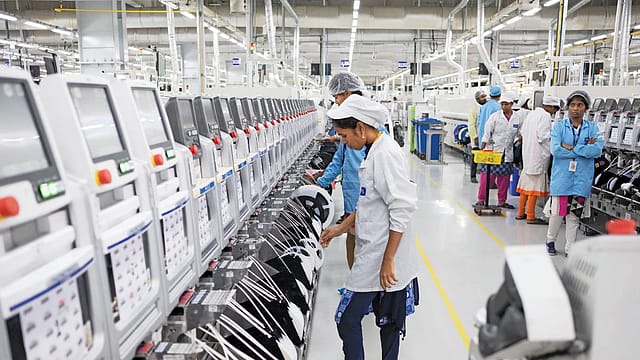
India wants manufacturing to power its next growth leap. But despite policy push, incentives and global interest, the factory engine is losing momentum, exposing deep structural cracks beneath the optimism.
What is the warning signal from recent data?
India’s manufacturing PMI slipped to 55 in December 2025, its lowest level in 38 months, signalling the weakest improvement in factory conditions since December 2023. Production growth and new orders slowed sharply, even as optimism about 2026 softened.
Why is this slowdown worrying despite strong policy support?
Because it’s happening despite flagship initiatives like Make in India and PLI schemes. The slowdown suggests that policy intent at the Centre is running into execution bottlenecks at the state level and weakening global demand.
What does NITI Aayog say is holding manufacturing back?

The Health and Wellness Issue
25 Sep 2026 - Vol 05 | Issue 39
NITI Aayog member Arvind Virmani points to three binding constraints: Land availability and acquisition delays, high industrial electricity tariffs, often above production cost, and education and skilling gaps. These issues lie largely outside the Centre’s control and sit with state governments.
How serious is the skills problem?
Severe and structural. Around 80% of Indian employers report difficulty finding skilled workers, higher than the global average. Shortages are acute in robotics, industrial IoT, CNC operations and data analytics. Only 11.7% of manufacturing workers are regular employees; most remain informal or contractual, limiting productivity gains.
Why does informality matter so much?
Because productivity, scale and innovation suffer. Nearly 85% of India’s workforce is informal, contributing just 45% of GDP. In manufacturing, informality blocks technology adoption and prevents firms from integrating into global value chains.
How is China reshaping the competitive landscape?
China’s falling export prices and unmatched supply-chain integration are squeezing global margins. Despite rising wages, China remains dominant due to scale, productivity and deep ecosystems. Nearly 40% of India’s electronic component imports still come from China, highlighting continued dependence.
Are PLI schemes working at all?
Yes, but selectively. Smartphones are the standout success. Exports rose 42% in FY24, Apple now makes 20–25% of iPhones in India, and India overtook China as the top smartphone exporter to the US in 2025. The challenge is replicating this success across sectors and building domestic supply chains at scale.
What about foreign investment trends?
FDI softness reflects higher dividend outflows, not collapsing inflows. Manufacturing FDI actually rose 18% year-on-year in FY25. India’s free trade agreements and ongoing negotiations are aimed at embedding the country deeper into global production networks.
What reforms could reignite manufacturing growth?
Experts point to four priorities. First, rationalising industrial power tariffs at the state level. Second, streamlining land acquisition through digitisation and timelines. Third, scaling skill development aligned with industry needs. Fourth, benchmarking states via a new manufacturing performance index. Without state-level reform, national ambition will stall.
What lesson does China’s experience offer India?
While China spends 2.7% of GDP on R&D, India spends about 0.7%. China’s dominance is built on sustained investment in human capital, R&D and industrial infrastructure. India’s ambition is similar but execution remains uneven.
(yMedia is the content partner for this story)