From $3.44-Billion Unicorn to $200-Million Unicorpse: How 'Real' Was Unacademy’s Valuation?
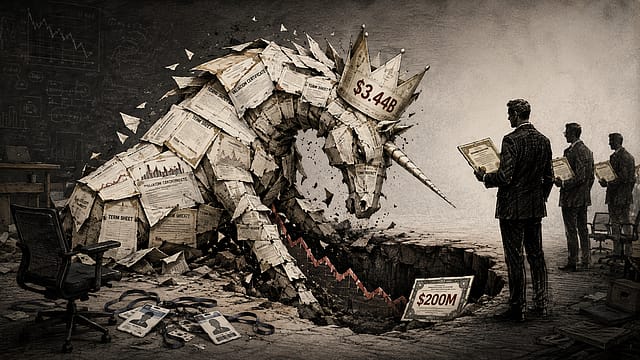
Gaurav Munjal did not attempt to hide the corpse.
“We raised at a peak, but sold at a fraction of that,” the Unacademy co-founder and chief executive wrote after upGrad completed its acquisition of the edtech company on September 1.
The fraction was just over $200 million. The peak was $3.44 billion.
In five years, more than 94 per cent of Unacademy’s headline valuation disappeared. A company once anointed one of India’s most valuable startups was acquired for less than one-sixteenth of the number placed above its name in 2021.
That makes a spectacular obituary. It does not complete the post-mortem.

Zeroing In on ECI
09 Oct 2026 - Vol 05 | Issue 41
Constitutional legitimacy versus political opportunism
The harder question is who created the $3.44-billion number, what it represented and whom it served. It helped investors proclaim another unicorn, allowed Unacademy to hire, acquire and spend with the authority of a future champion, and gave employees stock options carrying the perfume of impending wealth. When the assumptions collapsed, the company cut jobs, shut bets and watched revenue retreat.
The investors did not receive a $200-million cash exit. They received shares in upGrad. Munjal remains with the business. upGrad acquires Unacademy’s brand, products and reach. Thousands of people who left the company during its long contraction cannot exchange their lost jobs or diminished options for equity in the buyer.
The unicorn was celebrated as a collective triumph. The unicorpse arrived with an order of preference.
The $3.44-Billion Question
Unacademy’s peak valuation was not fictitious. It was also not what most people were encouraged to believe.
In August 2021, a funding round led by Temasek brought in $440 million and valued Unacademy at $3.44 billion. SoftBank Vision Fund, General Atlantic, Tiger Global and Mirae Asset participated. The number was a post-money valuation: broadly, the price paid for shares in that round was applied across the company’s equity after including the new capital.
It did not mean a buyer had offered $3.44 billion for the whole company. It did not mean every shareholder could sell at that price. It did not prove that Unacademy possessed $3.44 billion of realisable assets, sustainable earnings or durable demand.
Most importantly, all shares in a startup are not necessarily equal.
Venture investors commonly buy preferred shares carrying negotiated protections. Depending on the term sheet, these can include liquidation preferences, anti-dilution rights, board rights and priority over common shareholders when a company is sold. Founders and employees generally hold common shares or options without the same protection.
Yet the unicorn calculation frequently treats the price of the protected shares purchased in the latest round as though every share possesses the same economic value.
Research by Will Gornall of the University of British Columbia and Stanford professor Ilya Strebulaev examined the contractual terms of venture-backed unicorns and found that reported post-money valuations averaged about 48 per cent above the companies’ estimated fair values. The researchers did not argue that every unicorn number was fraudulent. They demonstrated that applying the price of preferred stock to common shares could significantly overstate the company’s economic value.
Unacademy’s precise 2021 share rights would need to be examined before applying that finding directly to its valuation. The broader warning is unavoidable: a unicorn price can be mathematically correct under fundraising convention and economically misleading as a measure of what the entire company is worth.
The number was real enough to generate headlines. Whether it was real enough to survive a sale has now been answered.
When FOMO Entered the Classroom
Context did not merely help Unacademy. Context helped create the unicorn.
The 2021 round arrived during an extraordinary collision of pandemic demand, cheap global capital and fear of missing out. Schools, universities and coaching centres had closed. Millions of students were forced online. Investors could plausibly believe that years of digital adoption had been compressed into months and that the largest platforms would inherit India’s enormous education market.
The category began to price temporary necessity as permanent behaviour.
Unacademy’s valuation rose from about $2 billion in November 2020 to $3.44 billion in August 2021. The 72 per cent increase took approximately nine months. Its FY22 loss subsequently reached ₹2,848 crore.
This does not establish fraud. It establishes that the valuation depended on a set of aggressive expectations: online learning would retain its pandemic momentum, capital would remain abundant, customer acquisition could eventually become economical and scale would produce dominance before the cash ran out.
Schools reopened. Students returned to classrooms and coaching centres. Capital became more expensive. PhysicsWallah attacked the market with a lower-cost model. Unacademy entered offline education, then later retreated from company-operated centres towards franchising. Acquisitions that were meant to widen the empire became a lesson in distraction.
In 2025, Munjal acknowledged the error himself. “Any EdTech (and we have done this mistake in the past) that goes after multiple acquisitions to grow is bound to fail,” he wrote while describing the group’s attempt to reduce cash burn.
The confession raises a question for the board and investors who financed those years. If acquisition-led expansion was structurally unsuitable for Indian edtech, who challenged it when the money was being deployed? Venture capitalists cannot claim the governance rights of sophisticated owners during the ascent and behave like distant spectators during the descent.
Founders made the operating decisions. Boards approved strategy. Investors supplied the accelerant. Accountability belongs in the same cap table as the applause.
What is a Paper Valuation Good For?
A private valuation has legitimate uses. It determines how much ownership a company surrenders while raising capital. It prices the next transaction, provides acquisition currency, supports employee-option grants and gives investors a reference point for marking their portfolios.
It also performs several jobs that have little to do with underlying value.
The unicorn label attracts recruits, customers, lenders, educators and media attention. It signals that celebrated investors have inspected the company and endorsed its future. It can help a startup raise the next round at a higher price, which validates the previous investor’s decision and raises the apparent value of that investor’s remaining stake.
This does not make venture valuation a rigged conspiracy. It creates an incentive system capable of reinforcing its own optimism.
VC funds are built to tolerate numerous failures in pursuit of a few enormous returns. The logic is rational at the portfolio level. It can become dangerous inside an individual company. A founder may be encouraged to chase a market large enough to return the fund rather than build a business modest enough to survive. A sustainable ₹1,000-crore enterprise can appear less attractive than a theoretical category winner worth billions.
That is where valuation shifts from measurement to instruction.
The $3.44-billion mark did not merely describe Unacademy. It established the growth expected from it. A company bearing that price could not behave like a patient education business. It had to hire, advertise, acquire and expand quickly enough to justify the last round and prepare the next one.
If the context makes the company a unicorn, the context can also make it a unicorpse. Funding booms reward speed. Funding winters demand endurance. A business built primarily for the first season discovers that valuation cannot provide shelter in the second.
$854 Million In, $200 Million in Shares Out
The arithmetic becomes more uncomfortable when the funding and sale are placed beside each other.
Unacademy raised approximately $854 million across 13 funding rounds, according to Tracxn data cited in reports on the transaction. It has now been acquired for just over $200 million, entirely through a share swap.
That does not mean investors collectively lost exactly $654 million. Earlier shareholders may have sold some stock in secondary transactions. Different investors entered at different prices and hold different rights. Unacademy spent capital to build products, acquire companies, pay employees and generate revenue over many years. Investment is not cash deposited for return intact at the exit.
But the comparison reveals how little the final buyer was prepared to ascribe to the result of that investment.
There is another complication. When the upGrad term sheet was announced in March, Munjal said Unacademy retained more than $100 million in cash. Internal documents reviewed by Entrackr had placed cash and equivalents at ₹1,238 crore at the end of FY25. The cash position at closing has not been publicly disclosed.
If a substantial part remained, the implied value assigned to Unacademy’s operating businesses could be dramatically below the $200-million headline. The final transaction documents must answer whether cash stayed inside the acquired entity, was distributed, adjusted against the purchase price or treated separately.
And “sold for $200 million” can create the impression of a cheque that does not exist.
Unacademy shareholders received upGrad stock. The eventual value of their recovery depends on the exchange ratio, the valuation assigned to upGrad, the rights attached to the new shares and the possibility of a future listing or sale. upGrad reported ₹2,000 crore in FY26 gross revenue, ₹123 crore in Ind-AS EBITDA and a net loss of ₹130 crore. It is improving sharply, but it remains unlisted. Its shares do not provide immediate liquidity.
One private valuation has, therefore, been replaced by another set of private shares. Until the cap-table consequences are disclosed, $200 million remains a transaction value rather than $200 million recovered.
Investors Found Another Door. Employees Found the Exit
The cleanest measure of a paper valuation is what happens to people who were asked to believe it.
Unacademy reportedly employed about 6,000 people in early 2022. By July 2024, its workforce had reportedly fallen below 3,000. Not every departure was a layoff, and reported rounds can overlap, making careless addition misleading. Yet the documented contraction is enormous.
Approximately 1,000 full-time and contractual employees were reportedly affected in April 2022. Another 350 jobs were cut in November that year. In March 2023, Unacademy announced a reduction affecting 12 per cent of its workforce, or roughly 380 people. A further 250 jobs were cut in July 2024. TechCrunch estimated at that point that the company had eliminated about 2,000 jobs through repeated rounds.
Those decisions helped reduce losses. Unacademy’s FY25 total revenue declined 16 per cent to ₹826.3 crore, while its net loss narrowed 31 per cent to ₹436 crore and EBITDA loss fell to ₹305 crore, according to internal documents reviewed by Entrackr. Financial discipline arrived, but it travelled through a smaller workforce and a shrinking topline.
Employees understand that startup jobs carry risk. Many accept that risk partly because options promise participation in the upside. The bargain becomes morally lopsided when the headline valuation markets the upside while contractual preferences quietly determine the downside.
If preferred investors stand first in an exit, common shareholders can receive far less than the last funding-round price suggested. Silicon Valley supplied an infamous example in 2015. Good Technology had been privately valued at $1.1 billion before BlackBerry bought it for $425 million. After investor preferences were applied, employee shares reportedly fell from an indicated $4.32 apiece to 44 cents. Some employees had already paid tax based on the higher value.
There is no public evidence that Unacademy employees suffered the same specific outcome. That is precisely why the transaction requires disclosure. How were employee options treated? How many vested options converted into upGrad shares? What happened to unvested grants? Which investor classes received preference? What did founders retain?
The investors may have found a continuation vehicle. The employees who were dismissed during the contraction were never offered a share swap for the career risk they had already absorbed.
The Global Unicorpse Factory
Unacademy is an Indian edtech story. The valuation pathology is global.
WeWork reached a private valuation of $47 billion in 2019 after SoftBank repeatedly financed its attempt to dress a lease-heavy property business in technology language. When the company filed for an initial public offering, public-market scrutiny exposed its losses, governance failures and long-term obligations. The IPO collapsed. WeWork filed for bankruptcy in 2023 and emerged in 2024 with an estimated post-bankruptcy equity value of approximately $750 million after eliminating $4 billion of debt.
Vice Media was valued at $5.7 billion in 2017 after TPG invested $450 million in the digital-media company. Six years later, a US bankruptcy court approved its sale to a lender group for $350 million. The business later shut its flagship site and announced hundreds of additional layoffs.
Digital freight startup Convoy raised more than $1 billion and reached a $3.8-billion valuation in 2022. It ceased operations the following year after failing to raise more money or find a buyer. Flexport acquired its technology assets for an undisclosed price described as modest relative to their value, while leaving the overall business and liabilities behind.
The industries differed. The pattern did not. A funding round established a magnificent marginal price. That price became the value of the entire company. The company expanded to meet the story. When the next source of capital demanded proof, the old number offered no protection.
Valuation did not create a durable business in any of these cases. It created time, ambition and obligations. Management decided what to do with them. Boards and investors decided how long to keep financing the thesis. Employees discovered the outcome after the capital market changed its mind.
Questions for the Unicorn Makers
The upGrad transaction deserves celebration if it preserves Unacademy’s useful products, protects remaining jobs and gives shareholders a path to recover value. Munjal also deserves credit for saying publicly what many founders bury beneath words such as “strategic combination”: the company raised at the peak and sold at a fraction.
Candour cannot close the inquiry.
What operating assumptions justified $3.44 billion in August 2021? What evidence suggested pandemic-era online adoption would persist? Which board members tested the acquisition spree? What downside scenarios were presented when the $440-million round was accepted? Were employee options priced and communicated using a valuation that ignored the superior rights attached to investor shares? How will the $200-million upGrad equity be distributed across preferred investors, founders, employees and other common shareholders? What became of Unacademy’s cash? Who receives liquidity, and when?
The hardest question belongs to the venture-capital industry.
If investors can confer unicorn status through a protected minority investment, use that status to accelerate expansion and then preserve their remaining claims through an all-stock rescue, what responsibility do they carry towards the workers recruited under the spell of the valuation they helped create?
VCs do not control markets, founders or pandemics. They are entitled to protect capital and seek returns. They also occupy boardrooms, approve major decisions and sell themselves as expert selectors of exceptional businesses. Expertise cannot be invoked while making the mark and abandoned while explaining the markdown.
Build the Business, Not the Birthday
India turned the unicorn into a national achievement. Each billion-dollar valuation became a birthday, complete with founder portraits, investor congratulations and breathless arithmetic about the country’s startup power.
Unacademy demonstrates the danger of confusing financing success with business success. A valuation is the price of belief at a particular moment, negotiated between parties with particular rights. It can buy a company time to build something enduring. It cannot become the thing being built.
Companies need revenue customers will continue to pay, costs the revenue can eventually support and products that retain demand after the context changes. That sounds painfully unglamorous beside blitzscaling, category leadership and winner-takes-all ambition. It is also what remains after the funding announcement leaves the homepage.
If a boom makes you a unicorn, a winter can turn you into a unicorpse. The only defence is a business capable of living through both seasons.
Unacademy’s investors now hold another set of shares. Its founders have another chapter. upGrad has acquired another chance to make the assets work. The people who lost their jobs have no paper protection. Perhaps that is who the $3.44-billion valuation was never really for.