Explained: Why Venture Capital Is Betting Big on India’s DeepTech Startups
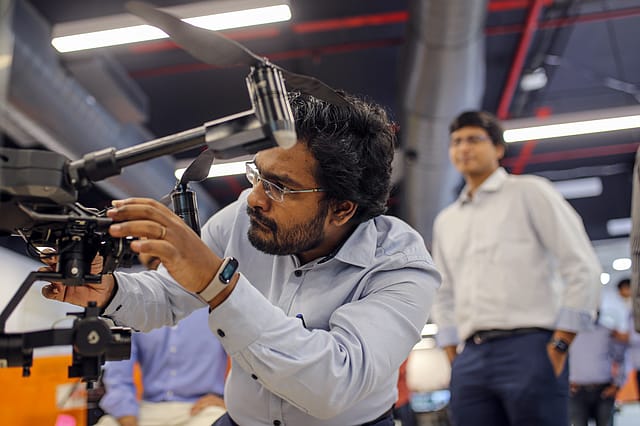
After years of chasing software scale, venture capital is rediscovering something harder, and potentially more enduring: hardware. In 2025, India’s deeptech ecosystem crossed a turning point. From rockets and chips to defence imaging and robotics, investors are pivoting decisively away from crowded B2B SaaS plays toward startups building physical technology with defensible intellectual property and global relevance.
What exactly is changing in India’s startup ecosystem?
India is witnessing a structural shift in venture capital allocation. Deeptech investments reached $1.57 billion across 265 deals in 2025, a 25.8% jump from the previous year. Unlike past cycles dominated by software, capital is now flowing into hardware-led startups building rockets, semiconductor chips, imaging systems and robotics.

Look Who's Talking Regime Change
23 Oct 2026 - Vol 05 | Issue 43
Why are VCs losing interest in B2B SaaS?
The short answer: saturation. B2B SaaS has become crowded, globally competitive, and increasingly incremental. According to Seafund data, investors are experiencing “post-SaaS fatigue,” prompting even generalist funds like Peak XV Partners to back deeptech ventures. Hardware offers stronger moats, longer lifecycles, and defensible IP, qualities investors are now prioritising.
What made hardware suddenly fundable?
Government policy changed the risk equation. In April 2025, Commerce Minister Piyush Goyal announced a ₹10,000-crore Fund of Funds for deeptech, with ₹2,000 crore earmarked for lab-to-market transitions. Combined with the Indian Semiconductor Mission and Design Linked Incentive (DLI) scheme, startups now have real financial infrastructure to move beyond prototypes. Now, the government has scrapped the three-year eligibility requirement for deep-tech startups seeking DSIR recognition, easing early access to funding and support.
How does China factor into this shift?
Heavily. As global companies pursue a China Plus One strategy, India has emerged as a credible alternative. In 2025, Apple ramped up iPhone production in India, with exports reportedly rising 76% year-on-year. Foxconn alone committed $1.5 billion near Chennai. This supply-chain rebalancing has opened unprecedented doors for Indian hardware startups.
Can India realistically compete with China in manufacturing?
Not on scale, at least not yet. China’s dominance is built on decades of infrastructure and ecosystem depth. India’s edge lies elsewhere: design, engineering talent, and specialised applications. According to Celesta Capital, the opportunity is to capture high-value design IP while selectively manufacturing in areas like defence, space and advanced electronics.
Which Indian deeptech startups are already delivering globally?
Several are past the prototype stage. Take, for instance, Agnikul Cosmos which has launched the world’s first 3D-printed rocket engine. Then there is Mindgrove Technologies, which has taped out India’s first 28nm Secure-IoT chip. And not to miss out Tonbo Imaging, which supplies thermal imaging systems globally. These successes prove Indian hardware startups can compete on technological sophistication, not just cost.
What’s holding the ecosystem back?
Talent. While India produces nearly 1.5 million engineers annually, only about 3% have deeptech-ready skills, particularly in optics, advanced materials and thermal systems. Brain drain to the US and Europe worsens the gap, making specialised talent the single biggest bottleneck.
Why do PhD founders struggle to scale companies?
Because deeptech isn’t just about invention. It’s about execution. PhD founders often excel in research but struggle with fundraising, manufacturing, certification and go-to-market strategies. Successful deeptech startups typically pair technical founders with strong business co-founders. Most incubators, however, are still designed for software and not hardware complexity.
What’s happening in semiconductors specifically?
India is betting on fabless design, not capital-heavy fabrication. The domestic semiconductor market is projected to double from $54 billion in 2025 to $108 billion by 2030. Startups like Mindgrove and InCore are building chip IP, while government schemes help offset R&D costs. The strategy is clear: own design value before chasing fabs.
Which sectors will break out next?
Space, defence and semiconductors lead in funding and visibility. EV-driven power electronics and robotics—especially for agriculture and manufacturing—are close behind. Startups like Skyroot and Pixxel are gaining traction, positioning 2026 as a year when Indian deeptech begins to demonstrate global competitiveness.
Is this deeptech boom real or just hype?
The signals suggest durability. Deeptech funding doubled in 2025, government support is structural, and global demand for China alternatives is long-term. India now hosts 3,600 deeptech startups, ranking sixth globally. Challenges remain, but this is no longer a speculative phase. It’s an early industrial cycle.
(yMedia is the content partner for this story)