EXPLAINED | How Videocon’s Loans Bankrupted Venugopal Dhoot
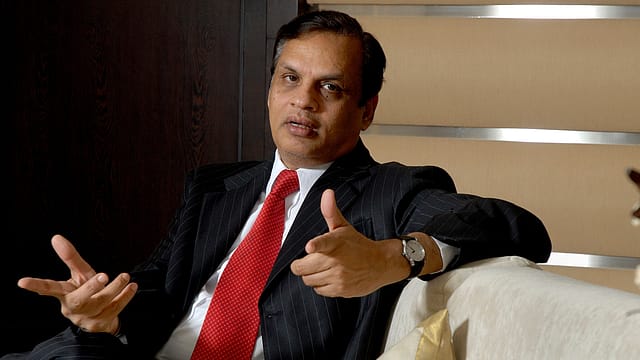
Videocon got the loans. Venugopal Dhoot got the bankruptcy order.
On November 5, the Mumbai bench of the National Company Law Tribunal (NCLT) declared the former Videocon Industries promoter bankrupt on a petition by State Bank of India (SBI). It put his bankruptcy estate, the pool of property available to pay his creditors, under the control of trustee Asish Narayan.
Dhoot had offered creditors ₹600 crore over three years. What could they collect on day one? Nothing. The money would come from a proposed real estate development in Siliguri, provided the project went ahead, got its approvals and generated cash. The creditors decided against it.
To see how a loan to the group behind the television sets became a claim on Dhoot’s own property, start with three sets of loan documents and the guarantees he signed to back them.

The Era of Forever Wars
30 Oct 2026 - Vol 05 | Issue 44
Coping with an explosive Middle East
How did Videocon’s loans become Dhoot’s problem?
Dhoot gave lenders a personal guarantee. In effect, he promised to pay if the company failed to meet the obligations covered by his guarantee. The company received the money. His signature gave the lenders a second person to pursue for repayment.
The guarantees in this case covered three groups of borrowings. Videocon Industries had taken rupee term loans, which were to be repaid over a set period, and working capital loans, which fund day-to-day operations. There were also facilities originally taken by Videocon Telecommunications. Under a 2016 agreement, Videocon Industries took on obligations for the telecom loans too. SBI and several of its then associate banks were among the lenders. Those associate banks merged into SBI in 2017.
The sequence matters. In January 2018, lenders sent demands to Videocon Industries. In February, they invoked Dhoot’s guarantees, which means they formally called on him to pay. In June, the tribunal admitted Videocon Industries into corporate insolvency, a process in which creditors try to find a buyer or agree on a way to rescue the business and recover some of what they are owed. By then, the bank had already called on Dhoot to honour his promise.
Can a bank go after the promoter before it has finished with the company?
Yes, if it has an enforceable guarantee and the terms allow it. Under Section 128 of the Indian Contract Act, a guarantor’s liability generally extends as far as the borrower’s, unless the contract says otherwise. The Supreme Court has held that a lender can generally pursue a guarantor without first exhausting its remedies against the company. It has also held that approval of a company’s insolvency plan does not, by itself, cancel a personal guarantee. The wording of the guarantee still matters.
That is the point of asking for a personal guarantee in the first place. The bank gets another route to recover the same debt. Payments received on that debt have to be accounted for across the two routes. If a bank is owed ₹100 and recovers ₹30 from the borrower, it can pursue the unpaid ₹70 from the guarantor, assuming the guarantee covers that balance. The two routes do not create two ₹100 debts.
Where did ₹12,668 crore come from?
It is the amount SBI says was in default on September 30, 2026, including interest and penalties. The November order breaks it down into ₹9,322.11 crore under the rupee term loan agreement, ₹1,437.76 crore under the telecom facility agreement and ₹1,908.19 crore under the working capital agreement. The term loan alone accounts for nearly three-quarters of the claim.
There are two earlier sets of numbers. The February 2018 demands listed amounts totalling ₹4,643.85 crore before the applicable interest, fees or costs cited in the notices. In July 2020, SBI issued a fresh demand under the insolvency rules for ₹6,157.58 crore. Those figures come from different stages of the proceedings. The orders report the amounts but do not give a full account of how interest, penalties and any credits took the balance from one figure to the next.
The tribunal found that SBI’s bankruptcy petition met the legal requirements. How much the creditors eventually receive depends on which claims are verified, what belongs to Dhoot’s estate and how much those assets fetch. The ₹12,668 crore tells us the size of SBI’s claim. The trustee has to work out the size of the pot.
Why did it take until 2026 to declare Dhoot bankrupt?
The banks called in the guarantees in 2018. A separate route under India’s Insolvency and Bankruptcy Code (IBC) became available to creditors of personal guarantors to companies in December 2019. SBI filed for Dhoot’s personal insolvency on September 1, 2020. The tribunal appointed Narayan as resolution professional in September 2021 and admitted the case on April 8, 2026. A resolution professional checks claims and helps run the process in which a debtor can propose a repayment plan.
Dhoot disputed SBI’s case at the April stage. He argued, among other things, that the petition was too late and that one of the guarantees was signed in favour of SBICAP Trustee Company, which he said called into question SBI’s right to file. The tribunal counted from Dhoot’s failure to pay under the guarantee and treated SBI’s July 2020 demand as the relevant date in this case. It also found that SBICAP acted for the lenders and that other guarantees specifically named SBI among the beneficiaries. It admitted the petition.
That April order opened the door to a deal with his creditors. Bankruptcy was a separate step. SBI could take it after the repayment process ended without an approved plan.
What killed the ₹600 crore Siliguri deal?
The creditors were being asked to wait for money from a development that still had to happen.
Dhoot emailed an outline on May 11 and said a detailed plan would follow. At a June 11 meeting, creditors found the proposal conditional and adjourned. On June 16, shortly before the next meeting, Dhoot submitted a project report and offered ₹600 crore over 36 months. Narayan reported that the proposal had been prepared without the consultation required under the Code, and that the approvals and cash flows it relied on could not be verified. The proposal offered no upfront payment. Narayan’s assessment was that any recovery depended on successful development over three to four years.
Creditors decided to seek an end to the process. On July 17, the tribunal rejected the plan and closed Dhoot’s personal insolvency resolution, opening the way for a bankruptcy application. SBI filed on September 24, within the three months allowed by law. The November order records that filing date and separately gives September 30 as the date of the bank’s default figure.
A creditor can accept less than it is owed if the offer looks better than the alternatives. What the creditors had to judge here was whether the offer would produce any money, and when. A project report gave them a proposal to consider. It did not give them cash they could collect.
How did the TV maker get into so much debt?
Colour televisions made the Dhoot family’s name. Refrigerators, washing machines and other appliances gave it a presence in more rooms of the Indian home. Venugopal Dhoot, the eldest son of the group’s founder, took Videocon into oil and gas and mobile services. The group was now borrowing to build mobile networks and develop oil and gas assets as well as to keep its original businesses running.
In 2012, the Supreme Court’s cancellation of 2G licences hit Videocon’s mobile business. Dhoot subsequently identified telecom as a major reason for the company’s heavy borrowings. By December 2015, Videocon’s total debt was reportedly at ₹47,554 crore. It was already looking to sell assets. In 2016, Bharti Airtel agreed to buy rights to use Videocon Telecom’s spectrum in six service areas for ₹4,428 crore. Airtel subsequently reported completing the acquisition.
The sale brought money into a group under pressure. The later demands on Dhoot show how far that pressure had spread. His guarantees connected the lending for the telecom expansion with borrowings for the wider business, including the money it needed to keep operating.
Whatever happened to the deal to rescue Videocon?
It is still a separate case. The company was admitted into insolvency in June 2018, and the tribunal combined its case with those of 12 other Videocon group companies in August 2019. In June 2021, the Mumbai tribunal approved a ₹2,962.02 crore resolution plan from Twin Star Technologies after creditors representing 95.09% of the voting share backed it. The plan covered the corporate group in that proceeding. Dhoot’s ₹600 crore proposal was made years later in the case over his own guarantees.
The 2021 approval did not deliver a completed takeover. In January 2022, the National Company Law Appellate Tribunal (NCLAT) set aside the plan’s approval and sent the matter back to creditors. It found that the plan did not meet a statutory requirement governing payments to certain creditors. Dhoot’s own appeal was dismissed in the same judgment, while four other appeals succeeded. Twin Star challenged the ruling in the Supreme Court. The Supreme Court reserved judgment in one Twin Star appeal on October 14, 2026. On October 27, it heard the remaining appeals in the batch and reserved judgment, while separating a Union government appeal for a later hearing. An October 30 exchange filing from Videocon notified creditors of their 66th meeting, scheduled for November 3.
The difference is practical. In the corporate case, creditors are dealing with the business and its assets. In the personal case, the trustee is looking at Dhoot’s property and obligations. Any recovery on the same underlying debt has to be taken into account. The November 5 order starts the work on his estate while the company’s case runs on its own track.
How much of Dhoot’s property can the trustee take?
The trustee takes control of property that falls within the estate under the Code. His work starts with establishing what Dhoot owns, what is pledged and what is legally available to sell. A shareholding owned by Dhoot can be part of his estate. A factory owned by a company is a separate asset, even if Dhoot held shares in that company. He can take control of relevant records and seek information from Dhoot, creditors and other people who can help establish ownership or trace assets. He can also ask the tribunal to reverse certain past transactions if the legal conditions are met. That is a power the trustee has under the Code, not a finding about any transfer Dhoot made.
There are limits. Property Dhoot holds in trust for someone else is outside the estate. Some personal essentials are protected, along with qualifying unpledged life insurance policies and pension plans. The rules also protect one home owned by the debtor if it is free of any mortgage or other charge and falls within a value cap of ₹20 lakh in an urban area or ₹10 lakh in a rural area. Whether any particular asset qualifies depends on its ownership, value and any existing security. The order does not publish an inventory of Dhoot’s property or assign it a value.
Security can change who gets paid. A creditor with a valid legal claim over a specific asset may have a route to enforce that security, subject to the Code and how it filed its claim. For the money distributed from the estate, the Code sets the order of payment. The costs of administering the bankruptcy come first. Secured creditors and certain unpaid wages rank ahead of ordinary unsecured debts. SBI’s role in bringing the petition does not, by itself, move it to the front of that queue.
Can Dhoot still run a company or travel abroad?
The bankruptcy order puts him under the Code’s restrictions immediately. He cannot act as a company director or take part in promoting, forming or managing a company while the restrictions apply. He needs the trustee’s prior consent to take on further debt or place a charge on the estate. Overseas travel requires the tribunal’s permission. He must also tell his business partners that he is undergoing bankruptcy.
The law provides for a discharge order, which generally releases a person from bankruptcy debts, subject to exceptions. Under Section 138, the trustee applies once a year has elapsed from the start of bankruptcy or, if creditors approve completion of the estate’s administration sooner, within seven days of that approval. It takes an order from the tribunal. And discharge does not stop the trustee from completing work on property already in the bankruptcy estate.
Which numbers will show what SBI can actually recover?
Start with Dhoot’s financial statement, which the tribunal directed him to give the trustee within seven days. Narayan must notify creditors within ten days and publish a notice inviting claims. He has 90 days from the start of bankruptcy to submit a preliminary report to the tribunal and creditors’ committee. He must then report on progress each quarter.
The figures worth following are the claims that are verified, the assets the trustee can sell and the cash available for distribution. For a sense of scale, the insolvency regulator reportedly recorded ₹234.56 crore in recoveries across 64 resolved personal guarantor cases through June 2026. Dhoot’s estate still has to be valued on its own.
The Siliguri proposal asked creditors to count on a project that had yet to produce cash. Now Narayan has to find out what the estate can put in their hands.