Customers Buy In. Can Scimplify Make the Chemistry Pay?
When Rio Tinto teamed up with SiTration, a startup born out of MIT, it brought a problem for the young company to solve: recovering valuable metals from mine wastewater.
SiTration adapted its porous silicon membrane to the task, incorporating the mining giant’s feedback into its technology. Their partnership, formed in June 2023, connected a laboratory innovation with an industrial application—and a potential market.
That connection is central to the business of advanced materials. Scientific promise needs a customer willing to test it, help refine it and eventually pay for production.
Bengaluru-based Scimplify is taking that relationship a step further. Two customers, Henkel and Teknor Apex, are becoming investors. Teknor Apex will also serve as a manufacturing partner for its US expansion.

Zeroing In on ECI
09 Oct 2026 - Vol 05 | Issue 41
Constitutional legitimacy versus political opportunism
Their participation raises a more consequential question than the size of the funding round: can customers with a stake in the supplier help an Indian materials startup build a commercially competitive American business?
A CUSTOMER WITH TWO CHEQUEBOOKS
Scimplify has raised $25 million in a strategic round led by Hitachi Ventures, with Accel India, Bertelsmann India Investments, Omnivore and 3one4 Capital also participating. The round brings its total equity funding to $80 million, according to Entrackr.
There is already revenue behind the pitch. Operating revenue rose more than elevenfold to ₹200 crore in FY25 from ₹17.74 crore in FY24, while losses widened to ₹25.38 crore, according to Entrackr’s July report. The figures sharpen the question behind its American expansion: can Scimplify turn rapid sales growth into profitable production while adding research and manufacturing capacity overseas?
The composition of its latest capital matters. An industrial customer can bring detailed knowledge of a product’s intended use, performance requirements and the practical problems involved in adopting it.
Becoming a shareholder creates an additional interest in the supplier’s development. Adding a manufacturing partnership could help connect that development with production capacity.
For Scimplify, these relationships could shorten the distance between identifying a customer’s problem and delivering a usable solution.
But equity participation does not establish how much a customer will purchase, at what price or for how long. The commercial strength of this round will emerge through orders and production, beyond the names on the investor list.
THE FACTORY IS PART OF THE PRODUCT
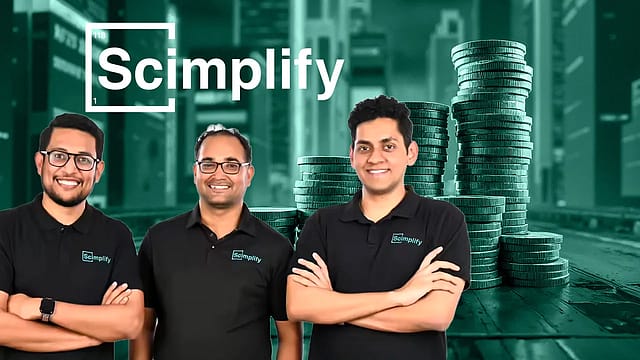
Founded in 2023 by Sachin Santhosh, Salil Srivastava, Dheeraj Dhingra and Hersh Manek, Scimplify develops manufacturing processes for advanced materials and specialty chemicals. Its work includes converting raw materials and industrial waste into high-purity products and taking laboratory discoveries towards commercial production.
Its proposition bundles chemistry, process development and manufacturing coordination.
Scinode, its AI-enabled platform, helps identify suitable production routes, equipment and manufacturing partners. Scimplify says its network covers more than 500 factories. Scientists and engineers oversee technology transfer and scale-up.
The commercial appeal is understandable. A buyer needs a material with particular characteristics; finding the right chemistry and a facility capable of producing it can involve several organisations. Scimplify wants to manage that journey.
Access to a manufacturing network could give it flexibility across products without requiring it to build every capability itself.
The same arrangement creates a coordination burden. Each additional partner introduces another set of equipment, operating practices and quality systems. Scimplify’s value will depend on making the network behave like a dependable supplier.
Its potential competitive advantage therefore lies in the knowledge accumulated through execution: which production route works, which facility can handle it and how to deliver consistently.
AMERICA WANTS OPTIONS. OPTIONS MUST PAY
Scimplify plans to expand its US research, processing and manufacturing capabilities, targeting materials used in semiconductors, defence, energy and AI infrastructure. It also intends to add American manufacturing partners and secure feedstock for critical metals and rare earth materials.
The expansion addresses a gap in the global effort to diversify materials supply.
The International Energy Agency’s Global Critical Minerals Outlook 2026 identifies an imbalance: refining and downstream capacity are lagging behind mining in efforts to develop alternative supply chains. Extracting raw materials elsewhere offers limited protection if the capacity to process them remains concentrated.
That creates an opening for businesses able to develop processing routes and organise production.
It also exposes them to difficult economics. The IEA finds that new refining projects outside dominant suppliers often face higher capital and operating costs, alongside technical constraints, infrastructure gaps and lengthy permitting processes.
Scimplify’s challenge is to make an alternative supply route worth buying from. Customers may value diversification, proximity and reliability, but those benefits must support a viable commercial proposition.
Teknor Apex’s manufacturing role could ground the US ambition in existing industrial capability. The question is how effectively Scimplify can combine that access with its process expertise.
WASTE HAS A PRICE TAG
One company-cited project illustrates the opportunity: developing a process to recover tungsten from industrial scrap and spent catalysts for a US metals manufacturer.
Waste becomes a potential source of supply when the recovered material is worth more than the cost of extracting it. Feedstock availability, recovery rates and processing expenses determine whether that opportunity becomes a business.
Tungsten’s market backdrop makes the work particularly relevant. The IEA’s 2026 outlook reports a sixfold surge in tungsten prices amid the rally in strategic minor minerals through 2025 and early 2026. It also identifies tungsten among the materials most exposed to supply vulnerabilities.
Higher prices can improve the appeal of recovery processes. Durable economics must also withstand changing market conditions.
Scimplify cites another project in which it delivered a semiconductor-chemical sample that passed a customer’s process test within two months. That demonstrates a development milestone. The larger commercial test is whether production can repeatedly meet specifications at an acceptable cost.
THE NEXT ROUND IS AN ORDER
The customer-investor model gives Scimplify a potentially useful combination: capital, industrial feedback and access to manufacturing.
It also requires careful management. Close relationships with strategic customers must coexist with the freedom to serve a broader market. Manufacturing access must translate into dependable output. Technical successes must generate repeat purchases.
For India, the opportunity is to build businesses that sell process expertise alongside materials, earning a place in global production by solving difficult industrial problems.
Scimplify’s funding strengthens its ability to pursue that opportunity. Its American expansion will test whether those capabilities travel successfully—and whether the resulting business can improve on the economics of its early growth.
Henkel and Teknor Apex have bought into the company. The more revealing vote of confidence will come when customers keep buying what it makes.