China Benefits If India-US Trade Deal Doesn't Happen, Warns Surjit Bhalla
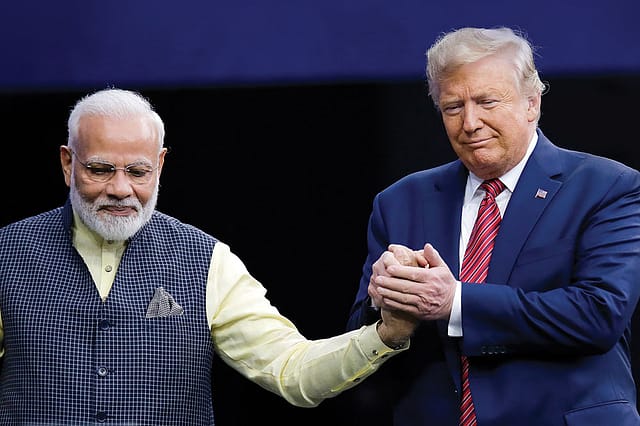
Economist and author Surjit Bhalla has called for an early India-US trade agreement, describing it as the single most important economic reform needed to accelerate India's growth. In an interview with ANI, he argued that such a pact would unlock competition, attract opportunities in technology and markets, and strengthen India's position in the global economy, while warning that further delays would primarily benefit China.
Trade deal with US key to India's growth ambitions
A comprehensive India-US trade agreement has the potential to reshape India's economic future and help the country achieve its Viksit Bharat goals, economist and author Surjit Bhalla has said. He argued that the absence of such an agreement remains one of India's biggest policy shortcomings over the past three decades.

Zeroing In on ECI
09 Oct 2026 - Vol 05 | Issue 41
Constitutional legitimacy versus political opportunism
"There is only one policy in my view... a major trade deal with the US. That will unleash animal spirits... and make us an important player in the global stage. Until we are an important player in the global stage, we're not going to achieve any of our ambitions," Bhalla said.
He stressed that the benefits of a trade agreement extend well beyond improving trade balances.
"The trade deal with the US is not just about trade surplus. It is about markets, technology, etc."
Bhalla pointed out that India already records one of its largest trade surpluses with the United States.
"If you take the trade surplus with the US and compare it to the aggregate trade surplus of Japan, the EU and the UK, it's four times. One is about 70 billion and the other is about 15 billion."
Questions policy delays, calls for greater competition
Bhalla questioned why India and the United States have been unable to conclude a trade agreement despite decades of negotiations.
"We've been talking about a trade deal with the US for 30 years... I think one needs to really examine why it hasn't happened. And I think it's very much the deep state."
According to Bhalla, an agreement with Washington would expose Indian companies to greater competition, reducing complacency among established firms that currently enjoy the advantages of a protected domestic market.
"If you have a trade deal with the US, everybody will agree that we will become a lot more competitive... Then the major firms in India will not be so comfortable anymore. They will have competition."
He also argued that India's policymaking process should allow for a more transparent discussion on the costs and benefits of major economic decisions.
"We should be able to have an open conversation of who benefits, who loses, from which actions. That we don't have."
Delay benefits China, no substitute for US pact
Bhalla said the strategic implications of a delayed trade agreement extend beyond economics, asserting that China stands to gain the most if India and the US fail to reach a deal.
"There is one country that really benefits from the lack of a trade deal between India and US and that's China."
When asked what advice he would offer Prime Minister Narendra Modi if he returned to an advisory role, Bhalla's response was direct.
"Trade deal with the US, 100%. Without thinking."
He maintained that such an agreement would fundamentally strengthen India's competitiveness.
"It will unleash competition, unleash the competitive urge. It will remove comfort. It will remove complacency."
Bhalla added that trade agreements with other major economies cannot deliver the same strategic and economic impact.
"The UK trade deal doesn't do any of that. The Japanese trade deal doesn't do any of that. The EU trade deal doesn't do anything of that."
He reiterated that India must integrate more deeply with global markets if it hopes to become a developed nation by 2047.
(With inputs from ANI)